
For about six years ending 10 or 11 years ago, I indulged in a weekly orgy of yarn purchases from the German dyer Wollmeise. They had a wickedly addictive business plan for selling their brilliantly-colored yarns: scarcity, two 15-minute opportunities each week to place an order, and competition with fellow addicts all over the world and the one with the best internet connection won pig-in-a-poke bags whose contents you wouldn’t know until you opened the package from Germany a couple of weeks later. I’m not an addictive personality, but this form of gambling hooked me bad. When the fever finally lifted, I found myself living in a tiny cave carved out of Wollmeise bags that literally threatened to bury me. Then I retired, and my new life goal was to use up my Wollmeise before I die.
I have done some Wollmeise projects since I retired, but I haven’t generally been as interested in Wollmeise as I used to be. It’s all superwash, meaning that the sticky fibers of the wool have been processed into smoothness so that the knitted work won’t fuse into felting and shrinkage in the washing machine, and these days I prefer to use less processed yarn. I still have non-superwash yarn from my First Knitting Era in the 80’s and 80’s, and I have used up a lot of that stash. Also I am close friends with a yarn store owner, and yarn stores need customers, so here I am, several times past SABLE (acronym for stash acquisition beyond life expectancy). Now my Wollmeise stash of heavy lace weight, fingering weight, and DK is staring at me from its prison, stacked up on shelves in vacuum storage bags.
But just as the pendulum of my tastes swung away from Wollmeise, it might be starting to swing back, at least for the DK and lace. I recently finished a machine-knit pullover in Wollmeise lace yarn for my older daughter’s next birthday, and I have a second version version in progress for myself, which I will discuss in my December blog post. I’m working on a double-knit baby blanket for my younger daughter’s soon-to-be-born baby, using Wollmeise DK, and I’ll write about that when it’s done. My plans for November are a matching mommy-baby pair of sweaters in DK for my younger daughter’s late November birthday. I’m thinking about interesting ways to use up the superwash fingering weight yarn in combinations that can be done on the LK150, because I don’t really like the flat mechanized look of stranded patterning that results from the fingering weight yarn knitted on the KH965i, or the limited sizing the yarn gets on that machine.
But I do like the way that Wollmeise DK knits up in Needle Beetle stranding on the LK150. A Ravelry friend on my group The Interior of My Brain showed us progress pictures of a beautiful vest she is hand knitting using the Blossoming Vest pattern by Sarah L. Kelly. I had seen the pattern before without feeling any urgency to gather up my colors and jump on the knitting machine, but Margaret’s color choices unlocked my imagination. I counted the stitches in the pattern repeat, which came to 12, which would disqualify it for use with the 8-stitch Needle Beetle from the KrisKrafter knitting supplies company. But my friend Tanya discovered a 12-stitch 3D printer recipe on Thingiverse. Here’s the description, click my link to see the picture it refers to:
The needle beetle from KristKrafter https://www.kriskrafter.com/product-page/needle-beetle-needle-selector is a very useful accessory for knitting machines. After passing through the machine, it resets the needle pattern periodically with period 8. The problem, however, is that the usual popular knitting patterns tend to have a period of 12. This simple insert (the blue part in the picture replacing the original black one) changes the needle beetle period to 12.
Tanya is a scientist of the junction between knitting and technology, and she printed out the piece and plugged it into her own Needle Beetle. It took some fine-tuning to get it to work, requiring her to file down parts of the piece to enable it to connect with the needles that needed to be selected and slide over the rest, but she did get it to work. Next time I visited, I brought my own Needle Beetle, and she set me up with my own 12-stitch adapter, now that she knew how to find the obstacles to it moving freely over the needles to select the desired needles and how to file down the bits that were crashing into the needles. The modified 12-stitch Needle Beetle operates exactly like the 8-stitch original, and expands the range of pattern repeats beyond 2, 4, and 8 stitches to include multiples of 3 and 6 as well as 2, 4, and 12. You still need the 8-stitch piece to knit 8-stitch repeats because of the math, and you need the original Needle Beetle itself to contain and operate the 12-stitch modification.
I knitted a swatch using leftovers of Wollmeise DK, and figured out the rough outlines of a color scheme: alternating light-dark sky colors for the background color of each sequence, green-related colors for the leaves, and contrasting colors that weren’t sky or leaf colors for the flower petals. I also got a rough idea for gauge, but I have never figured out the trick for getting reliable gauge swatches when I knit with superwash yarns. For Wollmeise fingering and DK weights, a washed gauge swatch will give you useful information for projects that weigh less than 200 grams, but a garment that uses more than 200 g will grow a lot after washing and blocking. The good news is that a few minutes in the dryer will shrink the garment back to pre-washing size if you throw it in while it’s still a little damp, My unreliable gauge swatch gave me 5.5 stitches to the inch knitted on T4, and I wanted the vest to be in the range of 40 to 43 inches around, so I cast on 121 stitches, which was 10 repeats plus a seam stitch to continue the patterning uninterrupted between front and back.
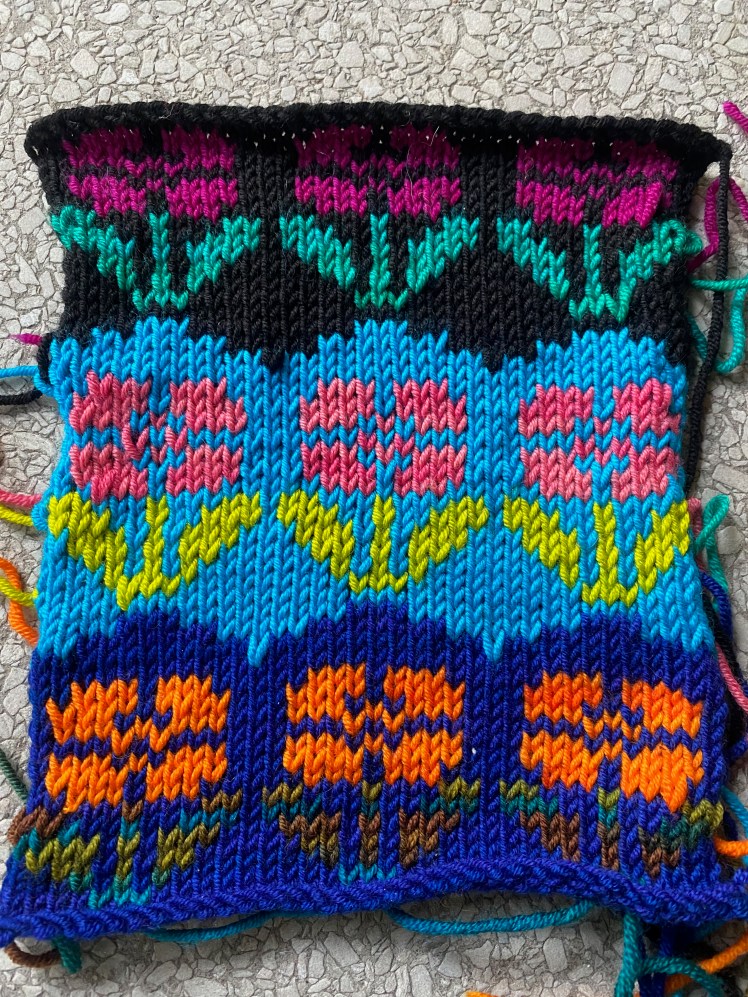
The vest pattern has 1×1 corrugated ribbing, which I approximated by knitting a folded hem in green with a garter stitch fold line formed by reconstructing the stitches of the row with a latch tool, then doing a 1×1 stranded alternation of bright yellow and hot pink. I think I tightened the tension to 3 for the faux ribbing. I reserved the green, yellow, and hot pink for all of the “ribbings”, and for the flower patterning, I followed my general sky-leaf-petal color scheme. There were some peculiar 3-color combinations, which I noticed but didn’t react to, because I had faith that the color interactions in the entire piece would make it all work out in the end due to the coherence of the logic that brought these colors together. Looking at the completed whole, I think I hit that sweet spot of coherence and unexpectedness.
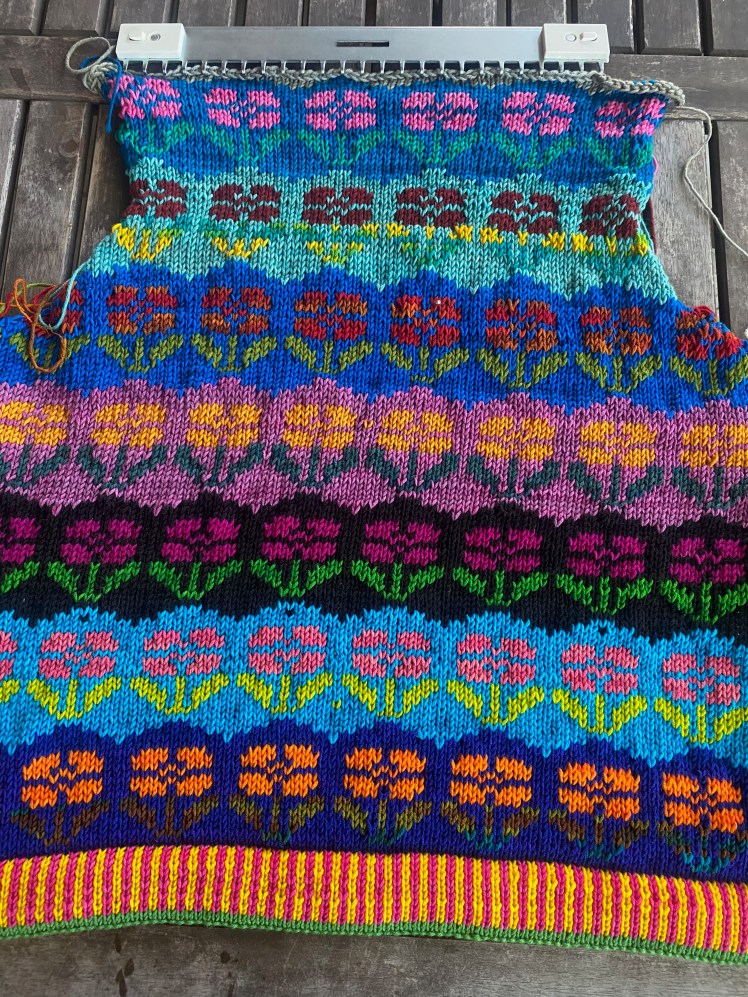
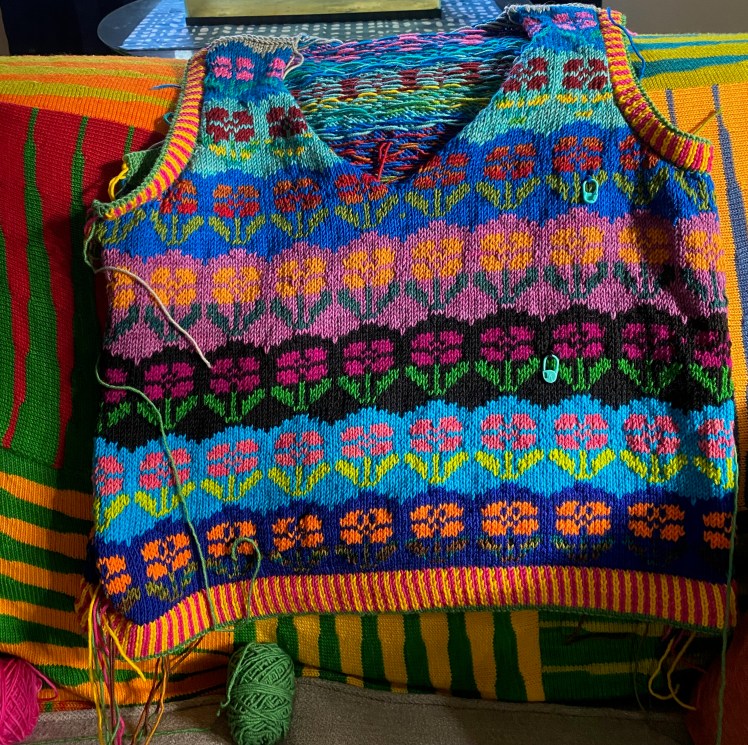
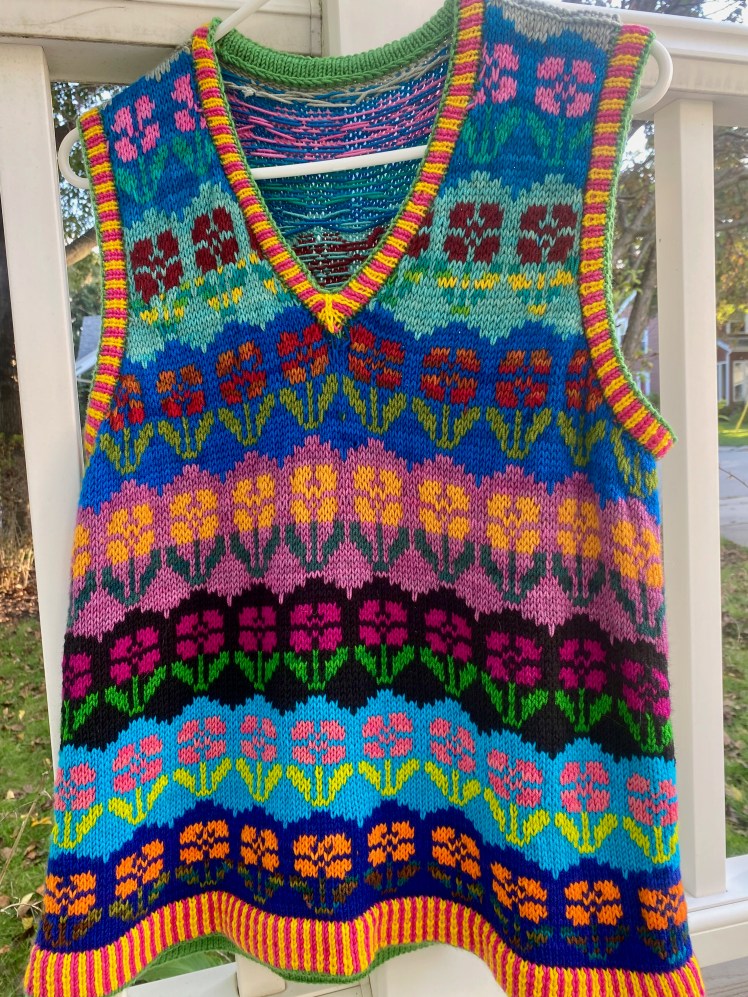
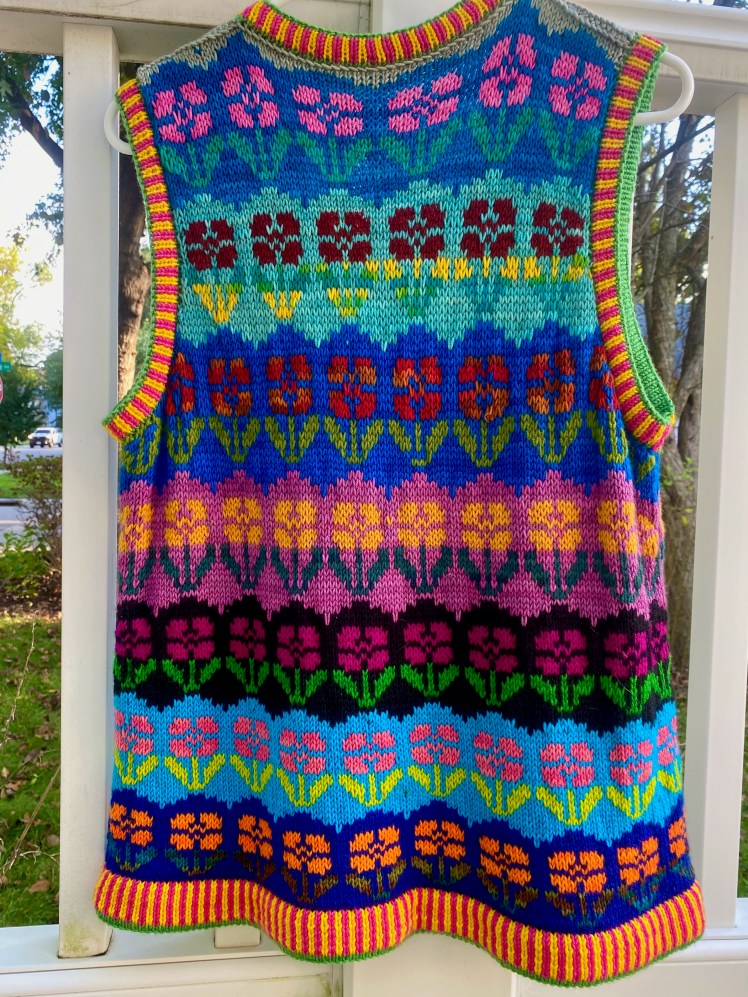
I was knitting this vest as a surprise for my older daughter, so I didn’t consult her about what length and fit she would want. In the past, she has asked for sweaters that would cover her very long torso down to the bottom of the fly of her pants, joking or not joking that she needed to cover it when she forgot to zip it. This time I decided that it was about time she learned to zip her fly. The garment was designed for the hem to land at the hip bone, mid-fly, and if she still had trouble zipping it, she could cover it with an untucked long blouse. I added a couple of inches of length more than the pattern called for, and when I washed it, I put it on a hanger to dry so that the weight of the finished garment, 450 grams, would pull it lengthwise. I wasn’t going to add more length to the vest. I did that with the vest I made her for her last birthday, and I think it looks dowdy.
I was at my younger daughter’s house when I finished the vest. Normally I would have asked her to model in place of her sister, since they are about the same height and circumference, but the younger daughter was 7 months pregnant and finally showing, so I was stuck modeling. Miraculously, I got one good picture.
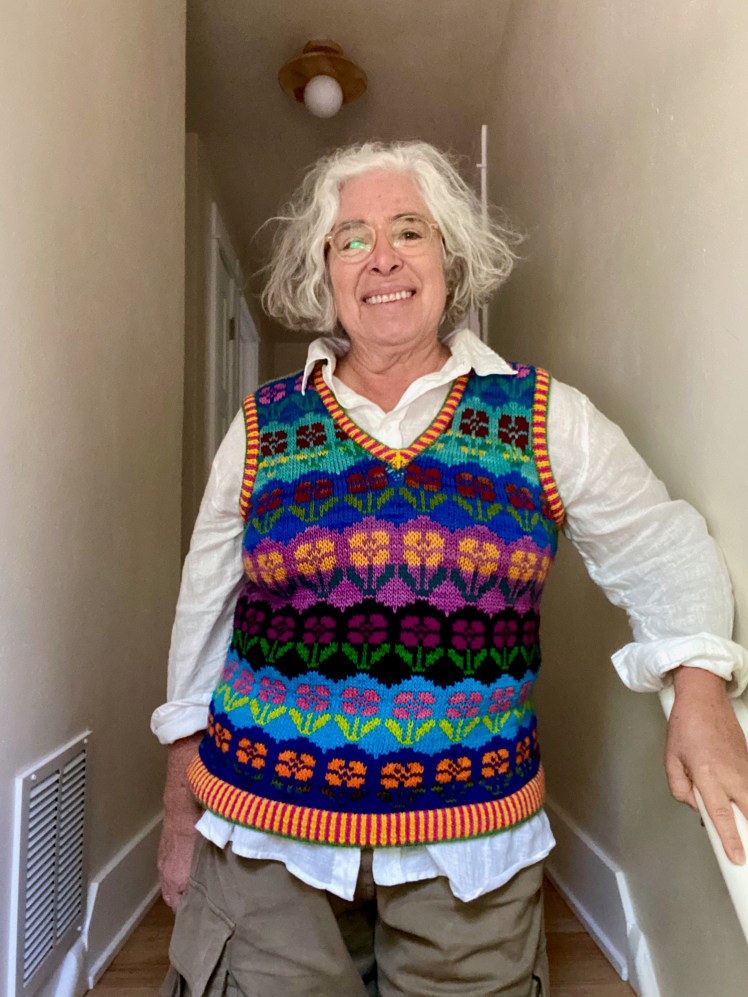
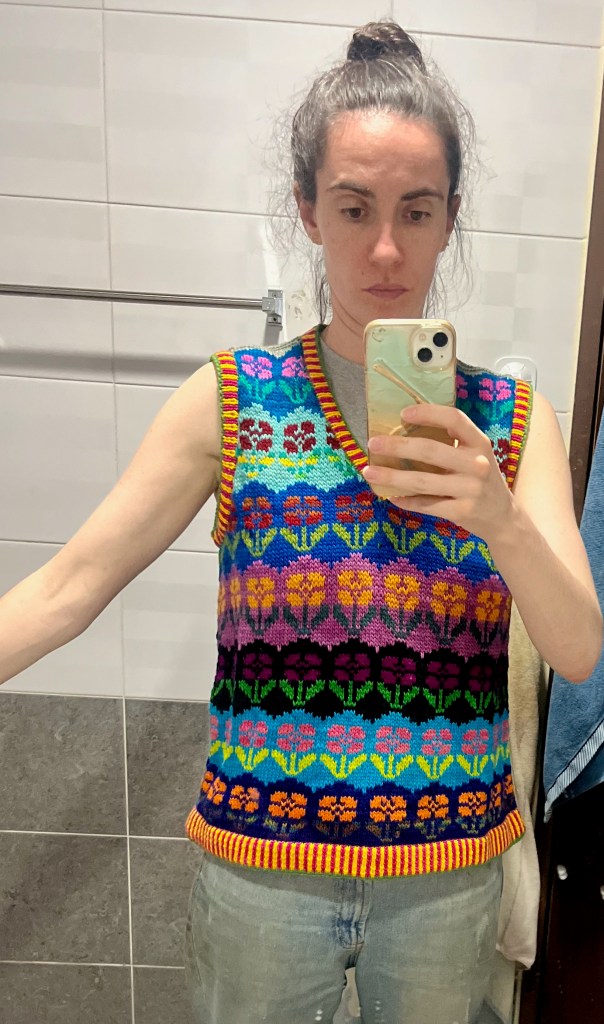
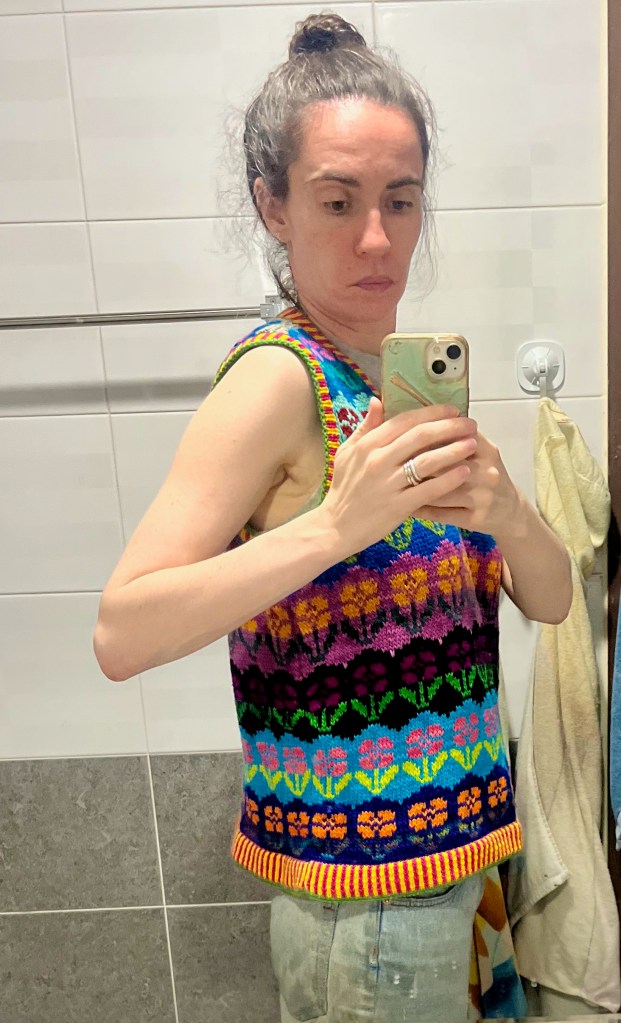
The fact that I could even get it on made me worry that it was going to be ridiculously huge on my long, slender daughter. She warned me that it would be a long time before she would be able to send me styled and modeled photos, but I begged her for something that would show how it fits, because I was planning to make one for her sister after she got back to her normal size, so she sent me a couple of quick bathroom selfies. I like the boxy fit. It hadn’t occurred to me that it could work as a sleeveless top, but it does. I knitted this piece to be a good luck charm, so I hope she wears it and enjoys the success and good mojo that I knitted into it.


Great vest! Beautiful use of all that yarn. I love the look of corrugated ribbing. It amazes me what can be created with a 3-D printer!
LikeLiked by 1 person
Thank you! The Wollmeise DK knits up really nicely in stranded machine knitting. I feel encouraged to knit much more of it on the LK150. And I’m so grateful to Tanya for her interest in technology and her willingness to share her skills with me, because that is way over my head!
LikeLiked by 1 person