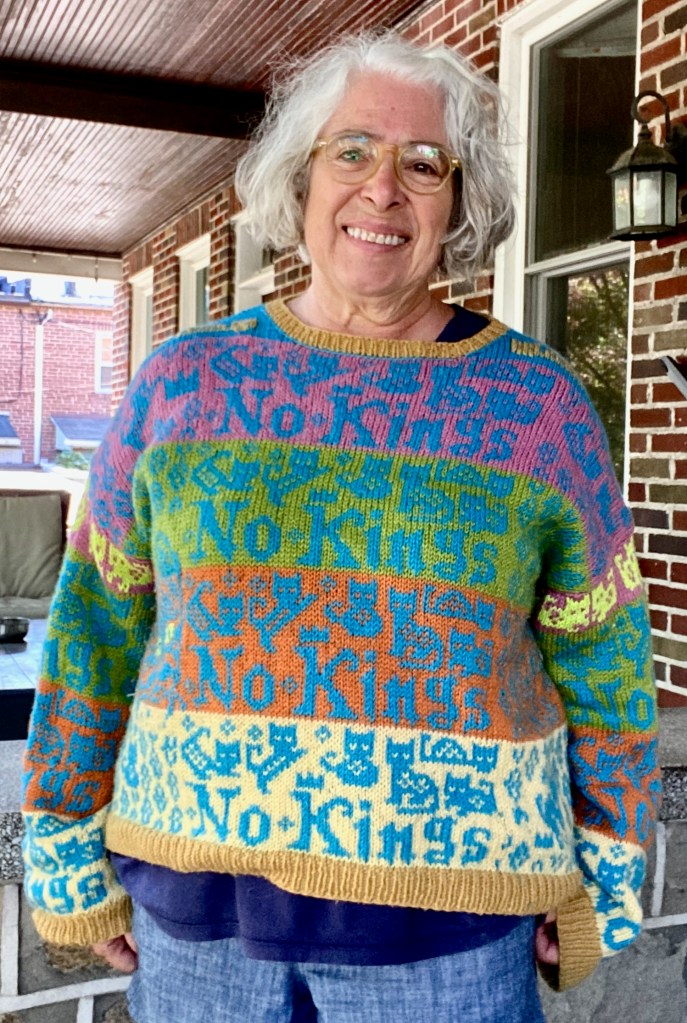
U.S. Vice President J.D. Vance now regrets famously sneering at “childless cat ladies.” Too late. Besides making an ass of himself, he also made himself the face of an authoritarian hierarchy that fears cats because cats don’t respect authority, and he feminizes a fondness for cats because patriarchal authoritarians fear women. There’s plenty to say about the use of “childless” as a slur against women, but this time I have knitted a project that employs cats as an authoritarian nemesis. Pronatalism as a weapon of hierarchical authoritarianism deserves to be the topic of its own knitting project.
The No Kings All Cats hat pattern appeared in my Ravelry feed during the winter. I was instantly charmed by its stylized and ornamented lettering font and the charts for cats in six different positions that were stripped down to the minimum details yet fully evocative and typical of cats, lovely cats that don’t care about how special and powerful one demented orange guy says he is. The hat would have been a great accessory for the No Kings protests at the end of March, and I could have gotten the hat done in time, but I like sweaters. I started constructing a design in which these charts were only the beginning. This was a hand knitting project, since hand knitting was easier for me than inputting the patterning on a machine.
I was envisioning a composition that expressed the duality of cats’ cuddly domesticity and their ability to see through fake power grabs. Melissa had just gotten some Universal Deluxe worsted yarn in pretty Easter egg colors that communicated sweetness and harmlessness, as a contrast to the anti-authoritarian messaging. To expand the idea, I referred to the sock and mitten patterns of the Finnish designer Lumi Karmitsa, who combines very detailed cat portraits with cozy wallpaper-like backgrounds.
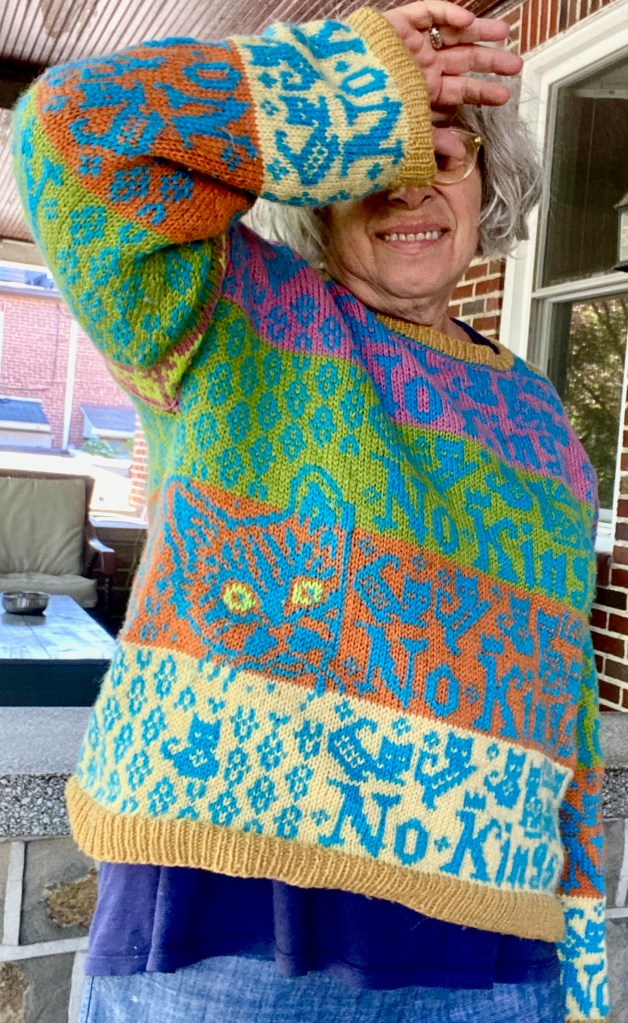
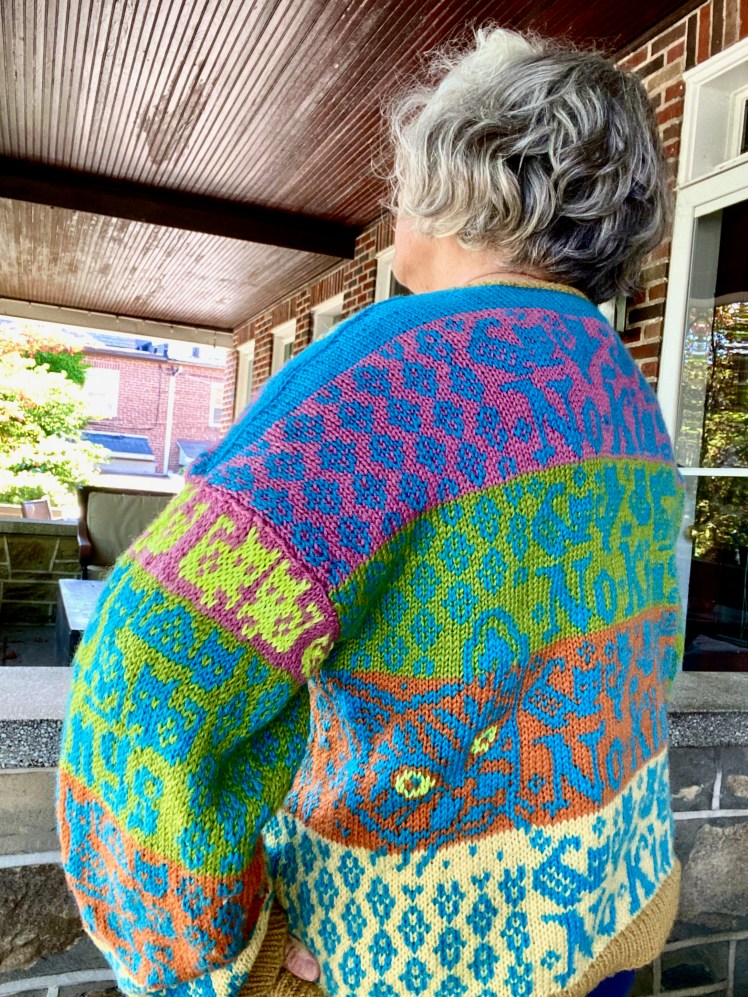
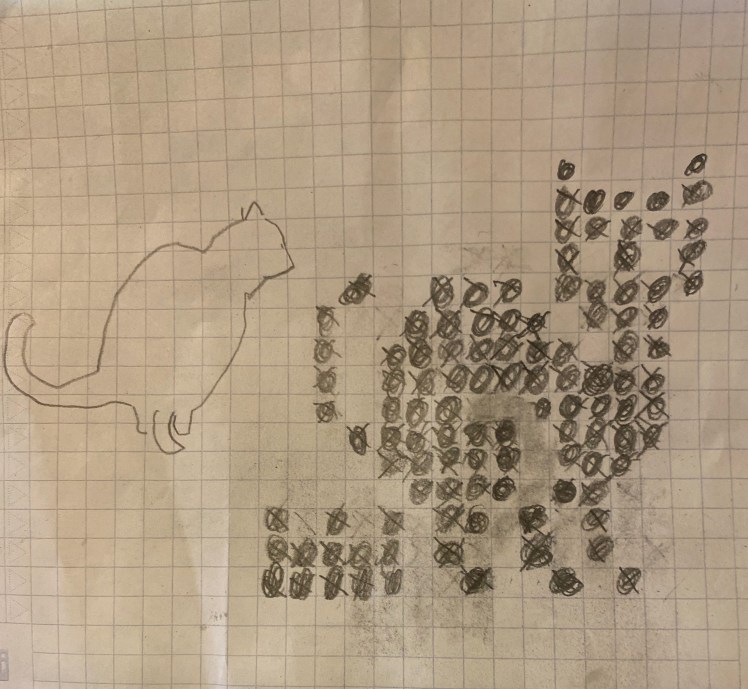
The chart for this cat was much larger and more detailed than the cat figures in the hat chart. I decided to position the big cat face at the left edges of the lettering on the front and back, like a monster cat standing guard, and if these sweet kitty faces look ominous and menacing… good. Cozy wallpaper patterning would occupy all of the space where there wasn’t cats and lettering, except for wallpaper space interrupted by isolated cat figures. One of them is my own original chart, the one depicting a cat using a crown as a litter box. Drawing is not in my skill set, so I’m pleased that I could make a chart that got the idea across.
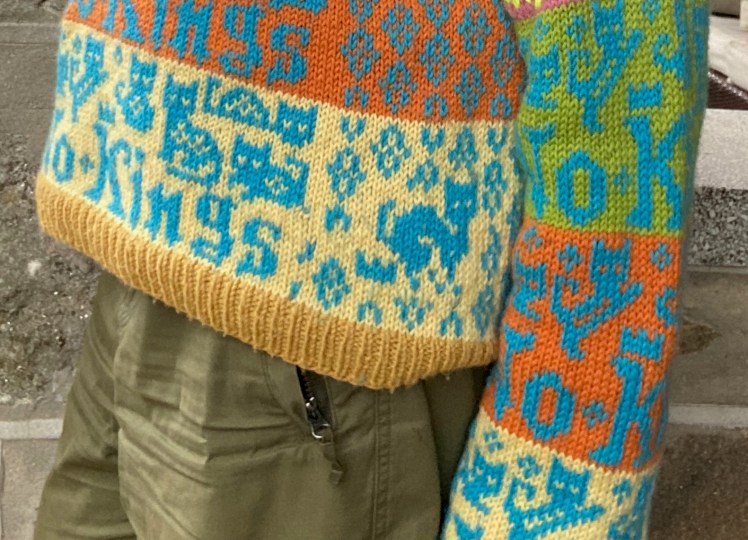
I knitted a gauge swatch in the stranded wallpaper pattern and applied the resulting gauge to the measurements of my banned words sweater, which has about 12 inches of positive ease. I like my sweaters big. The structure was a tube knitted in the round bottom-up, with steeks on the sides at the half-way points at the top 8 inches of the tube, to be cut open for the armholes where the sleeves would be sewn in, so that I wouldn’t have to knit complicated charts from the wrong side. I used to steek almost everything during my First Knitting Era, in the 1980’s and 1990’s, when my yarn was non-superwash wool whose fibers grabbed onto each other the moment your back was turned, and the fabric didn’t ravel when it was cut. But when I resumed knitting in the late aughts, I succumbed for years to the Wollmeise craze in a huge way, and all my yarn was processed wool that was so smooth that it felt like cotton. I didn’t feel safe cutting into it without a sewing machine to lock down the cut edges, and I didn’t have a sewing machine. Instead I did a lot of wrong-side stranding, or round yokes and raglans, to avoid cutting my fabric. Now I’m stuck with a stash of Wollmeise yarn to last two lifetimes of someone much younger than I am, and I search for ways to use it, despite the fact that the times have changed and I only want to use non-superwash yarn. This cats sweater was knitted in non-superwash yarn with grabby fibers that are conducive to steeking, so these were my first steeks in a few decades.
There were a couple of surprises along the way. One was the discovery that except for my bottom color sequence, the pale yellow background and the aqua contrast, there wasn’t as much contrast between the three other background colors and the aqua as I had expected when I juxtaposed the colors while they were in skeins. I shouldn’t have been surprised. I know perfectly well that colors in small juxtapositions have less contrast than they seem to have when they’re placed next to each other in skeins or cakes, and it’s easy enough to check how colors are going to read in small spaces just by taking a photo with a black and white filter that will show how much value contrast there is when the hue contrast is not there to distract you. As a result, the lettering is not that easy to read, the little cats look kind of like hieroglyphs, and the messaging is more subtle than I was planning. The other surprise was the downside of my impeccably tensioned stranding. The upside was that my floats were so perfect and even that I didn’t need to block the sweater to make the stranding lie flat. The downside was that all that perfection changed my stitch gauge and made the circumference of the garment about four inches smaller than I had planned. That left me with a mere eight inches of positive ease instead of the planned 12 inches. Fortunately eight inches of positive ease is still plenty.
I suffered a bit of angst while I was knitting the big cat faces mostly in the orange stripe, although the whiskers started in the light yellow stripe and the ear ended about a third of the way into the green stripe. The low contrast made it hard for me to see what I was doing and I got disoriented a lot when I was trying to follow the chart, because the dark squares on the chart corresponded to the lighter color that I was knitting. I couldn’t make out the knitted face at all until it was done, after I had duplicate-stitched the eyes in the glow-in-the-dark neon green. I had to cover up my mistakes with duplicate stitch, but now I don’t notice the covered-up mistakes at all.
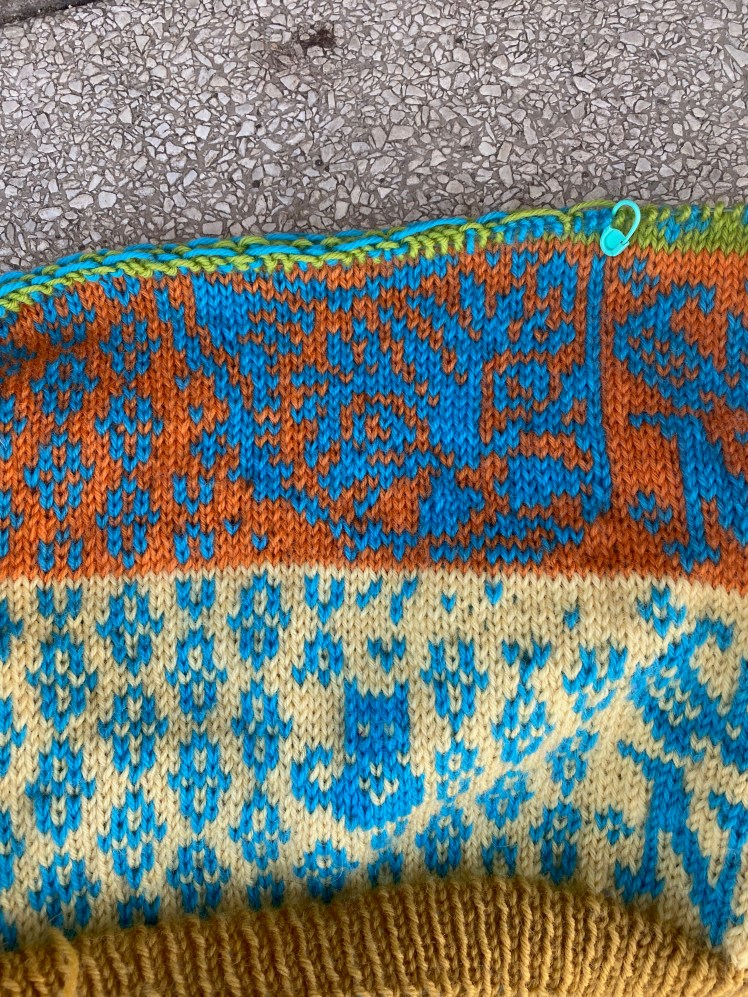
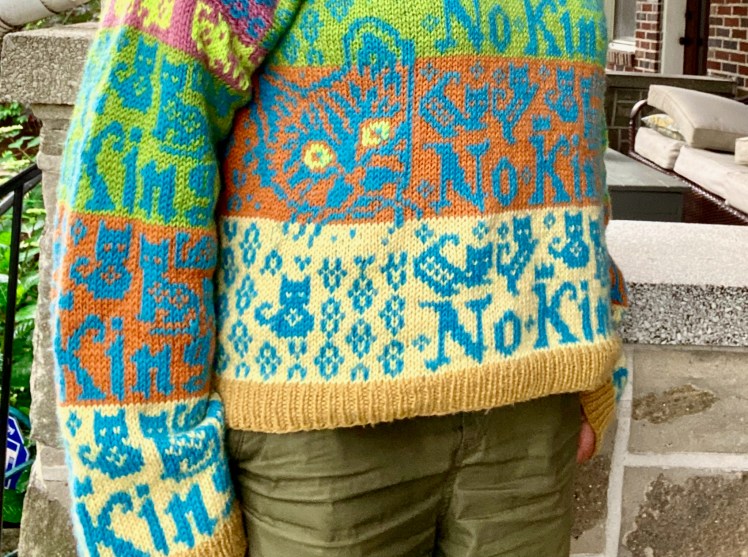
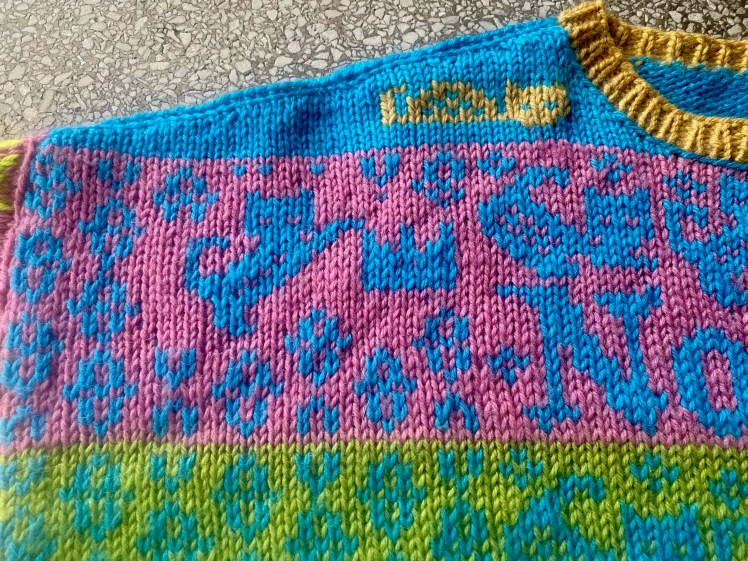
When I got to the front of the final stripe, where the front and back were divided by the steek stitches, I added some extra cat motifs doing disrespectful things to crowns in the space that would have been occupied by the wallpaper motif. On one side I have the cat using a tall crown as a scratching post, on the other side there are two cats using a little crown as a toy. Unfortunately the low contrast between the dusty pink and the aqua hides what I was trying to do there. You wouldn’t know what I did without my telling you explicitly. But at least the cat using the crown as a litter box requires no explanation. I also duplicate-stitched cats into the blue wedges between the neck band. They’re a little hard to see, but I just didn’t want plain wedges where I did the shoulder shaping.
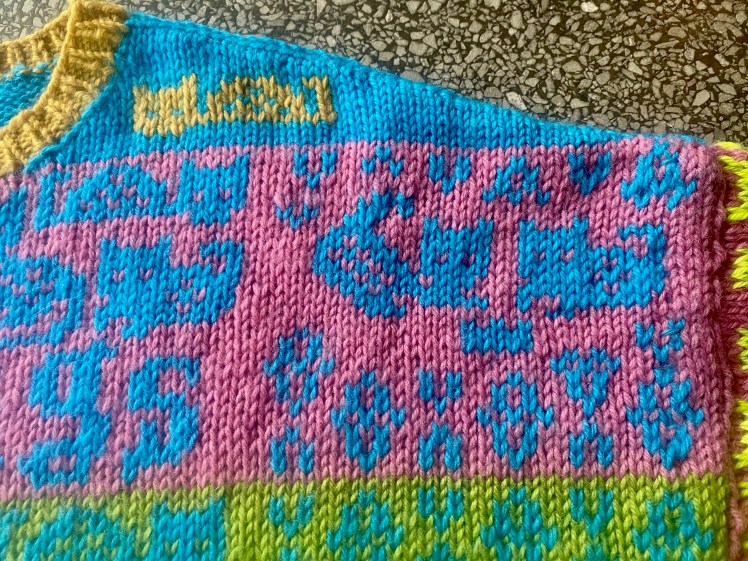
My original plan for the sleeves was to repeat the chart in the color sequence I had used for the body, but by the time I got to the green sequence, it was obvious that the cuffs would practically sweep the floor by the end of the pink sequence. So I finished off with pairs of low-lying cats in neon green on pink, to minimize the length while reprising the pink and neon green. The cuff still lands pretty close to my fingertips, but I like very long sleeves. They’re cozy when it’s cold and you can always roll them up when they get in the way.
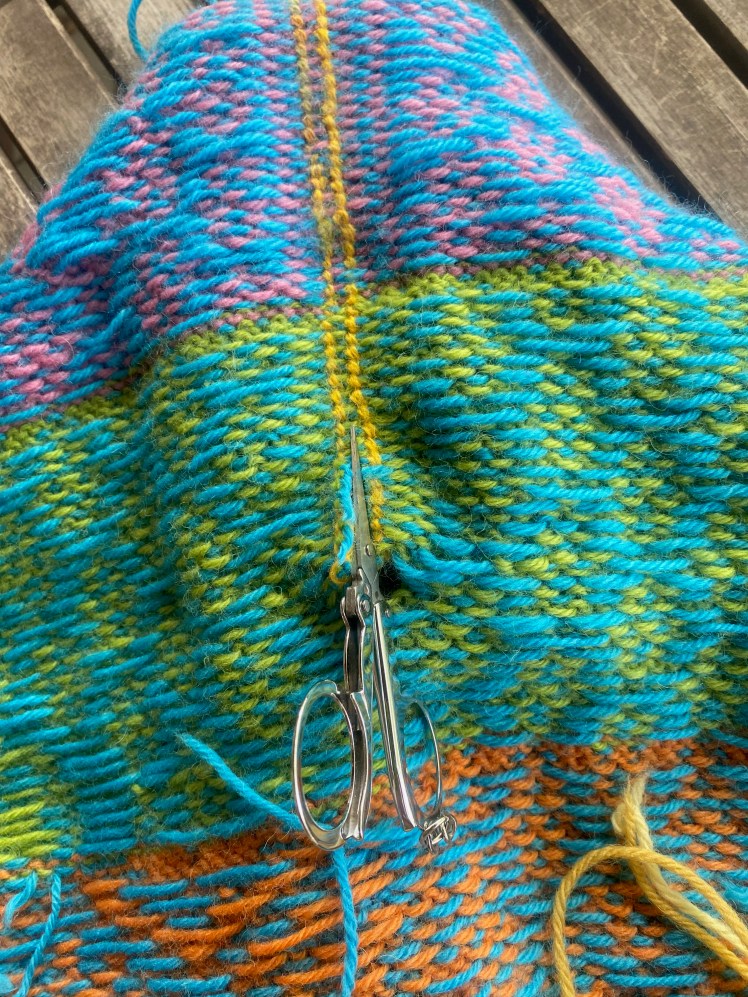
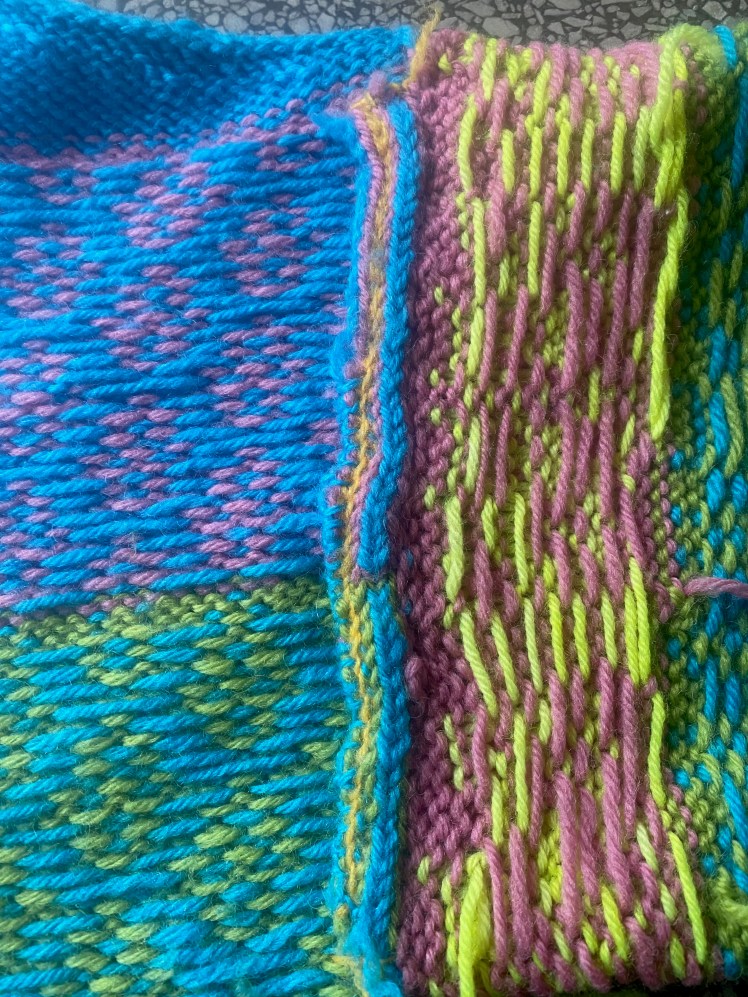
As for the steek, when I reached the place where I wanted the bottom of the armhole slit to be, I added six or seven cast-on stitches to the divisions between front and back and knitted them in a 2-color alternation. I reinforced them in ways that hadn’t occurred to me back in my First Knitting Era. First I crocheted into the ladders of the stitches between the stitch that I would cut into, creating vertical lines of crochet on either side of the center stitch. Then I stabbed the daylights out of the steek stitches with a felting needle. When the stitches were good and blurry from the felting, I cut the steek, then I stabbed the cut edges a little more with the felting needle, for good measure. Then I sewed the edges of the steeks onto the body opposite the sleeve seam.

The sweater was nowhere near finished for the big No King’s day at the end of March. We went to the protest in Hagerstown, an hour and a half west of Baltimore, where the regime had recently purchased an enormous, unused warehouse in a secret process at a wildly high and corrupt price, in hopes that nobody would notice when they immediately turned it into a concentration camp for 1,500 people, despite the lack of infrastructure to support more than four people needing a toilet at any one time. But people did notice and organized against it. The Hagerstown Rapid Response group was looking for support from elsewhere in Maryland, and we were happy to be there. I couldn’t wear my No Kings Yes Cats sweater because it wasn’t finished, so I wore my sweater with the meme of the in-denial dog sipping coffee in a room full of flames, saying “This is fine.” I got a great reaction to that sweater. One person after another came up to me and asked to take my picture as if I were a rock star. I always get a great reaction no matter when and where I wear that sweater. It’s vague enough that anyone can associate it with whatever causes them anxiety and discontent. Also I wonder if clueless dogs are somehow less threatening ideologically than watchful cats that don’t respect authority.
I finished the cats sweater in early May, while I was in Madison, Wisconsin. There were still some days that were cool enough to wear it comfortably, but I didn’t get that much reaction to it. I think it just looked like a normal sweater with wide pastel stripes and some hieroglyphic-looking patterning that you had to stare at to decipher, and it’s rude to stare, especially in Midwest-nice Wisconsin. I have gotten a few compliments on the messaging, but it doesn’t whack you upside the head with obviousness. As soft protest goes, this is very soft. Library voice soft. I’m a little disappointed that sweetness and harmlessness seem to be overpowering the anti-authoritarian purpose of the work. But it functions very nicely as something to wear, despite the fact that the fit is closer than intended.