
I have an entire wardrobe of neglected summer tops that I made in summers past. Every summer I knit them with hopes that I can face a Baltimore summer in something cuter than a holey, stretched out t-shirt. And every year I wear the holey, stretched-out t-shirt as a simple matter of survival. My cute hand-knitted summer tops are too heavy, they’re too tight, they’re too loose, they show parts of me that I don’t want to show, they’re constrictive. Worst of all, they’re HOT, and not in the good way. In the way that generates and traps sweat in weather that feels like a wall of thick unbreathable misery when you step outside, like the whole world is a sweaty armpit. I have put a lot of time, effort, and materials into summer knitting that taught me what I don’t want in my summer knitting.
Under the worst conditions, there really isn’t a hand-knit substitute for a loose, stretched-out, commercially knitted cotton t-shirt, preferably with a few holes, but once I knitted something that came close. The reason it’s the best knitted item I have for the summer is that the yarn is 100% linen, and it’s loose and airy but covers everything without excess fabric. This garment is the model for all of my summer knitting. It’s this, from summer 2019:
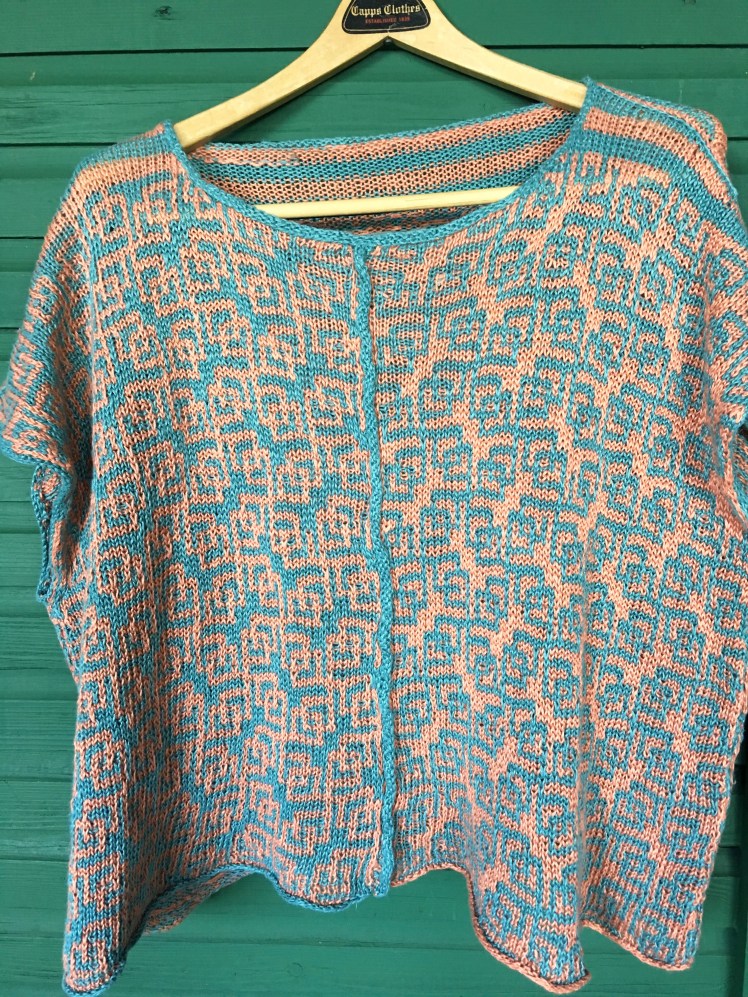
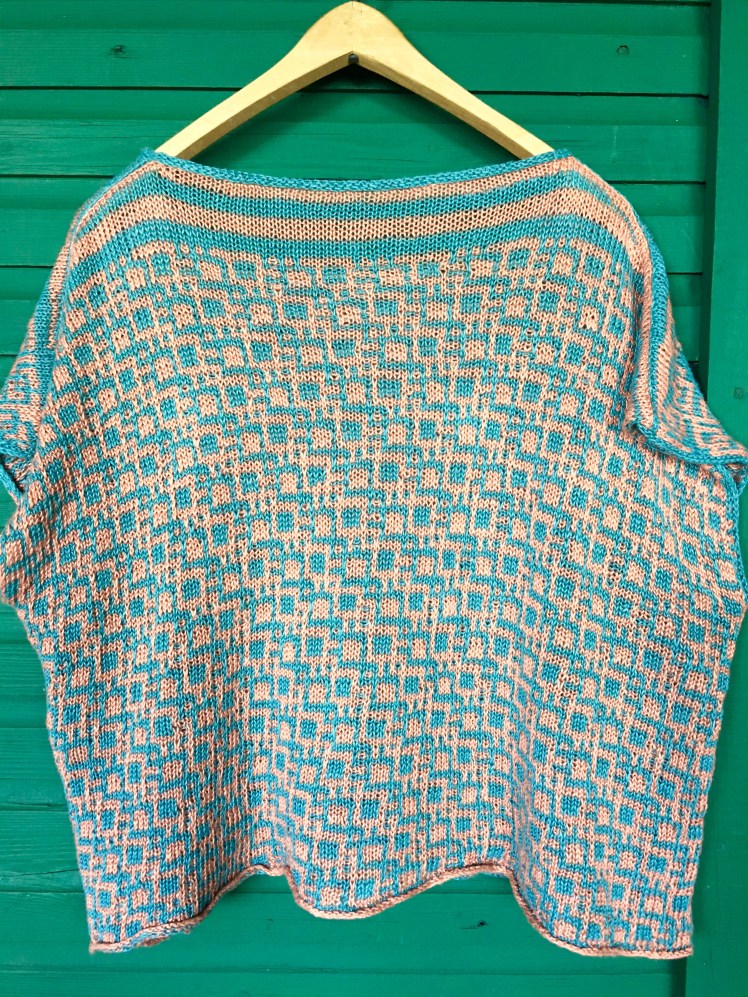
This summer I knitted two tops for myself that are runner-ups to the 2019 linen shirt in terms of summer functionality. They are runner-ups because the yarn isn’t 100% linen, but they are almost as good because the yarn, Urth Yarn’s Etesia, is 77% cotton and 23% linen. That bit of linen isn’t as good as all linen. But it’s better than nothing, and it’s good enough for me to have knitted four garments, with a fifth in progress, from that same type of yarn this summer, so it deserves a better recommendation than “better than nothing.”
I was actually hoping this year to skip summer knitting entirely and stick to my plan of getting a jump on birthday knitting and a double-knit baby blanket that I want to make for DD2’s first baby. But that plan got derailed when I saw Annie Lupton’s Twisted Vs Tee pattern and the Etesia yarn in a light hazy blue, and thought, this looks quick and easy. When will I learn that “quick and easy” are the famous last words that come before falling into a summer-long trap? I can’t hand knit anything in less than six weeks no matter how hard I try, and I tried to knit the through-the-back-loop twisted stitches so hard that I developed a repetitive-movement stress injury in my lower right arm. So that’s what tennis elbow feels like. It has taken all summer for it to heal enough to get back enough strength in my right arm to pour coffee from a full carafe.
In the meantime, I learned the eastern method for knitting purl stitch, which is less stressful for my hands and arms. I have always knitted purl stitch (and knit stitch, of course) in the continental style, with the yarn on my left hand. I don’t know if other people do this to knit purl stitch, but I got into the habit of using my thumb to help get the yarn over the needle that my right hand guides into the stitch from back to front, since the over-the-needle orientation requires a large, extra movement that stresses both hands. The eastern method for creating the purl stitch loops the yarn under the needle, which reverses the orientation of the stitch on the needle so that the back leg of the stitch is on the left rather than on the right. The advantage is that this method inflects less torquing on either hand, and it makes ribbing more even. There are lots of videos and websites with better explanations.
I think the resulting garment was worth the pain, now that the injury is healing.
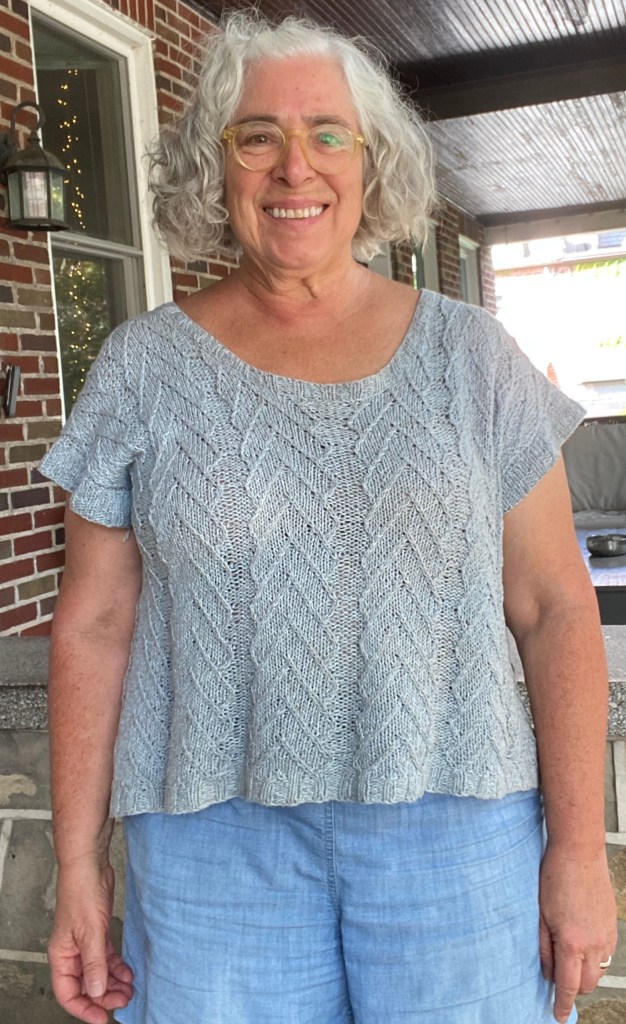
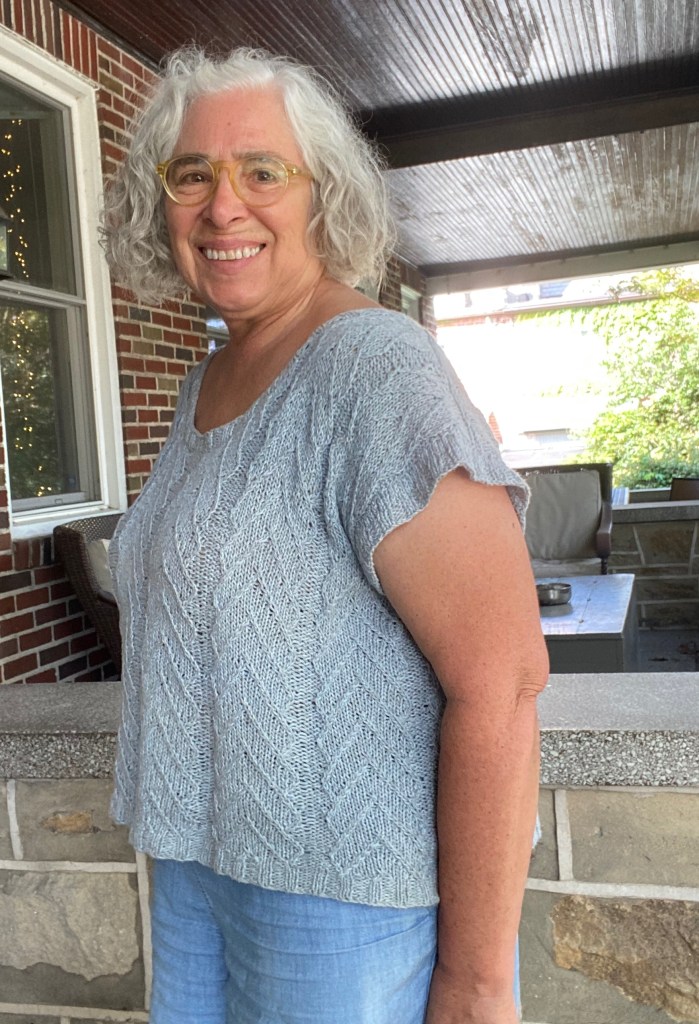
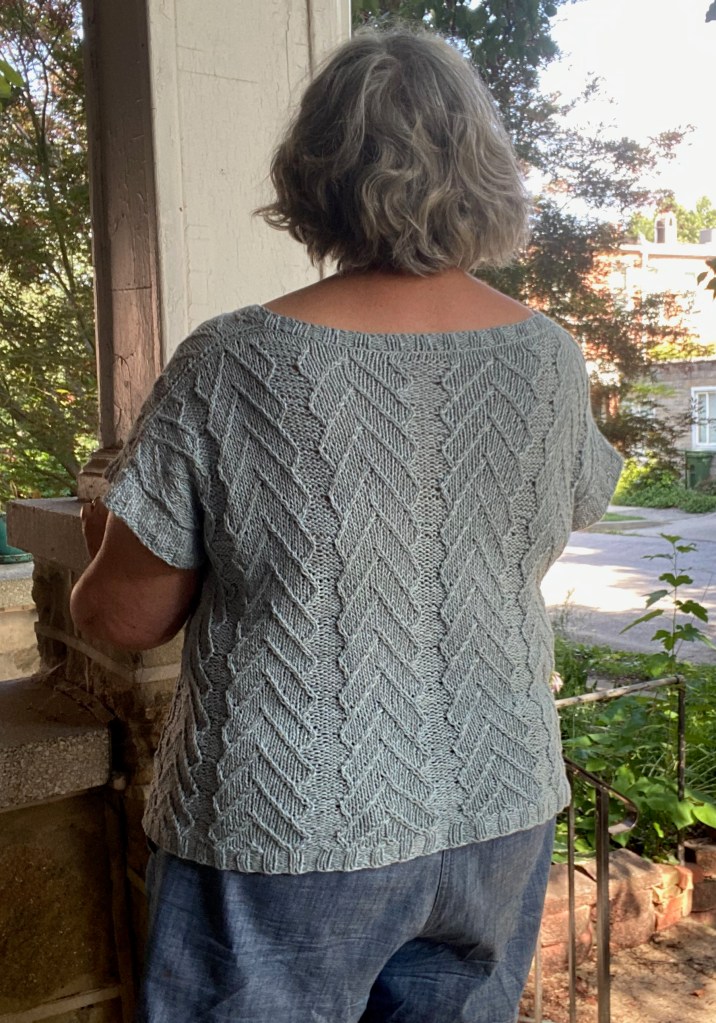
The Twisted Vs shirt was a functional success, wearable in pretty much the hottest and stickiest of our summer weather, and I liked the Etesia yarn so much that I’ve been buying and knitting it all summer long. I was contemplating its color range in machine-knit stripes, and magically a pattern came across my Ravelry feed that had a striping sequence that met my needs, although I didn’t like the finishing and the way it fit anyone who modeled it on the project page and project gallery. The pattern is Sole Mio by Schwedenherz Designs, and fortuitously, it was on a promotional free offer that very day.
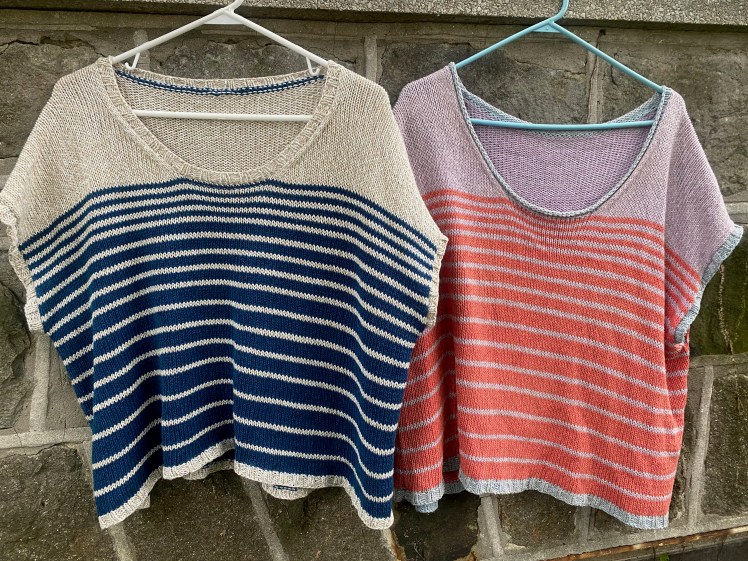
I had been considering a dusty orange/dusty lavender color pairing in the Etesia yarn for my machine-knit striped top, and the easy availability of this pattern sealed the deal. When I got the yarn home, some leftover light blue yarn from the Twisted V shirt happened to be lying next to where I took out the orange and lavender, and I loved the combination. Although I disliked the dated fit and the armhole finishing of the Ravelry pattern page samples, the pattern did have numbers that would work for the relaxed fit that I wanted. The pattern offered two unattractive options for finishing the armholes: either an awkwardly bulging i-cord edging or a too-long and too-tight ribbing. Those poor design choices were easy to correct with a narrow 2×2 ribbing that lay flat.
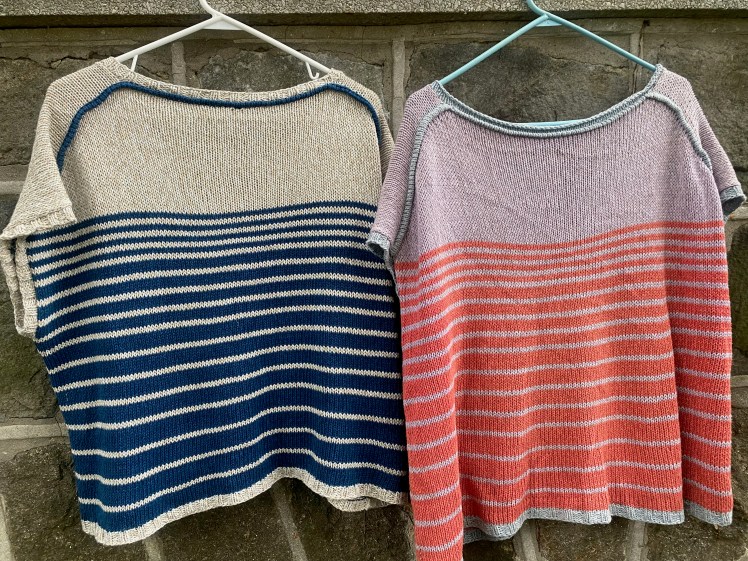
My gauge, using the LK150 at T5, was pretty close to the pattern’s gauge, so it was really easy to adapt the pattern from knitting in the round to knitting it in flat pieces, after attaching the front shoulders to the slanted European back and knitting the front downward. I did that thing I like to do with machine-knit European backs, which is to knit the cast-on edge as a welt before proceeding to the short-rowed back shoulder slant. I knitted the welt in light blue, then knitted the short rows in lavender, then knitted the stripes with orange and lavender. The pattern’s striping sequence was simple and logical, growing from two rows of orange (in this case) alternating with two rows of lavender, four times, to four sets of four rows alternating with two rows of lavender, to four sets of six rows, to four sets of eight rows. I could have gone on to 10-row stripes, but I was satisfied with the length after the 8-row sequence, at which point I knitted the 2×2 ribbing in light blue. I tried to follow the pattern as closely as I could for the depth of the front neck shaping, but the pattern measures that in centimeters rather than rows, which can be imprecise while the knitting is in progress. I ended up with a neck opening that was on the loose side. I was perhaps a bit more generous with the picked-up stitches for the rolled edging around the neck than I really needed to be, because I wanted the edge to roll rather than get pulled tightly, which would make it lie flat. It was something to learn from. Nevertheless, I now had another highly functional garment for the worst of a Baltimore summer.
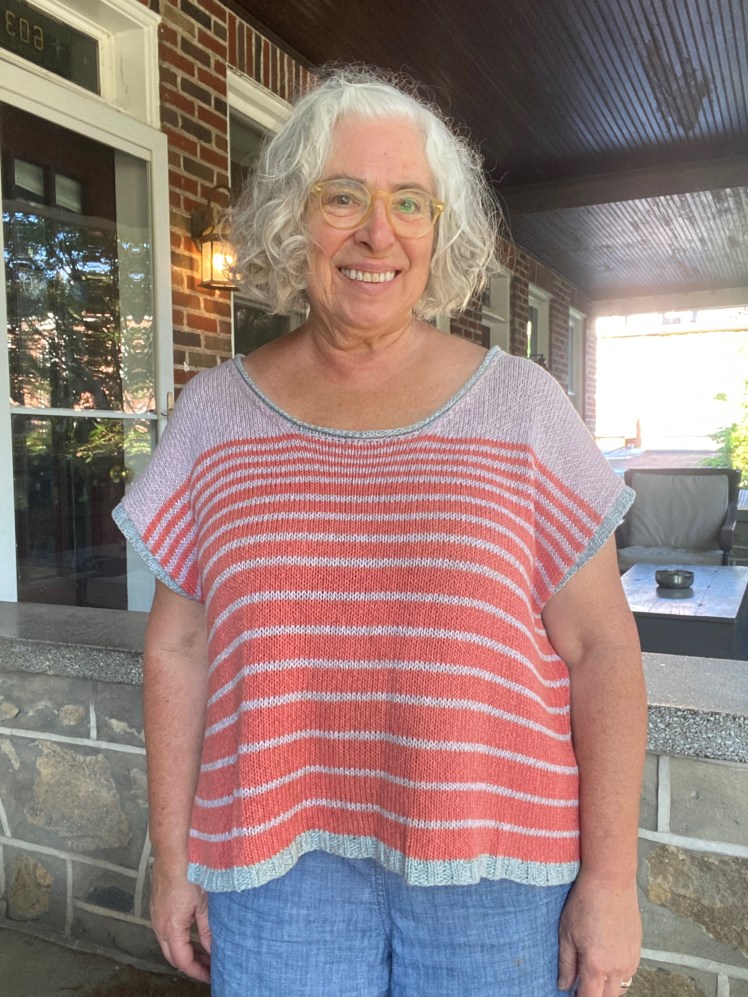
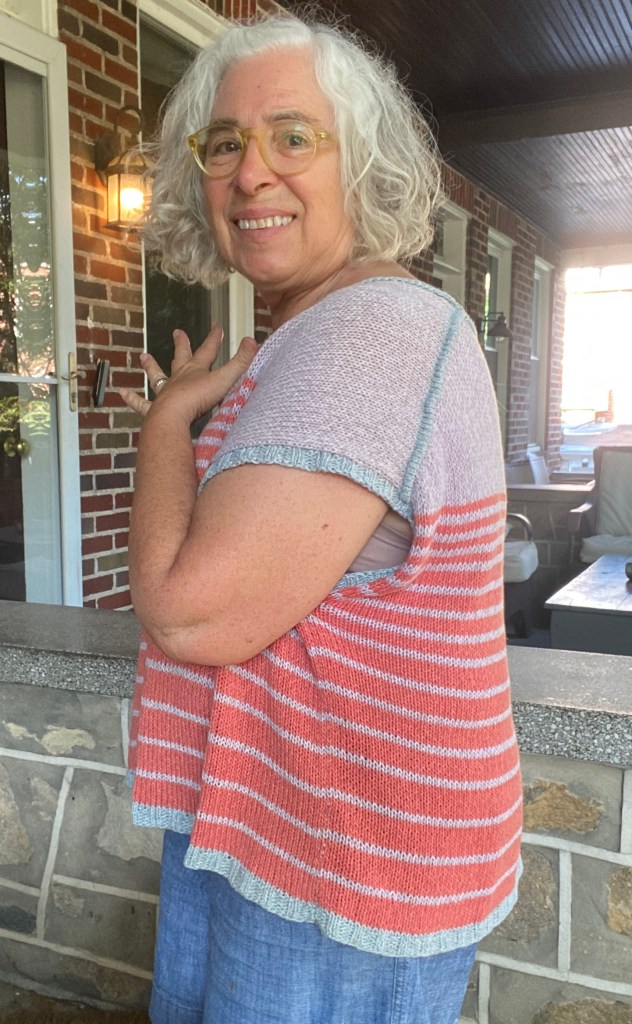
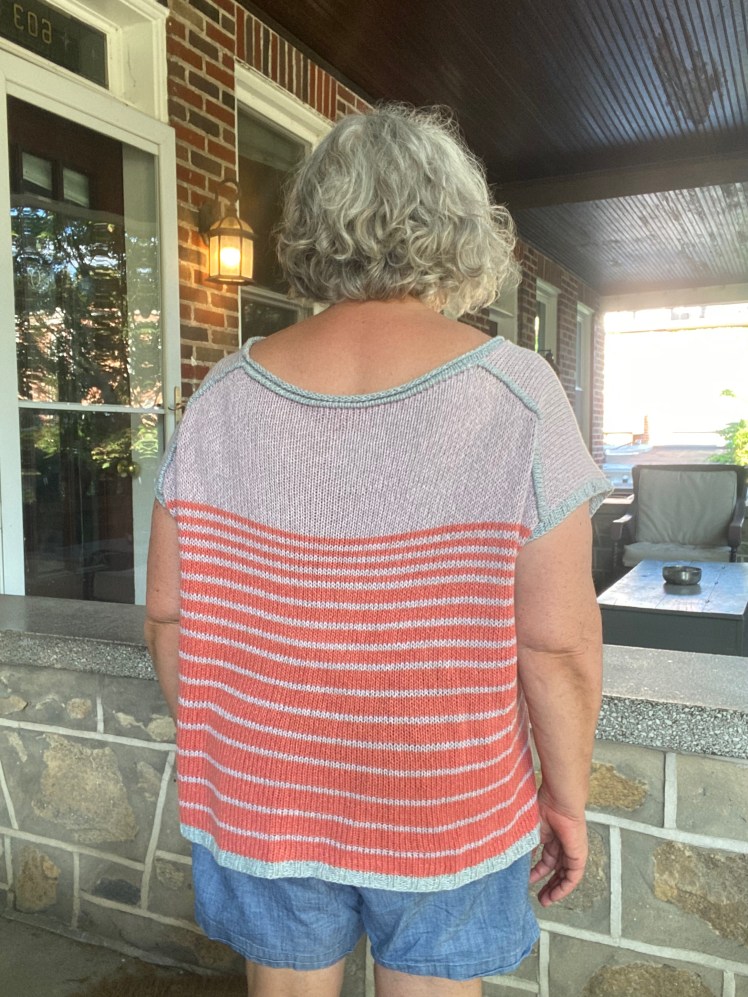
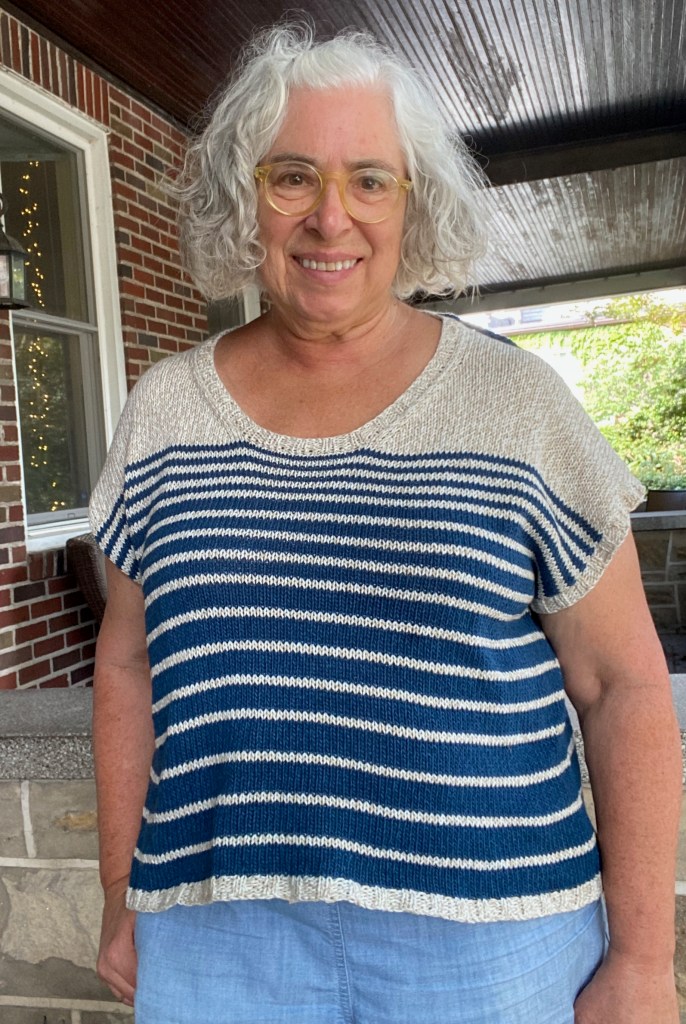
I was so pleased with this striped shirt that I offered my sister her own version when we saw her on her birthday in June. She said she would like that, but could I please make the neckline a bit closer-fitting, because she didn’t want the shirt to fall off her shoulders, as I admit mine does. Indeed I could. I took a few rows off the depth of the front neck shaping and knitted a 2×2 rib around the neck, and it does not fall off the shoulders. The color pairing for this second version was oatmeal and marine blue. I wished for a sweater quantity of those colors for myself, but I had bought the last of it for my sister’s gift.
For the long-sleeved sweater, I bought what Melissa still had left, light gray and inky blue-black, with a hopeful and optimistic faith that someday the weather might cool enough to make it tolerable again to wear long sleeves in a summery fiber. I’ll save pictures and discussion of the long-sleeved version for that blessed day when the weather is appropriate for wearing it.


Like you, I love the look of low contrast yarn pairings. Your Twisted Vs looks amazing on you. I am so sorry to hear about your injury, but kudos on finding a reasonable work-around.
LikeLiked by 1 person
Thank you! I really am pleased with Twisted Vs. I’m REALLY happy that the injury wasn’t permanent. What would I do if I couldn’t knit???
LikeLiked by 1 person
We aren’t going to go there! Just keep knitting…just keep knitting!
LikeLiked by 1 person