
When we left off our story last time, it was too hot to wear clothing. Day after day of humidity that felt like being in the clutches of a creature that couldn’t be escaped, and would it ever end? I’m too scarred by what we’ve been through to speak too soon, but logically I know that the earth has been rotating its way around the sun, and logically I know that means that seasons are supposed to change. I knitted lightweight garments with sleeves during the summer and never put them on long enough even for a quick selfie session. Dare I have faith that there will be a time between summer and winter when they will be seasonally appropriate?
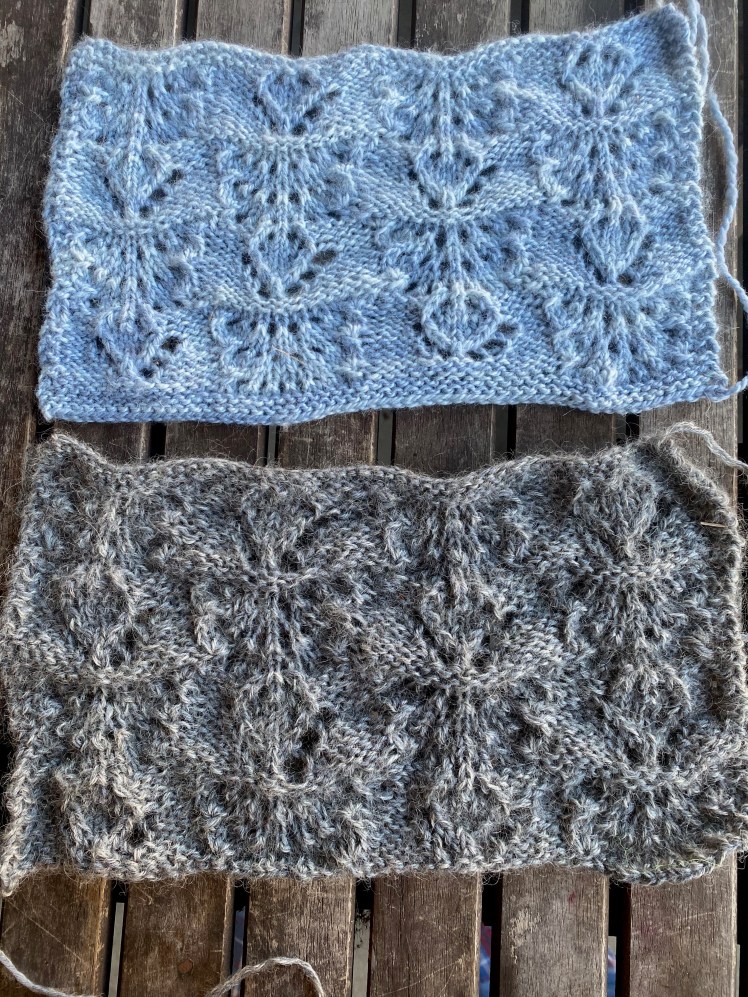
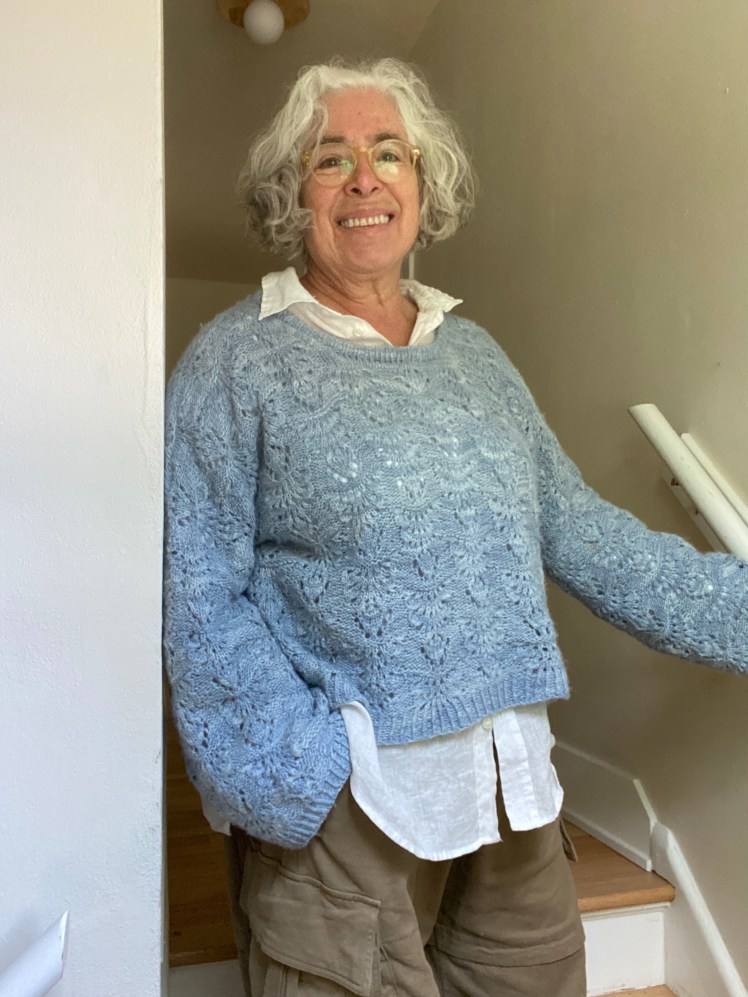
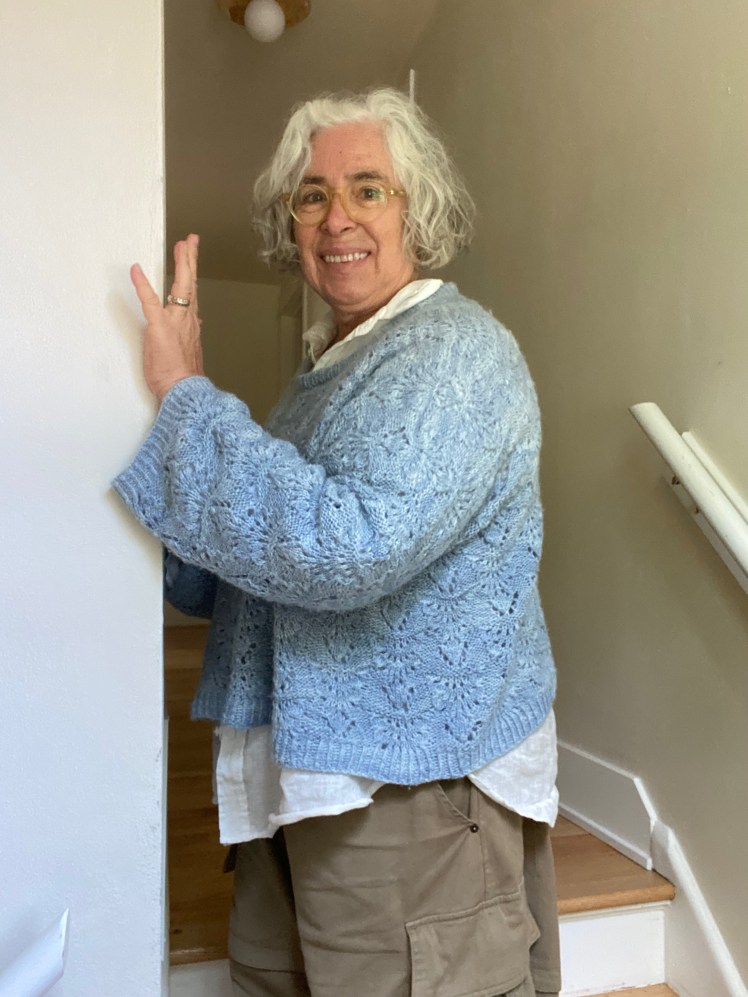
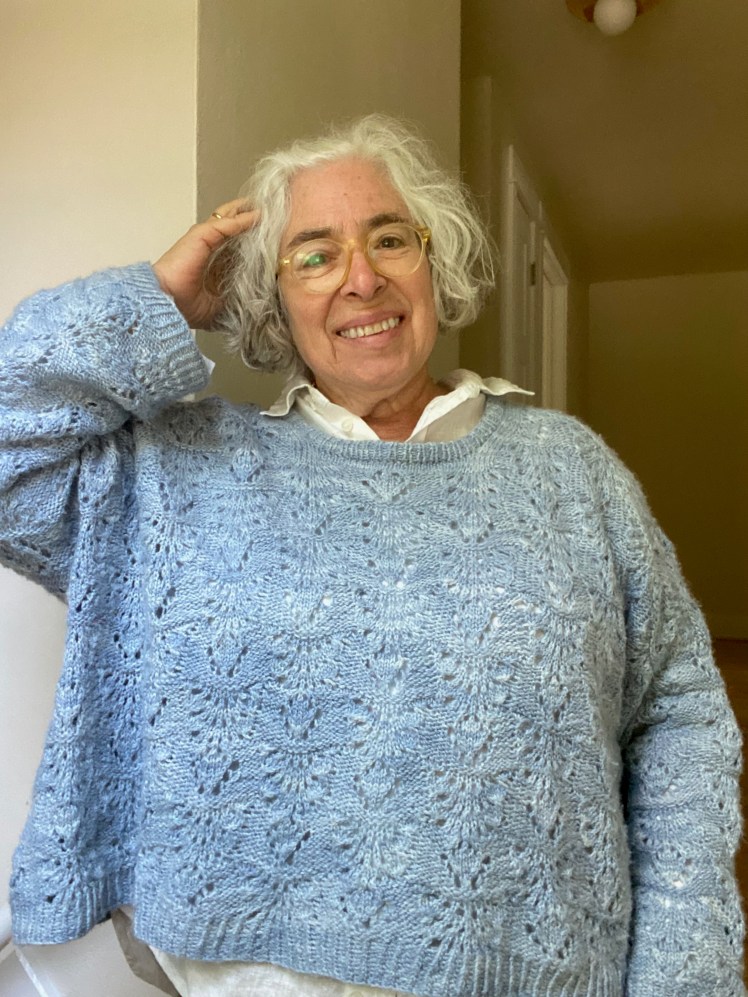
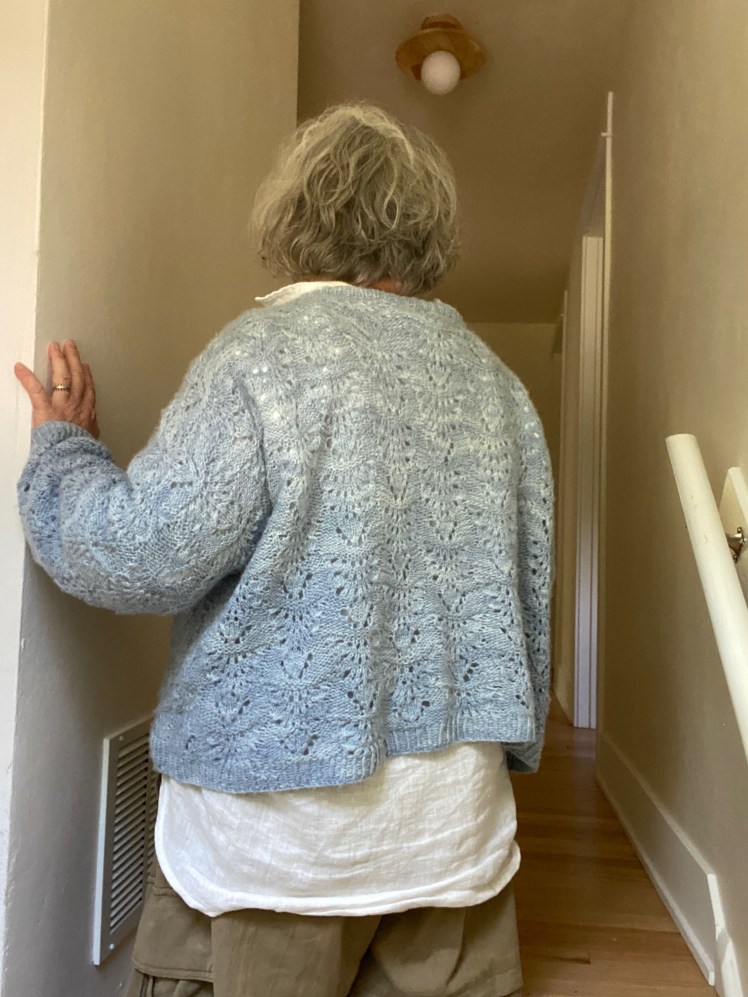
On the blind but tested faith that someday I would be glad to have a floaty, lacy, long-sleeved sweater made of sport weight alpaca yarn, I began my version of the Pierre Sweater at the beginning of this endless summer. I had swatched the stitch pattern every which way during the January 2026 Swatchathon before coming to terms with the fact that the gray Gotland farm yarn that I had assigned to this pattern was too hairy and fibrous to make the stitch pattern legible. When I accepted the fact that this arranged marriage just wasn’t going to work out, I tagged along with Melissa last December when she drove up to York, Pennsylvania, to select yarn for her Alpaca Yarn Company trunk show. I browsed through Lisa’s entire stock and chose a tonally variegated misty blue colorway called “Behind Blue Eyes” in her Simatri yarn value. It has the texture of a newborn kitten. I petted it often while working through the queue-jumpers that delayed the start of this project until the beginning of this notably sweater-unfriendly summer.
The stitch pattern is an adaptation of a lace pattern devised by Japanese stitch designer Hitomi Shida, but turned upside down for a top-down garment construction. It contains a variation on the yarnover/decrease construction of the Feather and Fan lace pattern, in that the open work has an alternation of yarnovers and plain stitches. In the Pierre stitch pattern, the decreases are done at the beginning and end of the yarnover sequences using 3-stitch decreases bracketing the yarnovers. The all-over patterning is built on an offset grid that alternates a downward-pointed lace shape with the scallop-bracketed decrease+yarnover section, producing a staggered, triangular, all-over lace pattern.
I started knitting this project when the overuse injury I had inflicted on myself doing a million twisted stitches through the back loops was at its worst. I suppose that the common-sense response to an overuse injury is to stop doing the thing that caused the injury for a while, but the idea of not knitting produced existential panic. I was leery but undeterred by the 3-stitch decreases leaning right on the left side and left on the right side, but I used the pain to tell me what movements to avoid and the absence of pain to tell me what to do instead. The eastern method of forming purl stitches by looping the yarn underneath the needle rather than over it also reduced the torque on the damaged tendons. Gradually the pain in my right arm reduced and the strength came back, even as this sweater grew.
I found the pattern mostly logical and easy to follow, because the construction of the garment was exactly what I would have done if I hadn’t been using a pattern, except for some confusion right after the cast-on at the shoulder about which part of the stitch pattern to start with. Apparently I chose the wrong part, because when I picked up stitches for the fronts, the pattern sequence according to the instructions looked wrong to me. So I mostly disregarded the chart showing the neck shaping and did it my own way. I used the pattern’s numbers for the smallest size.
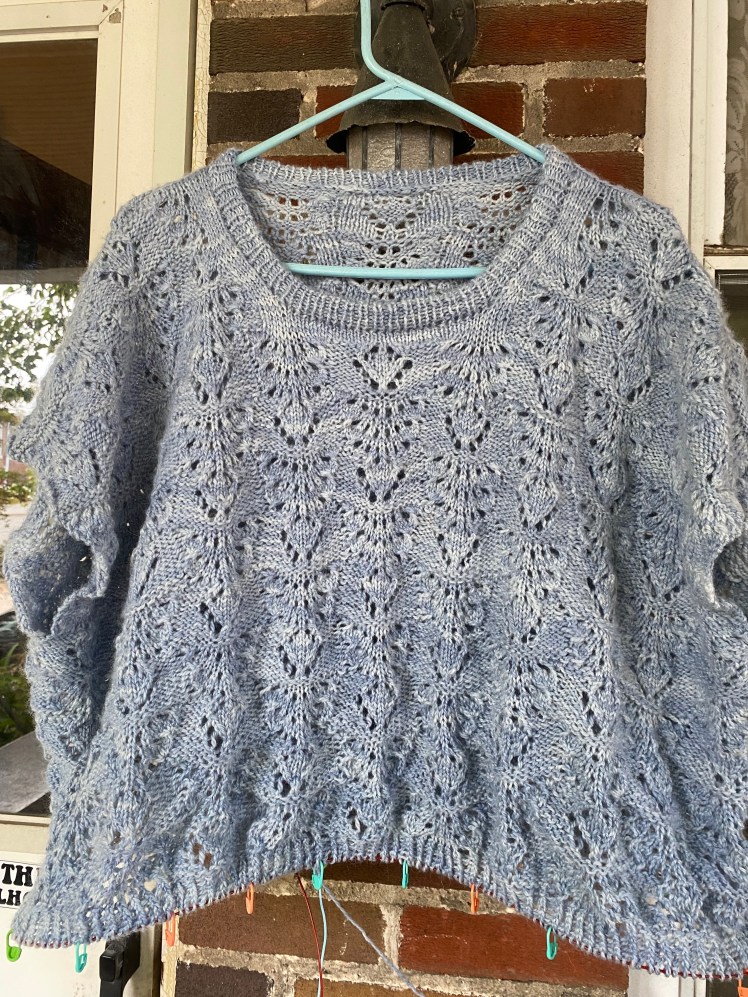
My gauge was a larger than the pattern gauge and loosened as I knitted, and the lace patterning was very stretchy before wet-blocking, so it was hard to tell the finished size by looking at the unfinished knitting. That uncertainty made it useful to refer to the pattern’s numbers so that I wouldn’t over-knit. Then I finished it, and it was too hot and sticky even to slip it on for a quick selfie. I put it aside while I despaired that the weather would ever change, and then I forgot about it. But it’s mid-September now, the world has turned a bit, and suddenly a fluffy, lightweight lace sweater in misty pale blue alpaca is a palatable idea.
In my last post, I talked about knitting a series of summer tops from Urth Yarn’s Etesia line, a cotton/linen yarn. I adapted a hand knitting pattern named Sole Mio for a striped dropped-shoulder sleeveless top to the LK150 knitting machine, and knitted a couple of versions.
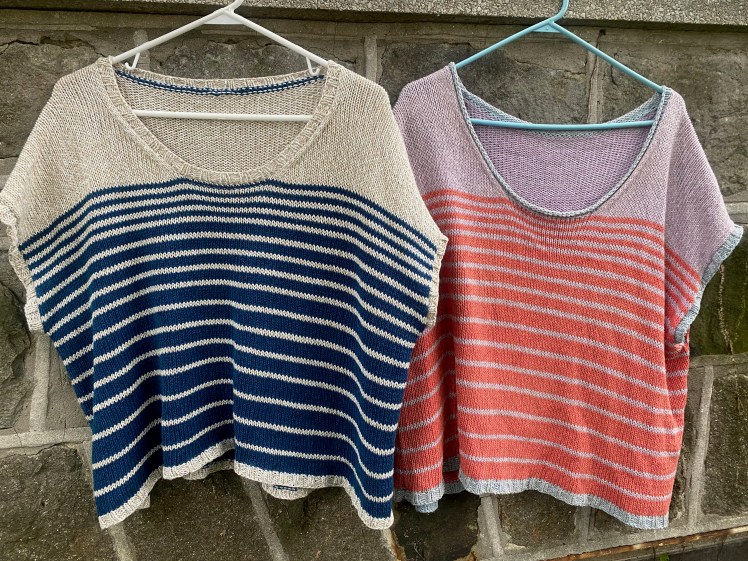
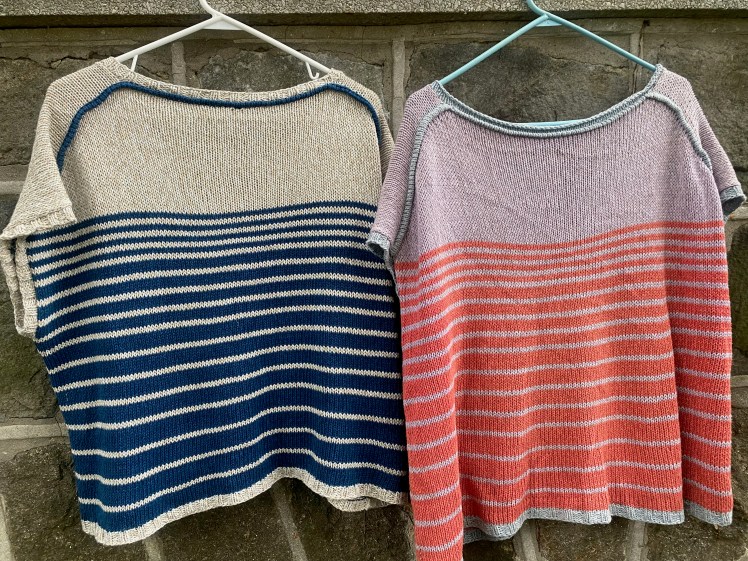
As I worked, I started to realize that I had something missing in my sweater wardrobe. I lacked lightweight, long-sleeved pullovers in a not-wool fiber. I imagined a time when the humidity wouldn’t be at 100%, and it would feel nice to slip on a cotton/linen long-sleeved sweater while I sipped morning coffee and looked at the computer. And here I am right now, doing exactly that, because we have not yet reached the point where the world has stopped turning and where the turning of the world fails to change the weather.
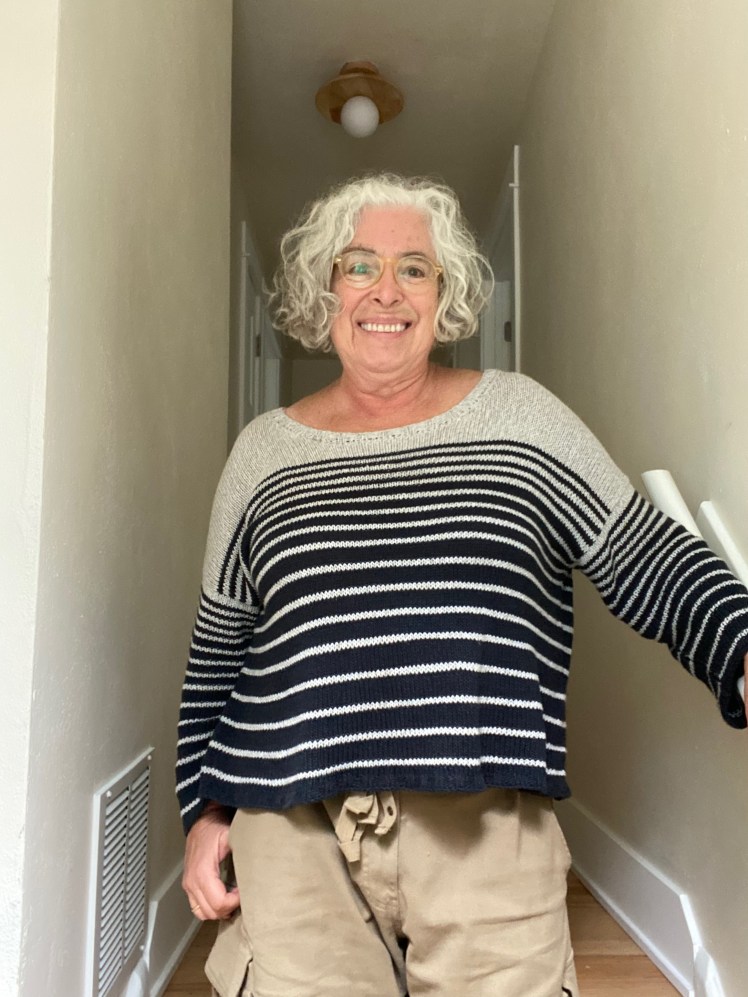
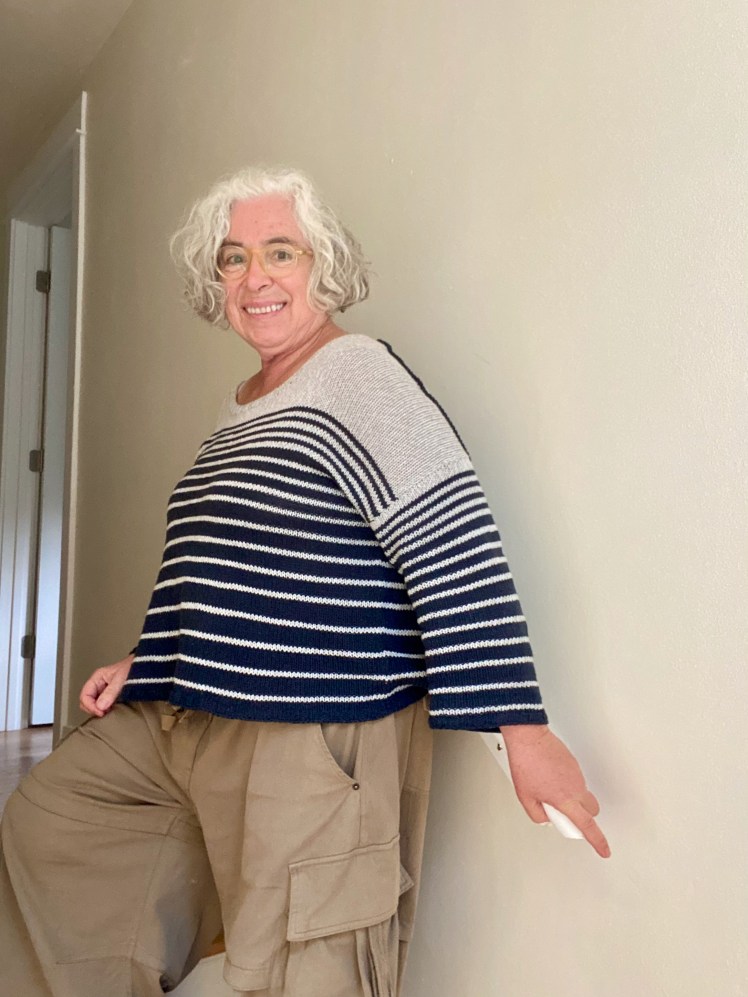
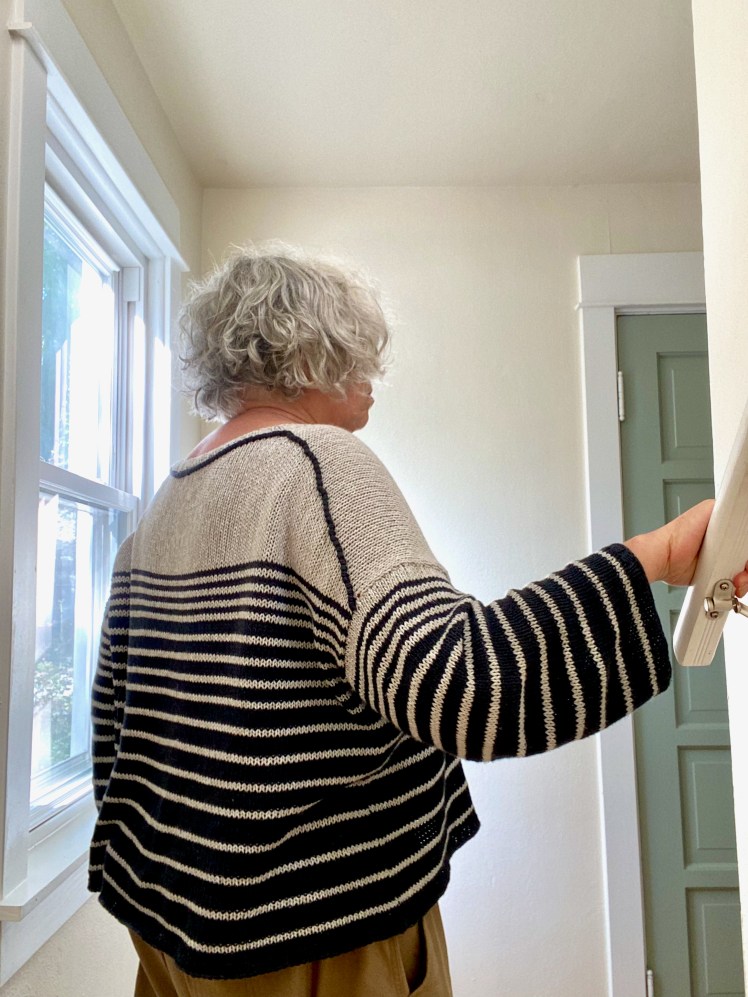
For the long-sleeved version, I knitted the back exactly the same way I had knitted the two previous sleeveless tops. The main modification for this variation was raising the neckline by about six rows, by speeding up the increases on the two fronts and joining them together earlier than the pattern calls for. It’s still a fairly wide and open neckline, which I would not enjoy in a cold-weather sweater, but this sweater isn’t intended for cold weather. I also lengthened the sweater by adding a 2-row stripe and then a 10-row stripe, into which I worked a 4-row ribbing. The sleeves were based on the same number of stitches that I had picked up around the armholes of the sleeveless tops for a ribbed finish. Here I just kept on knitting in the same striping sequence as the body, with a slight narrowing of the sleeves with a gentle rate of decrease down to the cuffs.
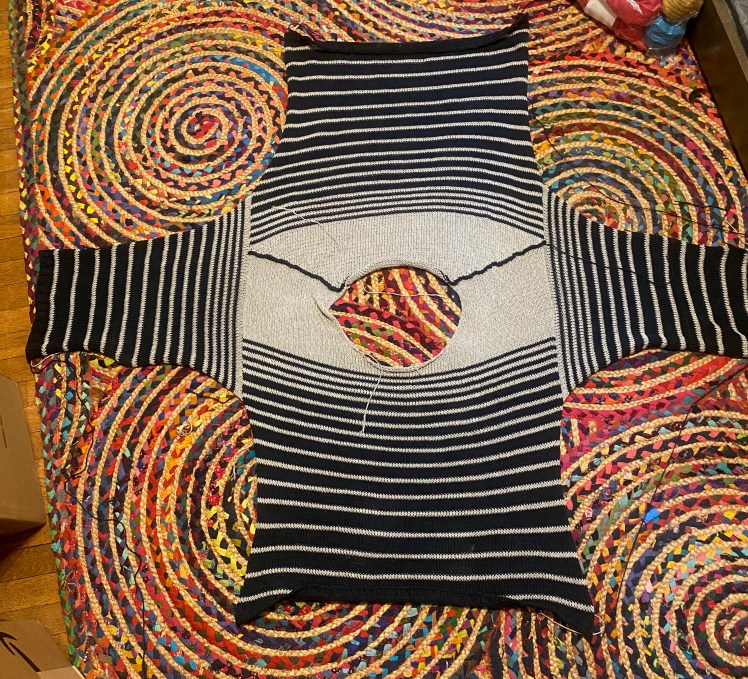
The idea for the long-sleeved cotton-linen sweater was to have a loose, casual open-necked pullover in an airy fiber that would be comfortable in temperatures below 80º F, before we get into serious sweater weather, wearable either as a single layer or on top of other shirts. Now that we have achieved the desired weather conditions, I’m wearing it day after day.
The light blue alpaca sweater is too lacy to wear without something underneath, and it’s too warm to wear it when there isn’t a bit of nippiness in the air. Also I worry that the fluffy fiber will mat and snag if I wear it in the heedless way I like to wear clothing, but it fits the way I like and looks good with everything I’ll wear it with. It can be worn on occasions when I want to look a little dressier but don’t want my clothing to constrict me or make me think about how I look after I have put garments on my body. Which is all the time, now that I have aged out of dressing for career and social success.


Oh, your creations are wonderful! I so get the struggle of having just the right layer for that in-between time of year. I think you nailed it!
LikeLiked by 1 person
Thank you so much! The hardest part was having faith that the in-between time of the year would even come!
LikeLiked by 1 person