
Over the course of the last eight or nine months, I have mentioned in my posts that the needle selection mechanism of my Brother KH965i electronic knitting machine was malfunctioning. I couldn’t imagine how I was going to fix it, so I figured out some clever workarounds to my panic over the fact that it was going to be hard to find someone else to fix it for me. One workaround was embroidering over the missed stitches, another was choosing patterns that were simple enough that I could move the misplaced needles into their proper place before moving the carriage. I flirted with the idea of intentionally moving needles into different positions and improvising freeform patterns. Or I could just abandon the idea of using the electronics altogether.
Machine knitter friends referred me to parts and service manuals that explain how to trouble-shoot and identify exactly what the problem is and sent me links to videos that show how to disassemble the machine and clean its innards. None of this information meant anything to me because I didn’t understand what the terminology meant and I was scared to open up the machine because I thought I’d never be able to put it back together again. But lucky me, a friend rescued me from helplessness and befuddlement! Tanya Cunningham is known in the machine knitting community as one of the developers of the knitting software img2track and is very knowledgeable about knitting machines in general and Brother knitting machines in particular. She has been working on restoring a KH930, and she has disassembled its parts so that she can repair and replace its malfunctioning bits. She has kindly taken an interest in my progress as a machine knitter. And she lives three miles from my younger daughter!
While I was visiting my daughter this summer, Tanya invited me to her house to show me the guts of her knitting machine and how they fit together and how they interact to produce patterning. She showed me that the plastic cover over the needle selection apparatus is held in place by exactly two screws, and right inside that is a metal cover that the circuit board attaches to from inside the cover, with three cords that connect the circuit board with the mechanical pieces, and this metal cover is held in place by exactly two more screws. Removing the two screws of the plastic outer cover and the two screws of the inner metal cover reveals the cam roller and the 16 armatures that the roller moves to put the needles into the positions that produce the pattern. Tanya showed me all the pieces from all the angles, and seeing the machine’s anatomy in three dimensions made the videos and drawings that had washed over my unabsorbing brain suddenly meaningful.
Based on my description of the symptoms, Dr. Tanya’s diagnosis was that the ailment was a physical impediment to the free movement of the armatures. The relevant information was that the mispatterning, when it happened, was 16 needles apart, but it didn’t happen every every row. Also, I had occasionally knitted preprogrammed patterns without needle selector problems in the years before my trouble started, while I was knitting a full-sized sweater in alpaca yarn with an all-over stranded pattern. And the last time my machine had been cleaned was seven years ago, before I purchased it. So it was reasonable to operate on the assumption that the cam roller and armatures needed a good cleaning, and if that didn’t solve the problem, it was a problem for another day.
Now I was ready to understand what Tanya and others had been trying to tell me for months. We viewed a 5-minute Answer Lady video that had previously baffled me, and now that I had seen the parts in real life, it was like Annie Sullivan pouring water over Helen Keller’s hand and Helen Keller suddenly understanding why Annie Sullivan kept grabbing her hand and wiggling her fingers. Yes! I too can remove four screws, keep track of them, and screw them back in! I can even put them back in the right place! And look at how much fun “Ask Jack” was having blasting the yellow glop off the cam roller with the food-grade silicone spray and restoring it to pristine whiteness! I want to have fun too! By the time I left Tanya, I couldn’t wait to come after my machine with a screwdriver, which is a sentence I never expected to write. This is what happens to knitters who had never even picked up a screwdriver before they started using a knitting machine that hasn’t been made for 30 years: they learn how to fix them because they have to.
When I returned to Baltimore and my KH965i, I had sobered up a bit, but I still felt I could remove those screws to get a knowledgeable look under the hood. I put the first pair of screws into a plastic bag and stuck it into my right pocket, and then the second pair of screws went into another plastic bag and into my left pocket. Then I was treated to a view of dust bunnies and a cam roller that wasn’t just yellow with gunk, but amber in places. I scooped up the dust bunnies, but I didn’t have the silicon spray yet, and also I didn’t want to do this operation without being supervised by someone who was comfortable with taking machines apart and putting them back together. The adult I recruited to supervise me was Melissa’s husband, Dave Showalter, who is an artist in all kinds of media and also can fix anything mechanical. Check out his website: https://davidshowalterart.com/home.html.
Tanya provided us with links to parts and service manuals and lots of videos to help us prepare for the task ahead. While I was doing my homework, I noticed that The Answer Lady had mentioned to Ask Jack that she had been knitting with alpaca yarn on the machine they were cleaning out in the video. I had been knitting with alpaca yarn too when my machine started mispatterning, so I went back and looked at my swatches, which had knitted perfectly, but when I got to the big pieces of the sweater, that was when I got those long vertical lines where my contrast color wasn’t knitting.

I took that as another data point to indicate that the problem was a physical obstruction rather than an electronic failure, which was a good thing, since I can remove screws and spray cleaner at the afflicted parts, but I haven’t the least clue how to fix electronics. I ordered a spray can of the same stuff Ask Jack and The Answer Lady were using in their videos, LPS food grade silicon spray, and when the LPS spray arrived, I set a time for Dave to come over so we could work on my machine together. I was nervous.
We started off by doing the diagnostic tests for the needle selection mechanism in the parts and service manual for the KH930 machine. The ones that were done with the covers removed and the power on were the most informative, because we could see where and how often the needles went out of their proper position. It wasn’t every time, which gave us confidence that the problem was physical, not electronic. Just removing the covers was informative, because then we could see the fluff and gunk stuck on the cam roller and in between the armatures, and picking it out with a pair of pliers was really gratifying, like reaming out a cell phone’s charger hole with a toothpick to extract the pocket fuzz. We got more accustomed to the way the carriage moved the cam roller and the cam roller moved the armatures in a wave, and then the needles did or didn’t move move out of position. So I moved the carriage while Dave watched the way the armatures moved, until he had identified the 15th armature, the second one from the right, as the particularly sticky one. While I moved the carriage, he would call out when the armature failed to move, and sure enough, there would be a needle in the wrong position.
Now that we knew what and where the problem was, we had the fun of spraying the grooves of the cam roller and under, on, and between the armatures to banish the old sticky oil, which had turned the alpaca fuzz into a kind of cement. The old congealed oil was the color and consistency of ear wax (depending on one’s genes), and swabbing it away offered the same icky gratification as cleaning out a very waxy ear. We were giddy with excitement as the cam roller got whiter and the Q-Tips got yellower, and our tests with the carriage and the needles in B or D got more consistently successful. Toward the end we tried a test that Tanya had suggested, which was to program in Stitchworld pattern #537, which puts all the needles into B on one pass of the carriage, and all the needles into D on the return pass. We did that about 100 times, and each time everything went where it was supposed to go. Success!
Before and after:
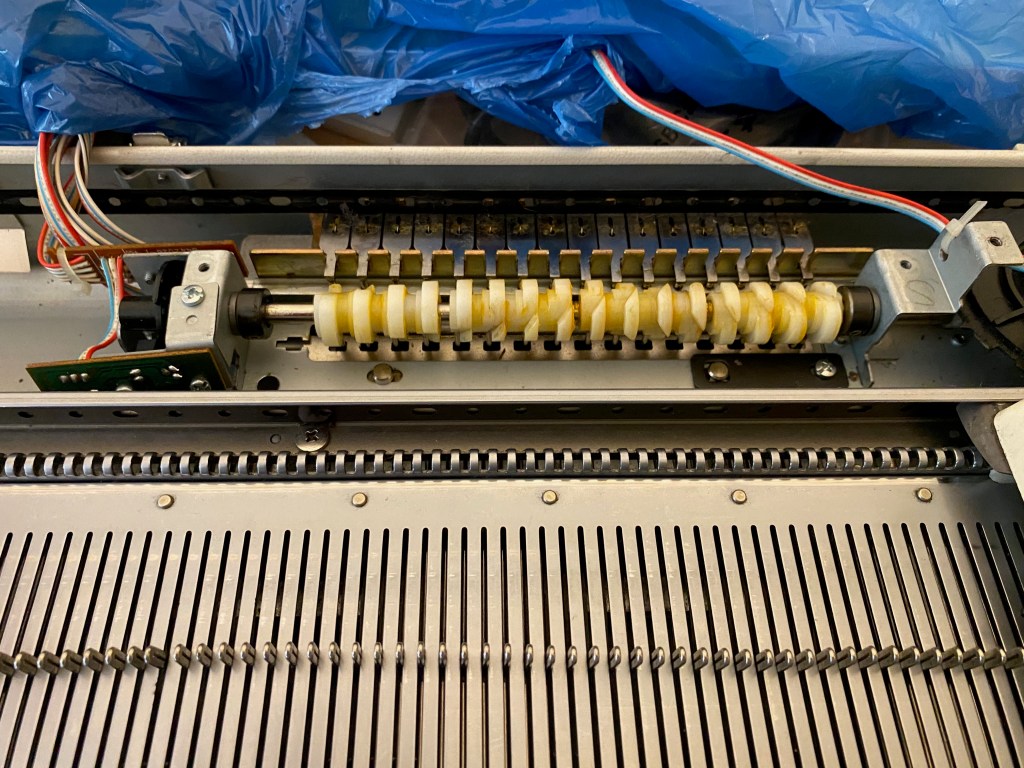
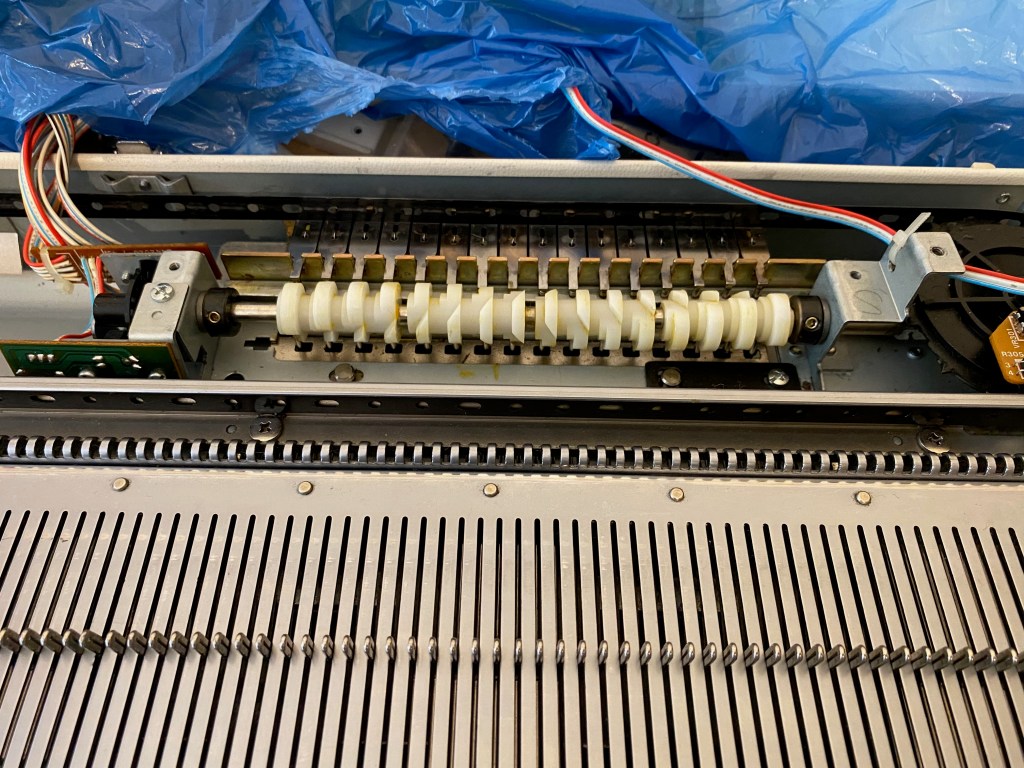
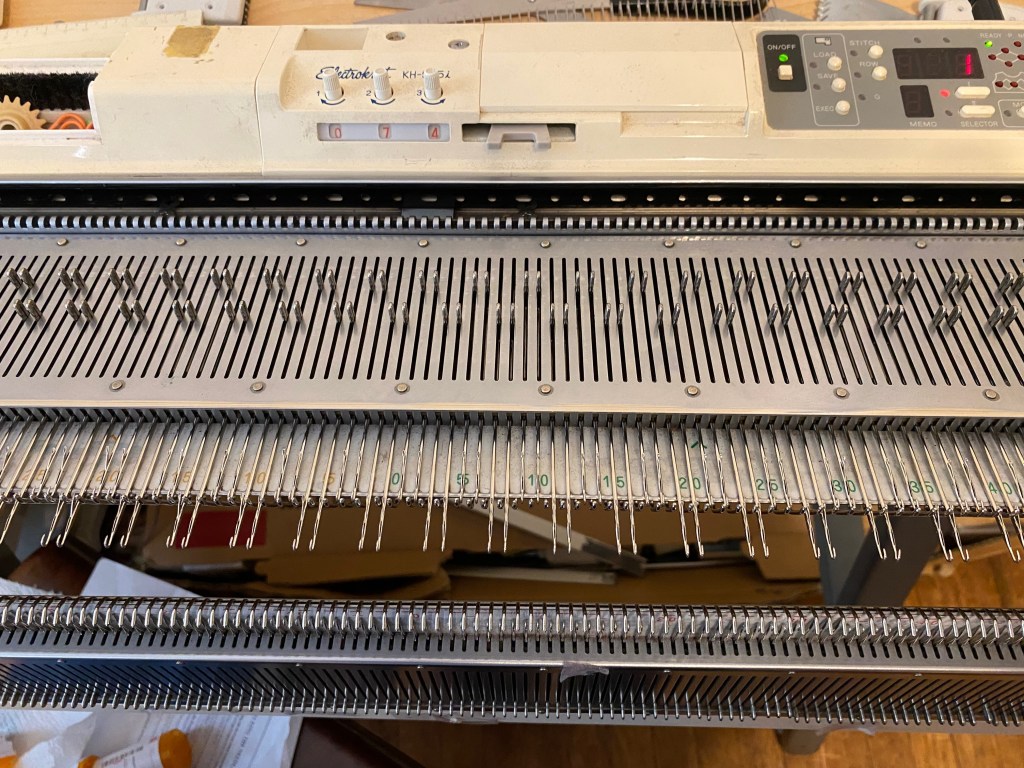
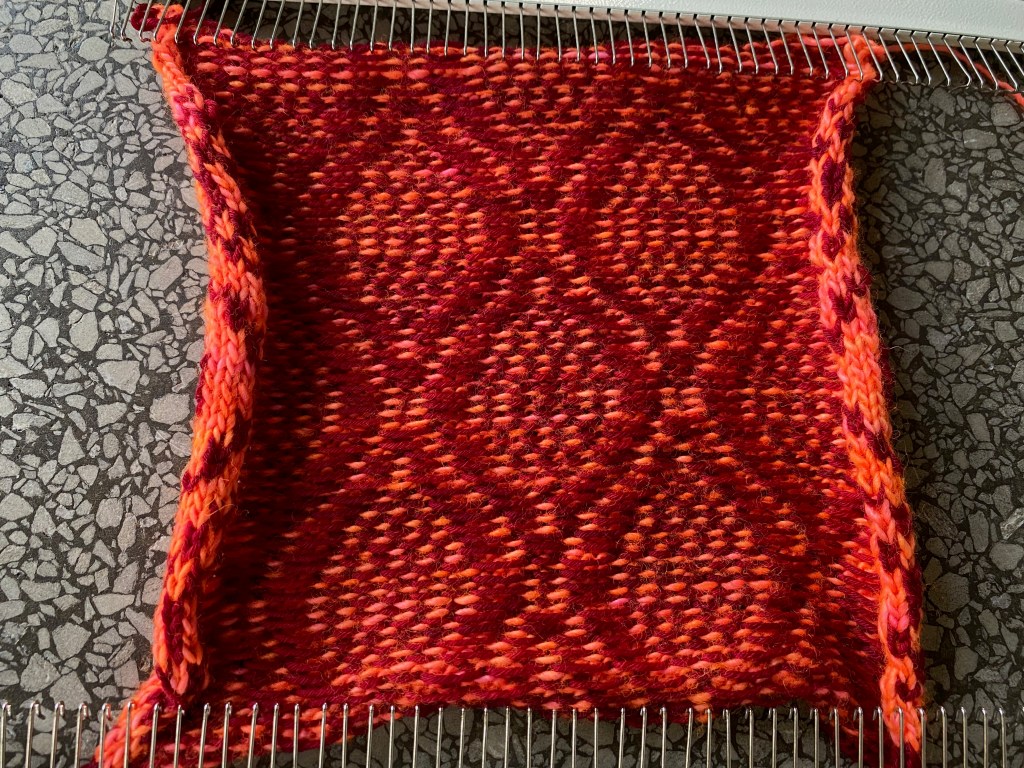
We had proven the success of our effort with air knitting, in which we input the pattern and moved the carriage across the needle bed without yarn, but what if it didn’t work when I tried it with yarn? I was pretty anxious. The next day I threaded up two contrasting colors, cast on 60 stitches, and input one of the knit-purl patterns in the Stitchworld book with the machine set for fair-isle. I especially love those patterns for stranded knitting because they have been derived from classic weaving designs and have very short floats that reduce the chances of skipping stitches. I repeated the pattern twice lengthwise with no mistakes in the knitting, other than a dropped edge stitch due to insufficient weight at the edge and not because of the needle selector mechanism. Now I had tangible knitted proof that we had fixed the problem, as well as an idea for the first sweater I want to make with my now-functioning electronic patterning capabilities. The brocade appearance of the wrong side appealed to me even more than the right side, so I’m thinking about making a positive-negative design, half right side, half wrong side. I have already chosen my yarn… not alpaca! But why not knit all the alpaca that the carriage can handle? If it gunks up the works, I know how to fix it!

 The Interior of My Brain: A Knitting and Fiber Arts Blog
This was amazing information. Thanks very much.
LikeLiked by 1 person
You’re very welcome! I’m glad it’s useful!
LikeLike
Did you take out the sponge bar and using a long cat tail brush, clean out all the fluff from inside the needle bed?????
LikeLike
Yes, but the problem was solved when I cleaned out the cam roller with the silicone spray.
LikeLike