
In my last post, Next-Level Needle Beetling, I closed with a sweater that still needed sleeves, and I promised a follow-up after completion. I also have not talked about my most satisfying-to-wear sweater since it was a swatch in the 2026 Swatchathon. There really isn’t enough to say about either FO (finished object, knitting jargon) to fill separate posts, but I left one as a cliffhanger and the other one is everything I want in a sweater, which deserves some discussion and definitely depiction.
I left off that last post with a tentative plan for the sleeve cap, based on some principles from Shirley Paden’s knitting design tome, Knitwear Design Workshop, minus the obsessive-compulsive math. I can summarize the essentials: the base of the sleeve cap is the same as the base of the garment’s armhole, the bind-off at the top of the sleeve cap is slightly less than a quarter of the maximum number of stitches on the sleeve, the length of the sleeve cap is three to four inches shorter than the length of the armhole, and the last four to six rows before the final bind-off decrease three or four stitches per row. What you do in between the base of the cap and the last bit at the top is pretty arbitrary, just as long as you get there with the right number of stitches in the right number of rows. What I did was to replicate the decreases that I did to shape the curve of the armhole, then kept on going with a decrease at either end every other row until the last six rows, where I bound off three at one end on one row, then three at the other end on the next row, and did that two more times, until I was at the bind-off row with the number of stitches I wanted to bind off. The bind-off was on a plain row in my chart that landed three and a half inches shy of the top of my armhole. When I sewed the sleeve cap into the armhole, it fit like the glass slipper on Cinderella’s foot.
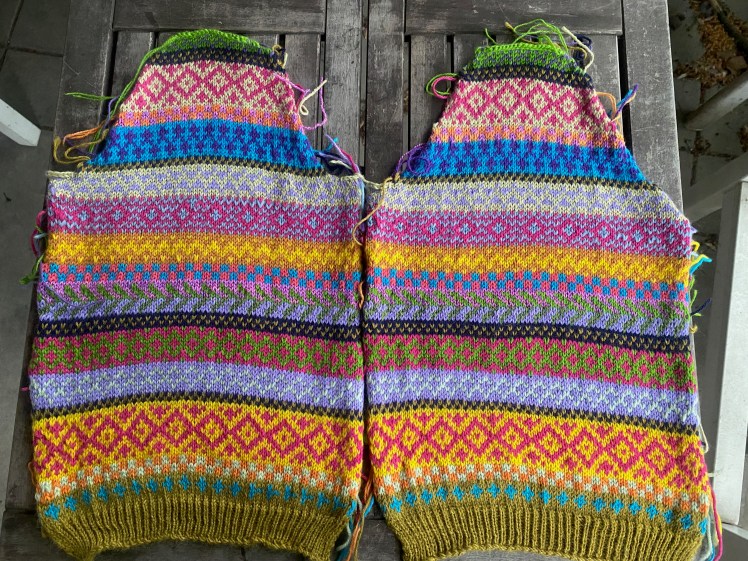
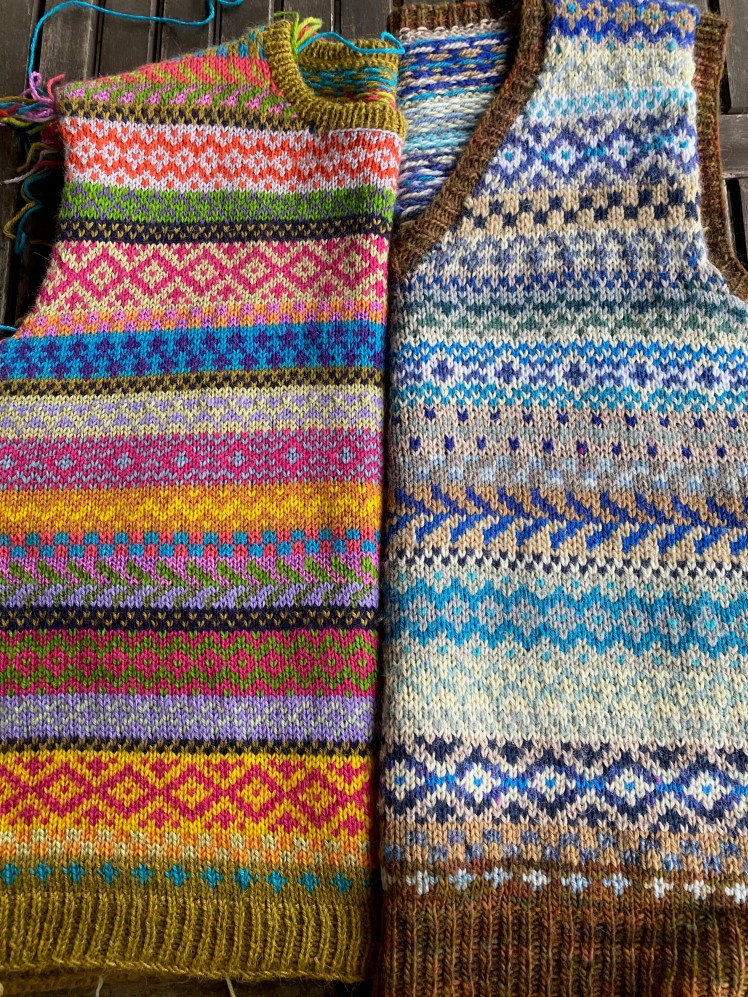
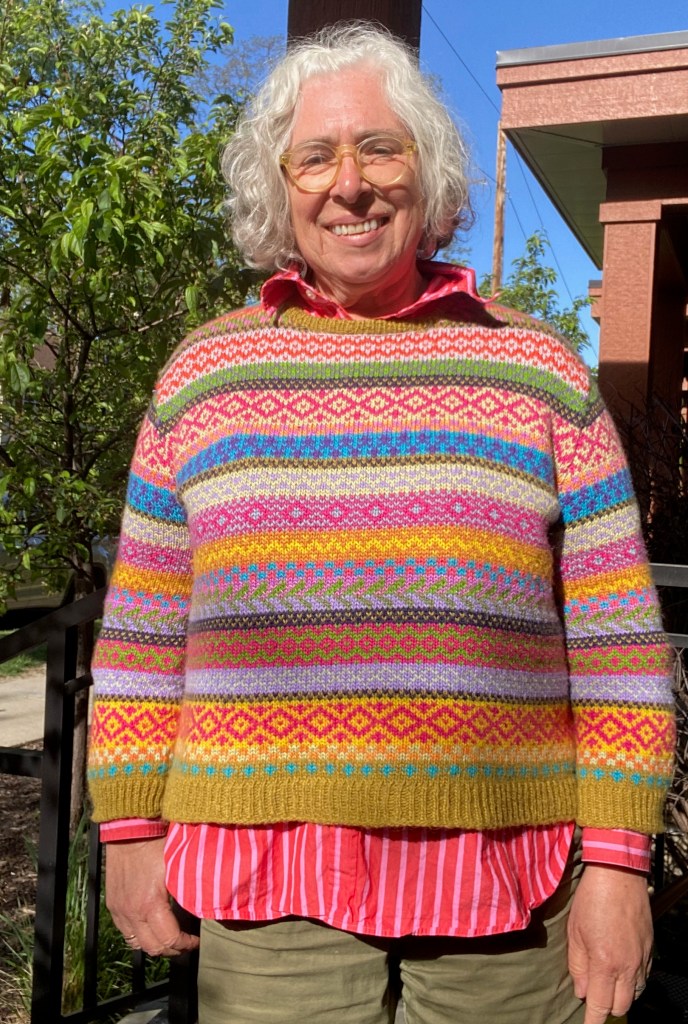
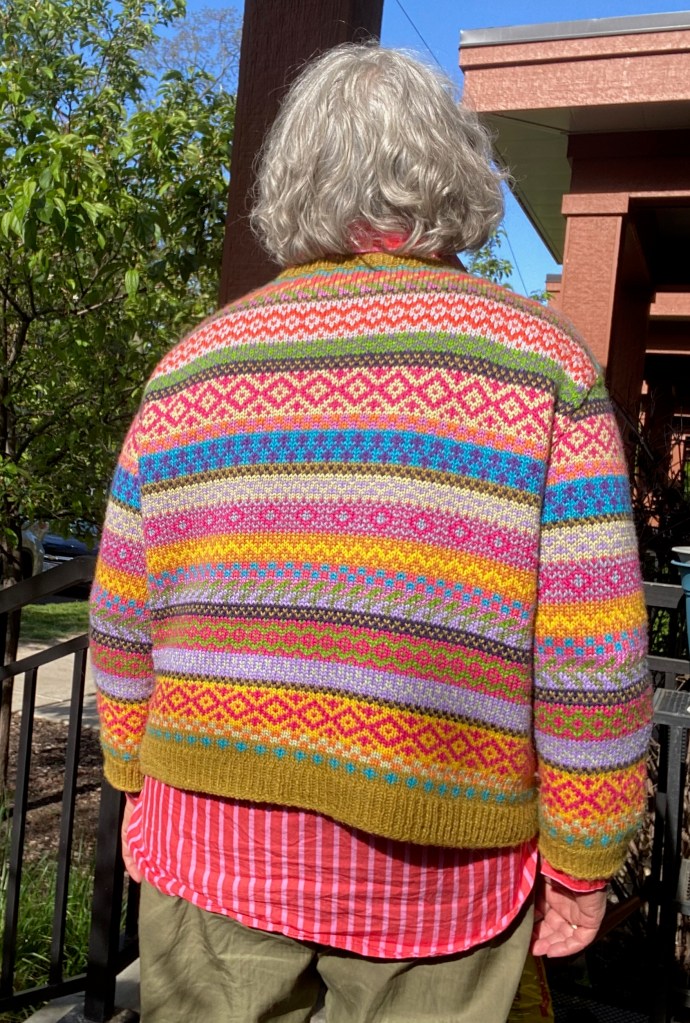
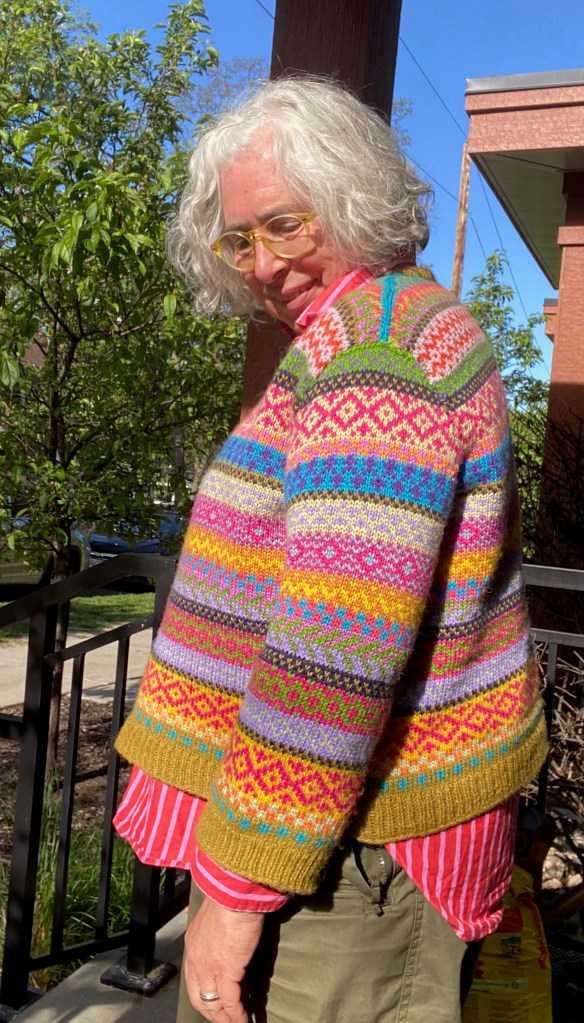
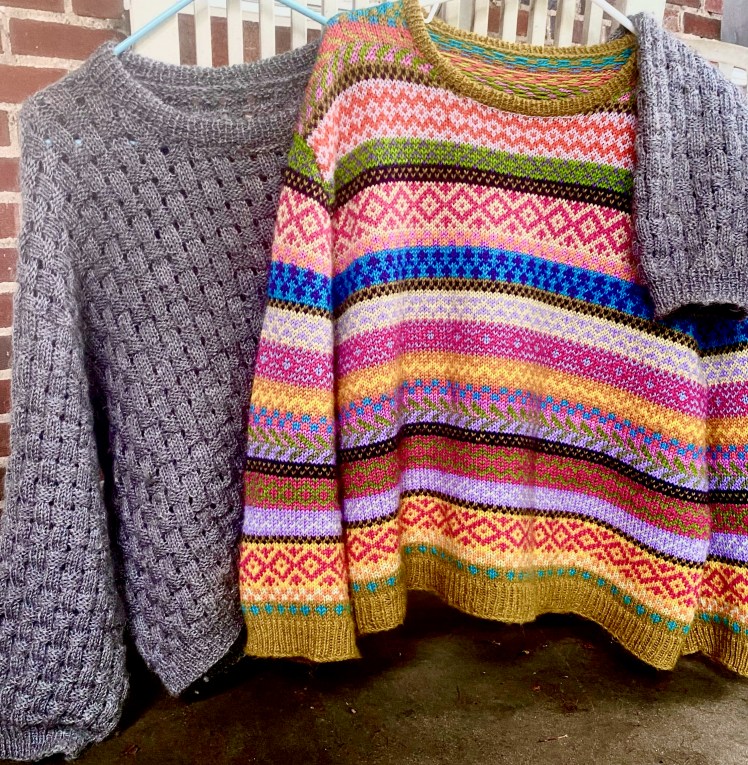
One thing I regret about the sleeves is not making them longer. I mostly used alpaca yarn, which I expected would stretch lengthwise, but the sleeves seem to be defying my stitch gauge swatch and have gotten shorter and smaller. The sleeves fit better and are a bit longer when I’m not wearing a long-sleeved shirt that takes up space. Fortunately I built enough ease into the body that the fit isn’t skimpy, although not as commodious as my gauge swatch told me it would be. On the other hand, the fabric itself is a tactile joy, and the alpaca halo softens the colors and gives them more complexity. I was expecting the colors to be more strident than they are in this configuration. The small patterning, where the colors are generally in a 1-, 2- or at most a 3-stitch alternation, reduces the impact of any one bright color. In this kind of patterning, it’s not hue that makes a color stand out, but contrast. I had much more value contrast in the vest that I made for my husband, which is why the two renditions of the same patterning look so different.
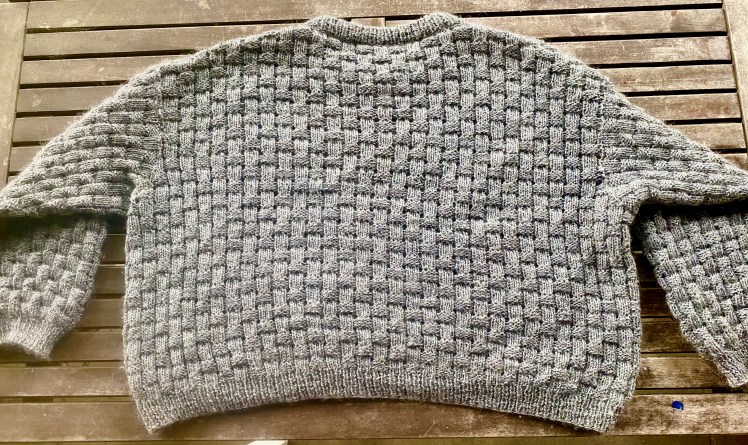
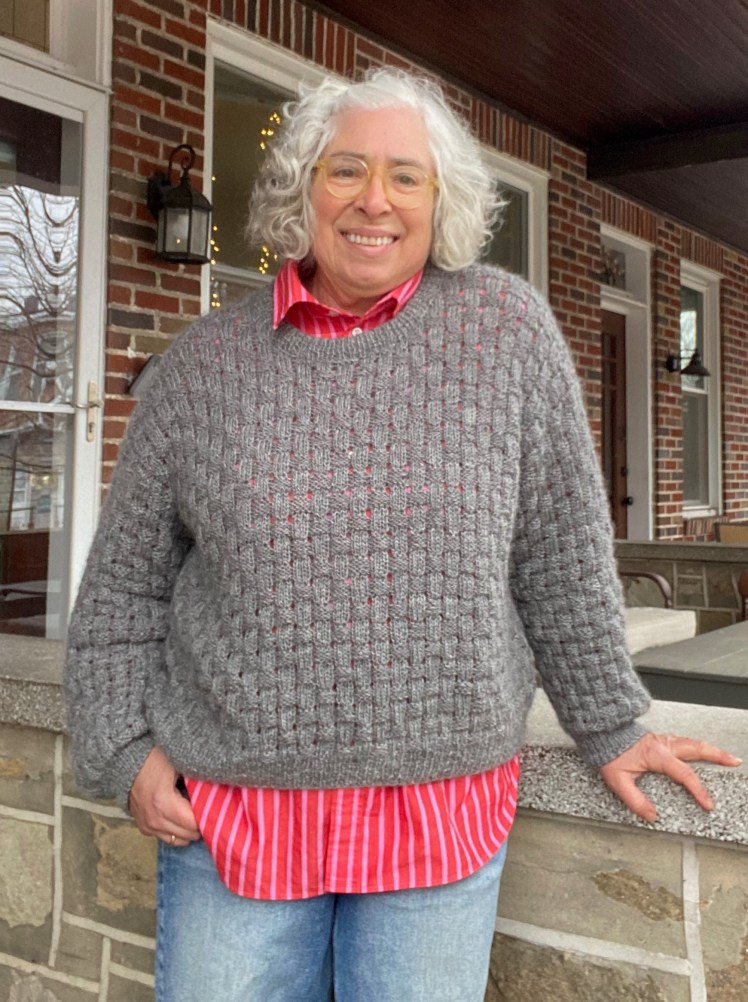
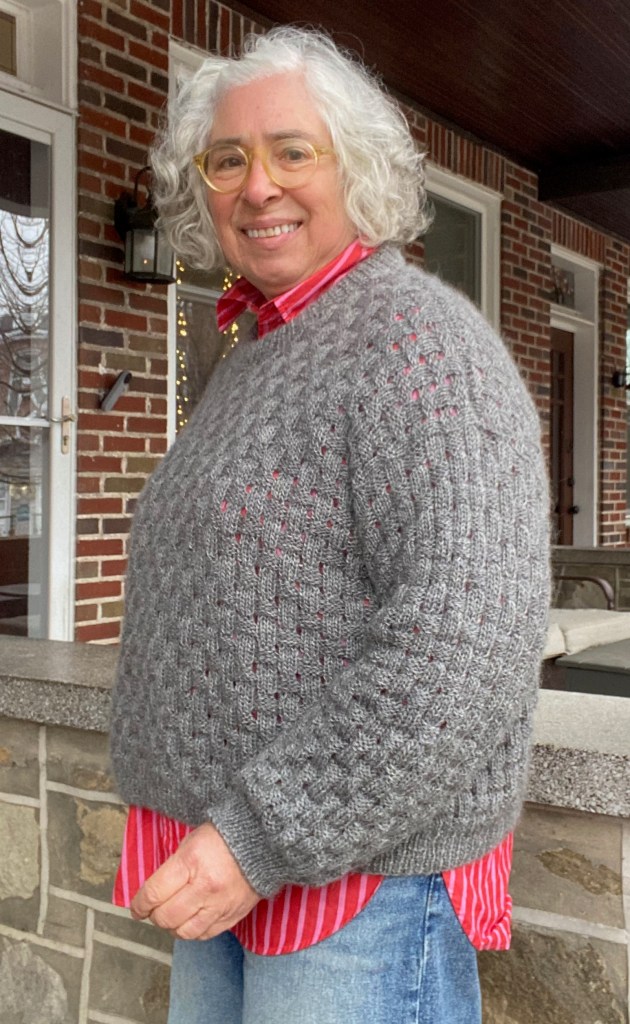
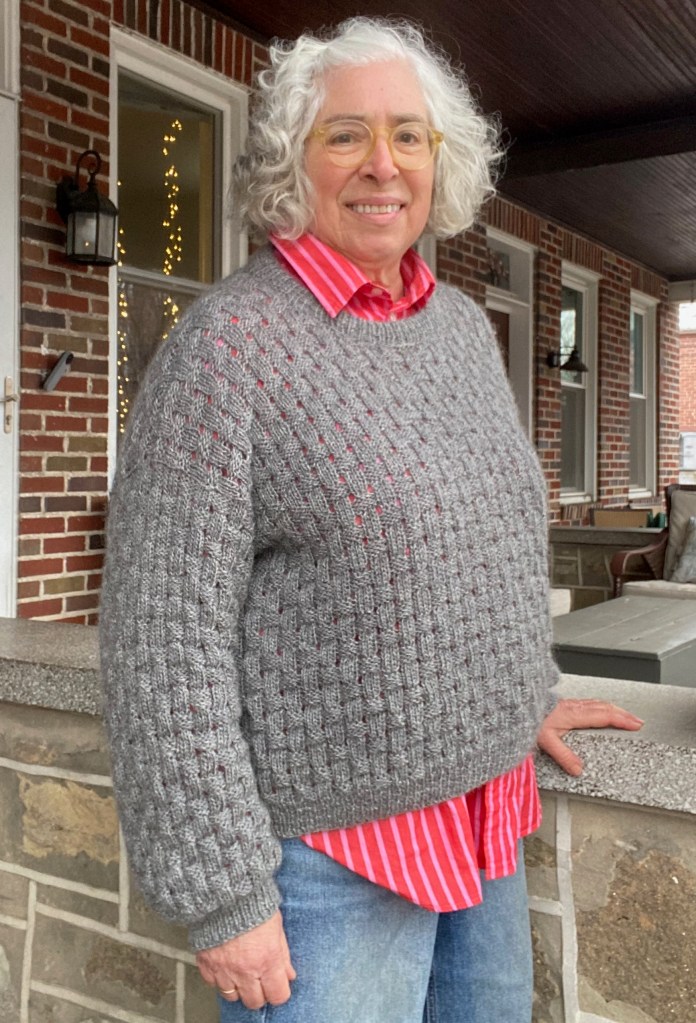
My second finished sweater was actually finished a couple of months before the colorful machine-knit Fair Isle sweater. As I said in the January 2026 Swatchathon post, I resorted to the Willow Pullover pattern by Andrea Gaughan because my yarn wasn’t working in the pattern I had originally intended to knit it in. The yarn is Gotland sheep from Little Valley Farm in Janesville, Wisconsin, and I bought it directly from the farmer at the farmers market at the Wisconsin state capital building in Madison in October 2024. It is silvery gray with a soft halo, and it purports to be DK, but it knits like a sport weight or heavy fingering, which wasn’t working for what I wanted to do. I paired it with an almost-matching Wollmeise lace yarn in superwash merino, and the pairing did work. So I started the pattern and knitted and knitted and knitted. The pattern was accurate but required me to translate it into terms that made better sense to me than the terms that made sense to the designer. It’s my least favorite thing about using patterns, but I have given up expecting designers to think the way I do.
The pattern’s instructions specified the number of rows required for the places that needed shaping, but the stitch pattern gets in the way of a straightforward row count. What I wanted the pattern to tell me was how many pattern repeats I needed to knit in order to accomplish the pattern’s instructions and where in the pattern repeat I needed to end. I figured that out for myself by doing the math and using stitch markers to show starting and stopping points. I was also concerned that the pattern as written was going to result in too low a neckline, so I did some more math and placed my neck shaping higher up in the total number of rows required to make the armhole the right size. It wasn’t until I got to the short rows for the back shoulder that I realized that the designer’s intention was to make the fronts on either side of the neckline about an inch longer than the center of the shoulder line for the European dropped back that is currently in vogue. Unfortunately there are no photos depicting this feature and no verbal description of it. My sweater’s shoulder seam is exactly at the center of my shoulder line, not dropped onto the back of the shoulder.
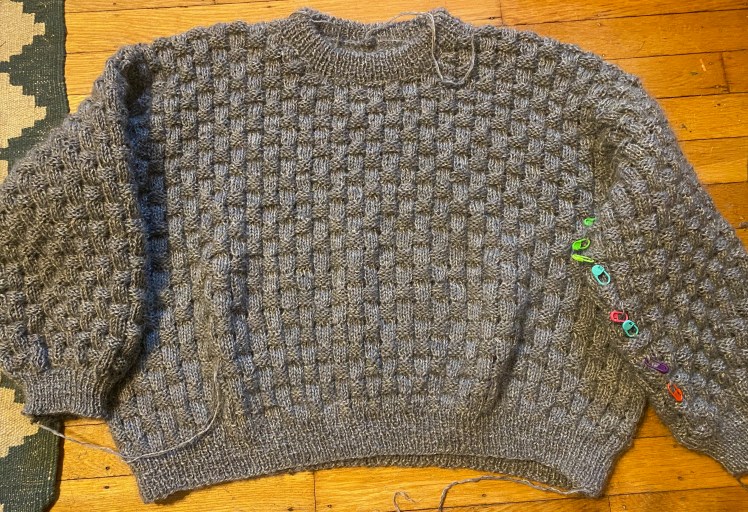
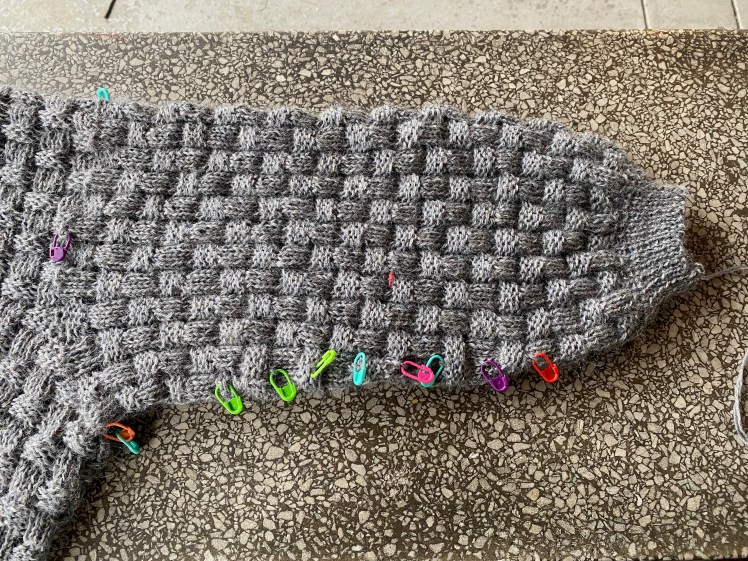
I also found myself doing remedial math on the sleeves when I misunderstood where to start the decreases for the shaping from the lower arm to the cuffs. My failure, not the pattern’s, and yes, I do need the designer to draw me a picture. I started decreasing later than the pattern called for, so I have fewer decreases than the instructions for my size called for. The important thing is that the number of decreases should be a multiple of 4 to enable the final decrease round, K2 K2tog or SSK, to fit smoothly into the stitch pattern. I appreciate the designer’s attention to this kind of detail.
It would have been nice if the designer had communicated her instructions in the terms that I understood without recalculating and translating them to Abby-think, but her numbers are accurate and shouldn’t cause any problems for experienced knitters who are better than I am at following instructions when they don’t know the reason for the instructions, or who just think the way designers think. It was a slog and probably required more brainpower than if I were capable of mechanically following instructions without understanding where they’re going, but I ended up with exactly the sweater I wanted. It has the width-length proportion that suits my height and girth, the neckline is flexible but high enough to prevent draftiness, the sleeves are a generous length and width, the natural color lets the basketweave texture speak eloquently for itself, and the Gotland wool reflects light, with a halo that respects my skin’s sensory boundaries. I long for more of that Gotland farm yarn. Recently I saw the farmer at the Madison State Capital farmers market, who told me that he wouldn’t have any more spun yarn for a year because there aren’t enough mills in the United States for the demand. Now I’m kicking myself for all the times when I didn’t snatch up the yarn when it was available.
I usually work a handknitting project and a machine-knit project simultaneously, and I almost always finish what I start. I’m not one for multiple UFO’s (knitting jargon for unfinished objects). In fact, at this very moment I have two finished garments that are awaiting their blog posts. So sure, I get stuff done, but maybe the bigger news is when I get the blog post done.


I truly have a hard time deciding which I love more: Your beautiful knitting projects, or your exquisite blog posts. When that frightful day comes that you close the blog (I’d say “if”, but of course I know it will come, and I live in dread), I hope you will consider compiling these remarkable essays into a book. It would be a real gift to the crafting community.
….And, I am in love with both of your fair isle sweaters, and though the vest has ‘my’ palette, I also feel the visceral jolt of joy whenever I see that sweater!
LikeLiked by 1 person
I truly have a hard time deciding which I love more: Your beautiful knitting projects, or your exquisite blog posts. When that frightful day comes that you close the blog (I’d say “if”, but of course I know it will come, and I live in dread), I hope you will consider compiling these remarkable essays into a book. It would be a real gift to the crafting community.
….And, I am in love with both of your fair isle sweaters, and though the vest has ‘my’ palette, I also feel the visceral jolt of joy whenever I see that sweater!
LikeLiked by 1 person
Thank you, Tanya!
LikeLike