
This is my 10th annual January Swatchathon, which is an occasion for me to reflect briefly about how my knitting has changed over the years. At first I spent a lot Swatchathon time checking out the range of techniques that were currently trendy, some of which found their way into completed projects, usually garments. Many were one-off experiments after which I told myself, “that was interesting, and now I never have to do that again,” because what I learned from them was that I could find better ways to spend my time. I learned how to crochet during a Swatchathon, and I’m glad to have that skill in my toolkit, but I don’t like crochet enough to pursue advanced skills. In fact, I don’t like crochet enough at the moment to do it at all.
This year I have gone back to basics, mostly hand-knit textures and machine-knit stranded knitting using the LK150 and the Needle Beetle. I have neglected my standard gauge electronic KH965i because right now I want to use heavier yarn than it can handle. But that makes me feel guilty, because I have anthropomorphized the KH965i and view it as a kindly mentor who has to sit idle while watching me cavort with someone else. I’m telling it, I have plans for you, a nice stitch pattern from a hand-knitting pattern to poke into your memory and knit stranded with Wollmeise lace… but right now I’m busy.
One of the features of my annual Swatchathons is a look back at the previous year’s group photo and sort out which turned into completed garments; which got pushed aside by ad hoc projects that postponed their execution, maybe forever; which fell into the category of “did that, never have to do it again”; and which turned into fully functional garments whose technical features become a permanent part of my bag of tricks. This year, I think that pretty much everything is going to turn into a completed garment. A couple are already most of the way to being finished. On the other hand, the swatch that I was planning to knit as my next hand-knit project is being postponed so that I can knit another “soft protest” sweater for the next No Kings in five weeks. I doubt I will make that deadline, but I can try. I have the yarn, I’m working out the plan. But the seeds are planted for postponing the previous “next project” into the indefinite future, and I’m going to try to pull out those seedlings before they take over all of my time. After I finish this queue-jumper that is demanding to be knitted ahead of everything else.
I have a sweater quantity of silvery gray Gotland yarn that I got at the Madison, Wisconsin farmers’ market in October 2024. I swatched it during the January 2025 Swatchathon in tuck stitch, first on the LK150 and then on the KH965i, and it didn’t work. Back into stash it went but I was on the lookout for a pattern that would suit it. I found a candidate in the Pierre Sweater pattern, which had an ornate lace texture that I could envision in the soft silver of my lovely farm yarn. The yarn disagreed. I went down a needle size and tried again.
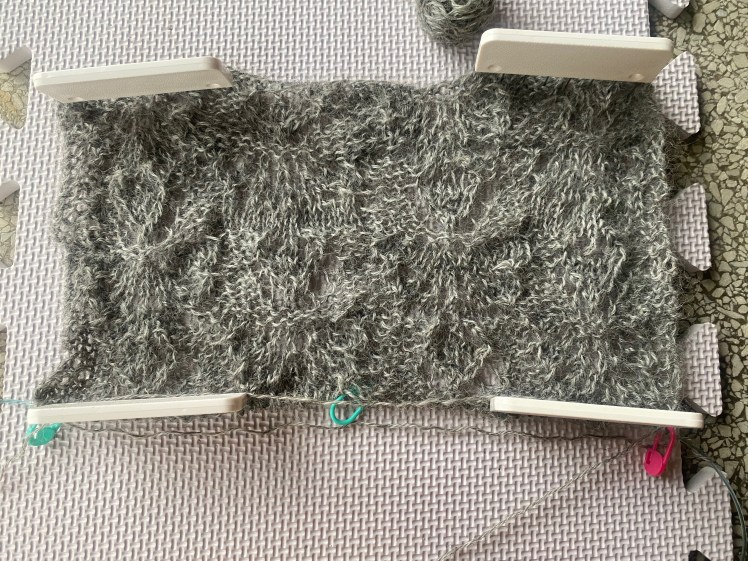
The hairiness of the yarn was obscuring the legibility of the patterning, but what if I beefed it up with a smooth merino superwash Wollmeise lace? I found a skein that was almost the same color as the farm yarn and tried again.
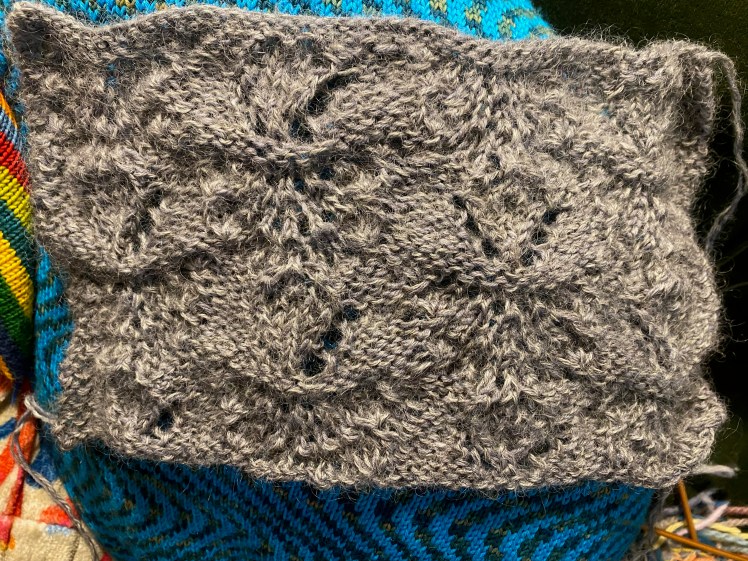
Better, but no. This yarn was not destined for ornate lace patterning. I did like the fabric when I doubled the Gottland with the Wollmeise lace, and then I came across a pullover pattern with a trendy basketweave stitch pattern in simple knit-purl emphasized by yarnovers and directional decreases.
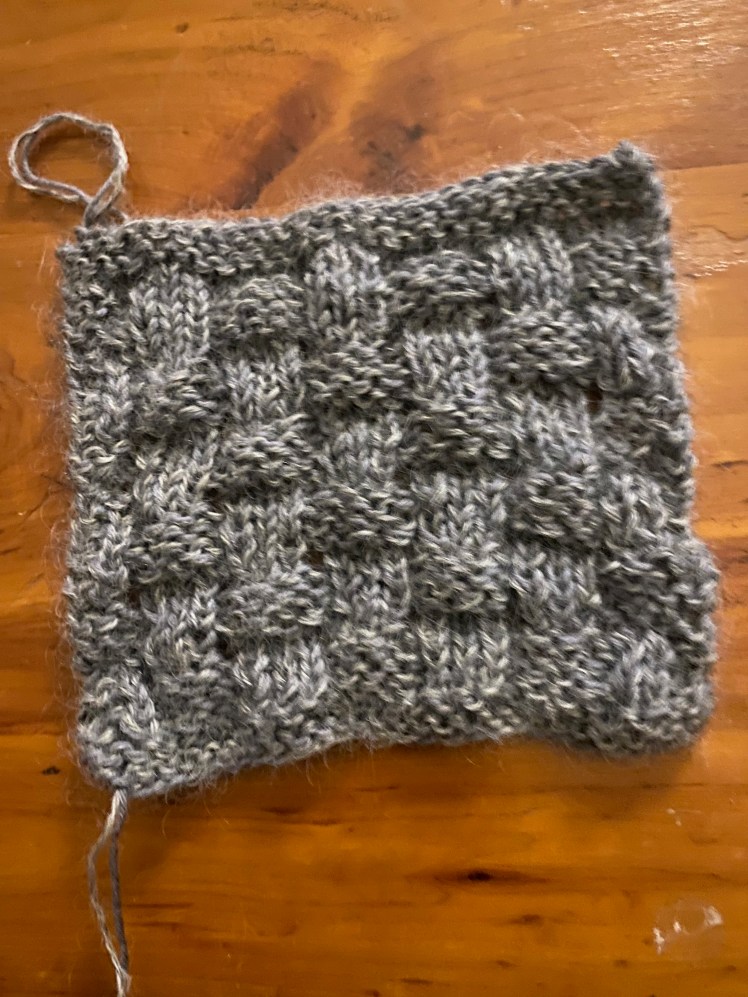
We have a winner for the Wisconsin farm yarn! Now I wanted yarn for the Pierre Sweater pattern. Melissa brought me along with her to the Alpaca Yarn Company in York, Pennsylvania to pick up yarn for her trunk show, and I picked out a sport weight alpaca blend in a pale sky blue.
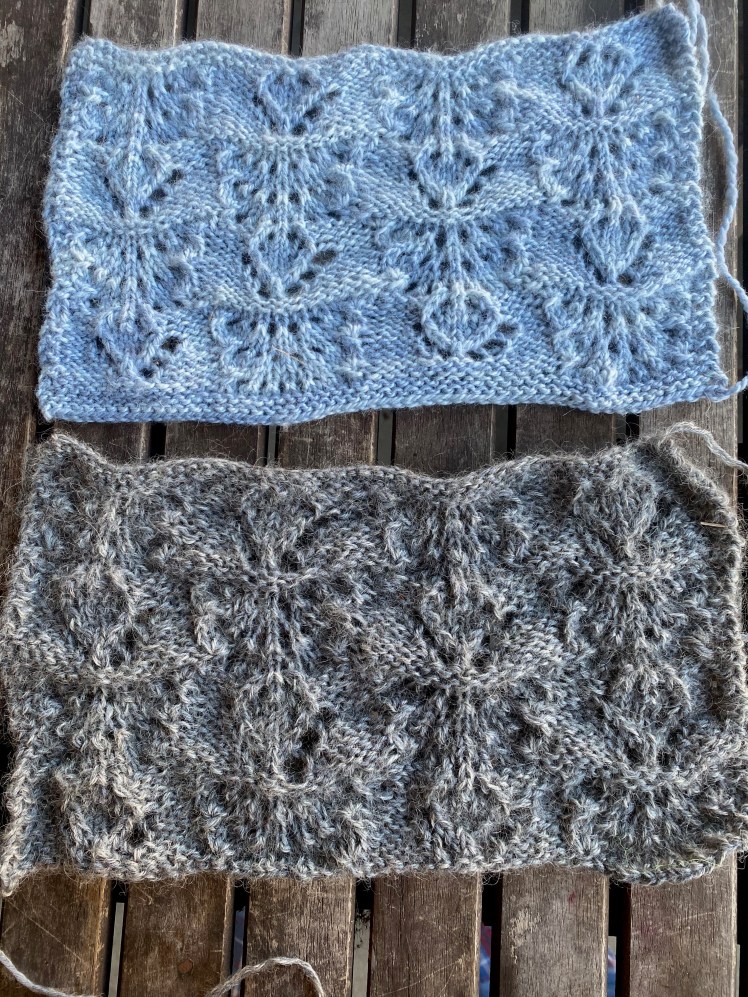
Yes, the stitch pattern reads in the blue alpaca. This is the project that is being preempted by the protest sweater.
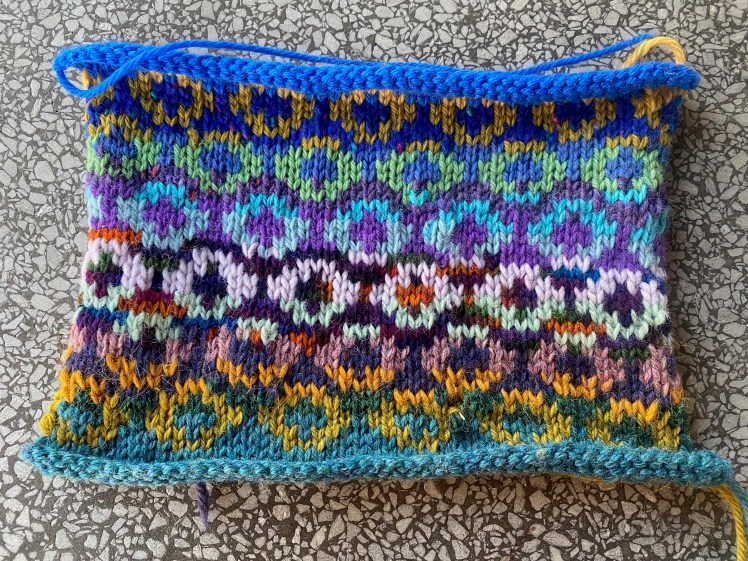
I have been interested in using random-ish strands of yarn in “magic ball” combinations that contrast with each other, in small geometric stranded patterning à la Kaffe Fassett. I discovered during the year that spit-joining was an effective and relatively low-effort way to join non-superwash yarn together while I was in the midst of knitting on the machine, and that it was convenient to do it while the work was in progress. This spared me weaving in a lot of ends once I discovered this trick. Now I wanted to do this with a lot of mid-row color changes and a lot of different colors without having to spend hours ahead of time to spit together entire balls of arbitrary scraps.
I charted an 8-stitch repeat of a circle with a smaller circle-ish shape inside it and tried it out on the LK150 with the Needle Beetle. Since I was adding colors within a context of an in-progress composition, I found myself doing a lot of smooth transitions from one color to another. In the end, even the colors that I thought might break up the gradients seemed to blend in, because I was choosing colors that were somewhat-to-very muted.
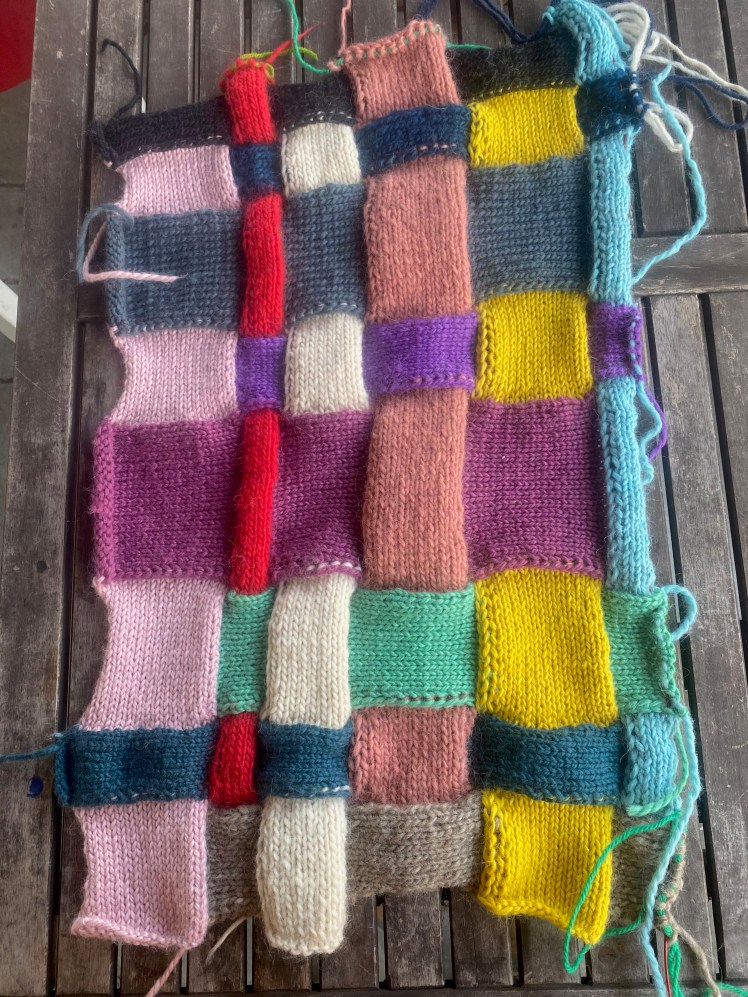
In the meantime, I was working on a hand-knitted piece that was based on colors of the Illimani Llama 2 colors that I snatched up at Lovelyarns after finishing my second Ogawa sweater. My original plan had been to improvise a machine-knit intarsia design for a birthday sweater for my older daughter, but the yarn was too bulky for the LK150 intarsia carriage to accept. When I looked at the colors of the yarn spread out together they reminded me of the way Norwegian designer Ingunn Birkeland composes plaids in her CITY series, in combinations of soft pastels with shocks of black and white and dissonant colors. It’s a very distinctive use of colors that I wanted to understand better. I decided to buy the CITY Basket Balaclava pattern so that I could try to fit my colors as closely as I could into Ingunn’s plan.
The pattern describes its technique as a kind of entrelac, but I see it much more as simple modular knitting, aside from the fact that entrelac likewise uses modular joins. My quibble is that I see entrelac as keeping the entire expanse of the knitting on a needle as you make your way across bias-oriented diamonds, whereas this method works one rectangle at a time while everything other than the rectangle in progress and the rectangle you’re joining it to are off the needles, stitches either bound off or held on waste yarn. Maybe that’s a pretty feeble quibble. I have a rigid notion of entrelac as diamonds knitted on the bias.
I knitted my version of the first chart of the pattern in colors that sort of approximated the designer’s colors, but my colors weren’t as good as the designer’s. I ended up with a piece of knitting that is the size of one quarter of an enormous pullover body, which I think I’m going to put together with three other similarly sized rectangles in the format of Junko Okamoto’s Kurt pullover, whose shaping comes from leaving the upper parts of the rectangles disconnected from each other front and back so that the slits form a V neck when there’s a body inside. The double-decreased ribbing around the slitted opening does the work of angled short-row shoulder shaping by pushing the left and right sides away from each other and down the shoulder from the neck to the upper arm. As for my colors, I think I can salvage them when I do the other pieces if I don’t repeat the muddy colors and replace them with more repetitions of the pastels, purples, vermilion, and black and white. Now I understand the structure and construction of the plaid. The sweater is going to be too long for me, but my older daughter is interested in it. I’m hoping to get back to this project in the summer.
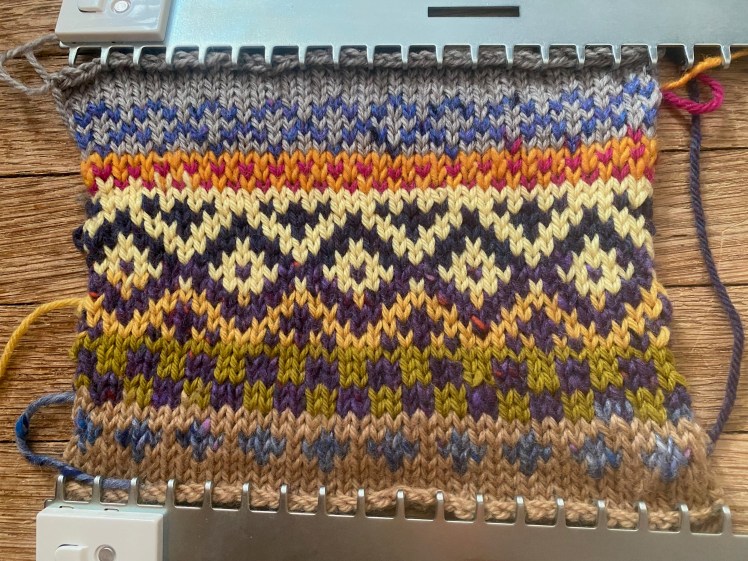
Our January was unusually cold for weeks without interruption, and our new mini-split HVAC system falters in such sustained cold. I started wearing my cats vest under other sweaters day and night, and my husband dug out a moth-eaten vest that I made him 30 years ago. That shamed me into devising a new vest for him that fits him and doesn’t have holes, and fortuitously the Ottavia Sweater pattern made its way into my Ravelry friends’ activity. This sweater is bottom-up traditional Fair Isle stranded patterning with 8-stitch repeats, perfect for the Needle Beetle! So I knitted up a swatch with a few of the motifs, using colors that I connected with a spit join. Charles’ vest is on the machine in a different colorway.
The next swatch was a hand knitted cable stitch pattern using a tweed yarn that I had bought for a machine knitting project, but once again, my yarn didn’t work on the machine. I have enough of it for a heavily cabled slipover vest. With the plan of fitting a cable pattern into a vest shape, I tried my yarn out on the chart for a sock pattern called Bilbo’s Rings, which was inspired by that opening scene in The Hobbit where Bilbo is sitting peacefully with his pipe blowing out a stream of perfect little rings. I was pondering a loose, short vest shape, maybe knitted top-down from a European dropped back shoulder where all the shoulder shaping was located. I liked the stitch pattern and I liked the yarn, but I didn’t them together because the bumpy texture of the yarn camouflaged the texture of the stitch pattern in direct light. I took this picture in dim light.
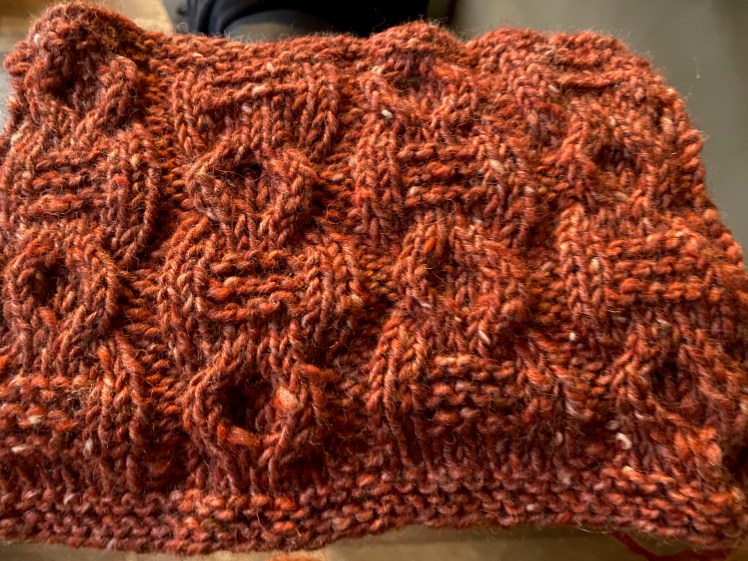
I’m still committed to using this yarn in a cabled slipover vest. I think that the reason why Bilbo’s Rings doesn’t show up in direct light might be because the yarn needs more reverse stockinette space between cabled motifs, so that the in-between space can sink down and the motif can rise up. I remembered that Irene Lin, who had written the most perfect pattern I have ever used, has done a lot of work with cabling and slipover garment shapes. Her Myra Vest pattern checked all of my boxes, lots of cables with plenty of negative space, European dropped back shoulder, the right proportion of length and width in the garment shape, and the likelihood that her instructions would make immediate sense to me. Why reinvent wheels when someone else has already done it right?
I ended this scaled-back Swatchathon with a final machine knit swatch, a tucked bubble stitch knitted in the same red yarn that I used for my Minneapolis solidarity Melt the Ice hat. Here’s an article on the background for this solidarity action.
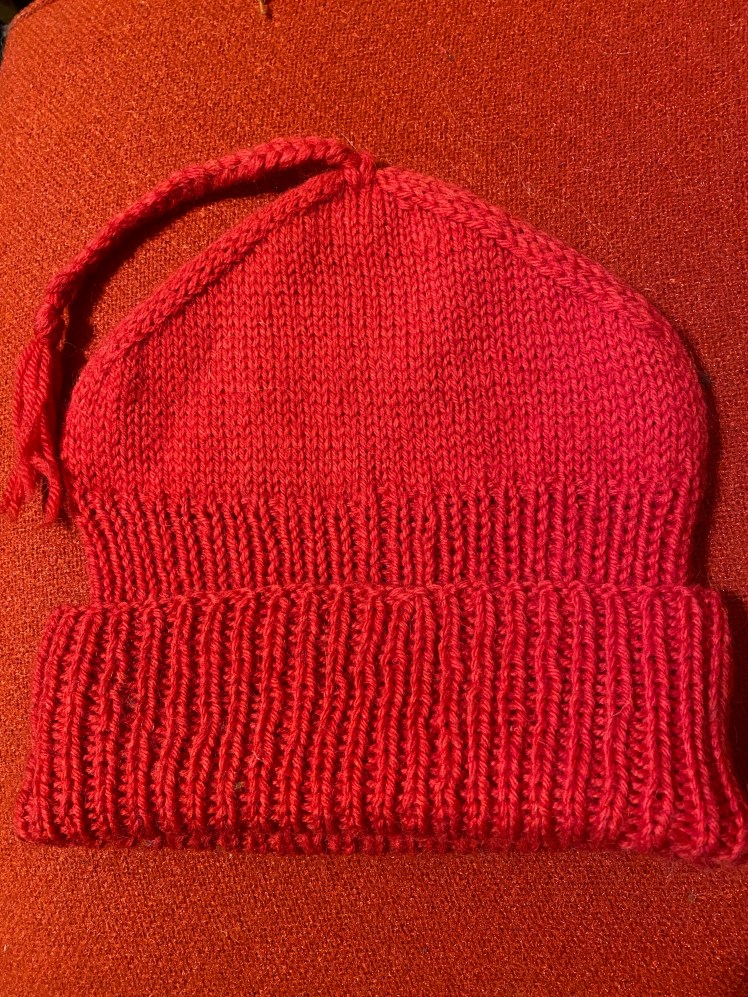
The yarn is a basic, standard non-superwash worsted, Universal Deluxe, in a watermelon-tinged bright red that I really enjoyed looking at when I was knitting the hat, and my LK150 really enjoys knitting this yarn too. My plan is to plug the stitch pattern into the numbers for a hand knitting pattern, Hechima Collar Sweater, a pullover with a dropped European back, a shawl collar, and the width:length proportion that I like. My gauge on T6 matches the stitch gauge for the pattern, although the tuck stitch has made my row count more compact than the pattern’s row gauge. It will be easy to adjust that if I want to.
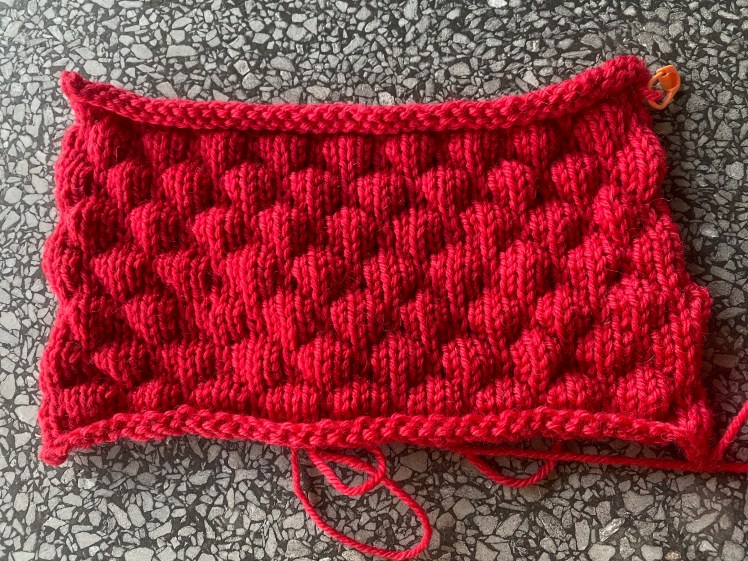
January 2026 Swatchathon Class Picture
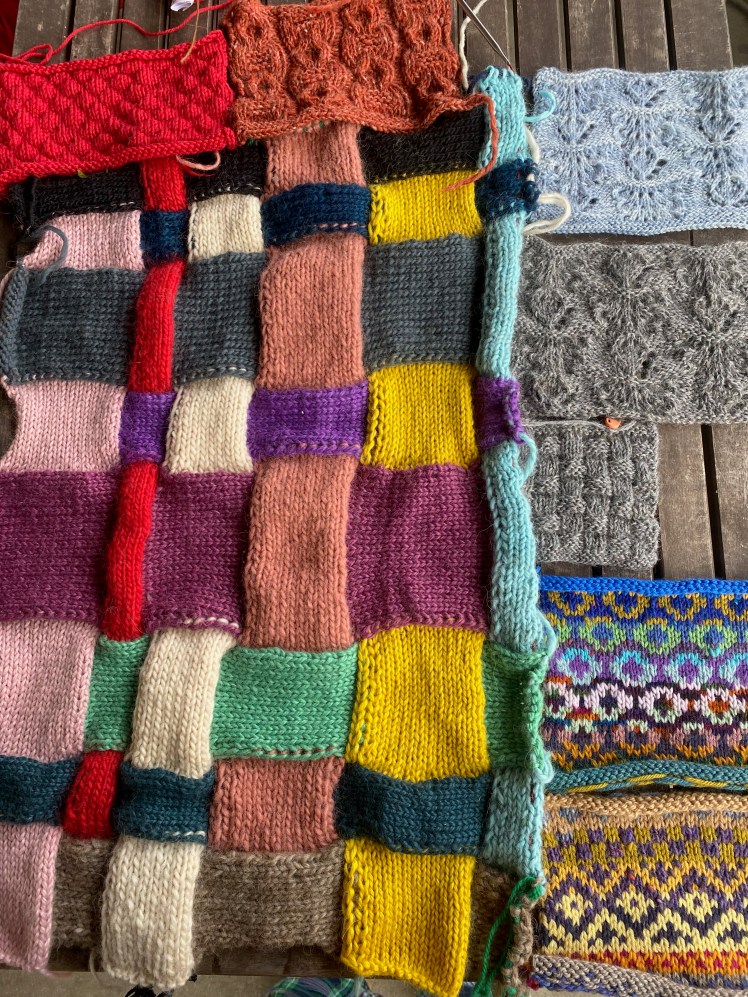
January 2025 Swatchathon: Where are they now?
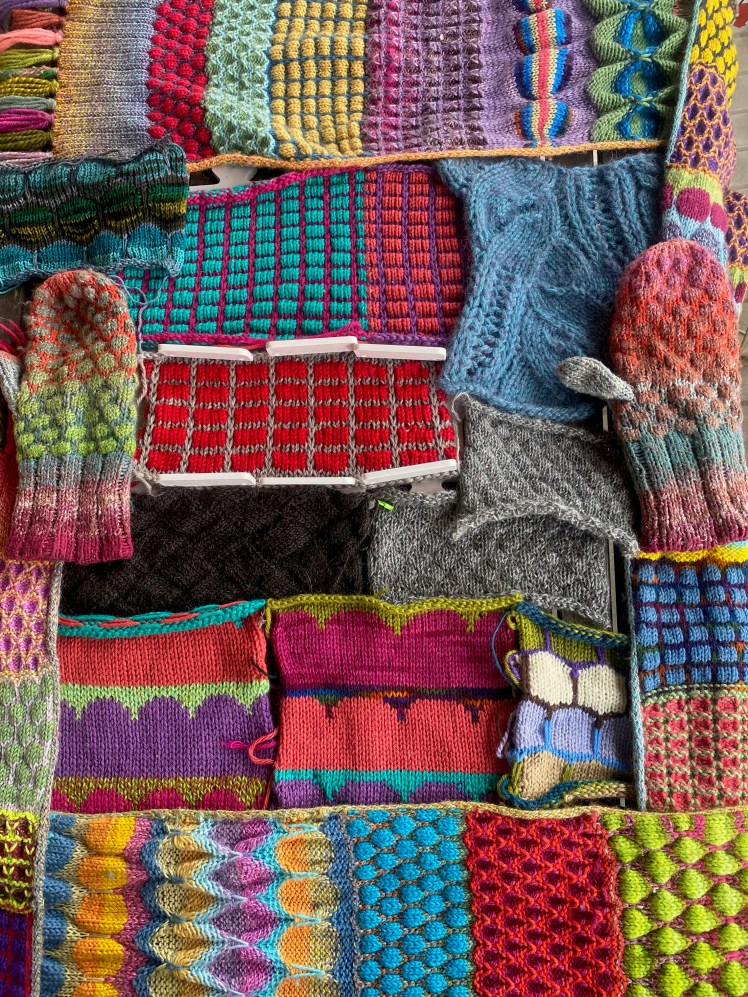
As always, I got a lot of information from the 2025 Swatchathon. This time the lesson disturbs me a little, because I might be getting old, jaded, and unadventurous, and that lesson is that I have lost my enthusiasm for fussy, fiddly, hard-to-manage techniques just for the sake of saying I did them and made them work. The entrelac in dark alpaca yarn? Nope, too much work, too little enjoyment. Same with the Alison Dupernex tuck stitch circles, especially after using the technique for a birthday present for my oldest sister. It’s nice, but it was stressful, and I’m done.
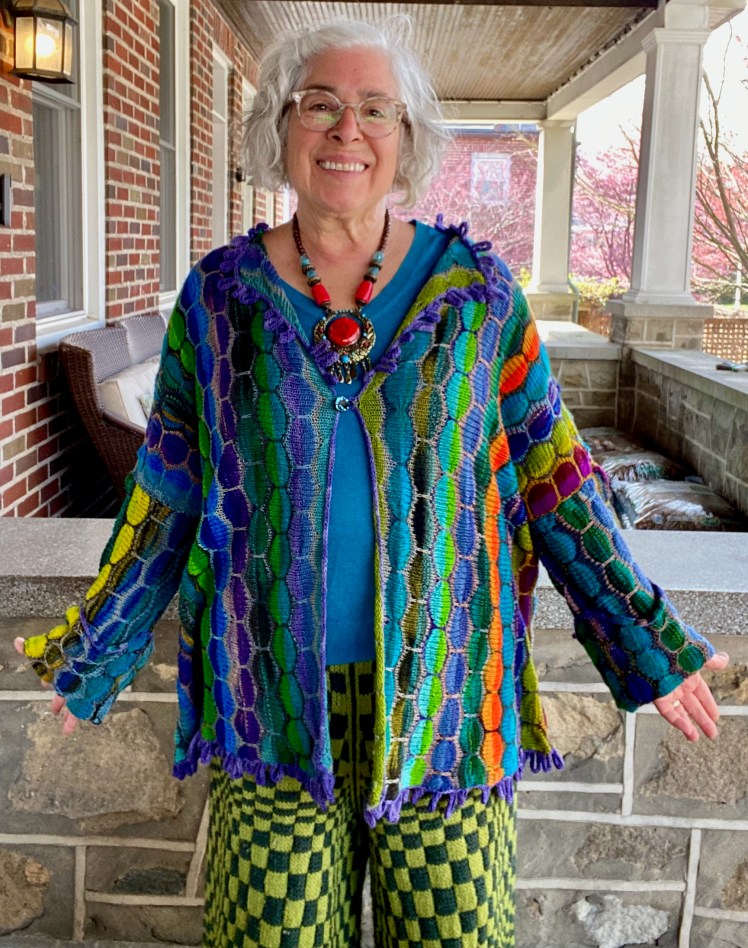
I do wear the sampler scarf every day in the winter but I have no urge to do the big circles again. The small tuck stitches in circles, bubbles, and squares, yes, they’re definitely worth the effort, but I didn’t apply the idea to a garment this year. The machine knit slipped stitch swatch is probably not something I’ll use in that large hexagon configuration, because I can see that long slipped stitch getting snagged on something. But smaller patterning could be viable.

The 2025 machine knit swatches using the Wisconsin farm yarn showed me what the yarn couldn’t do, and I used the information to arrive at the combination with Wollmeise lace as I explained above.
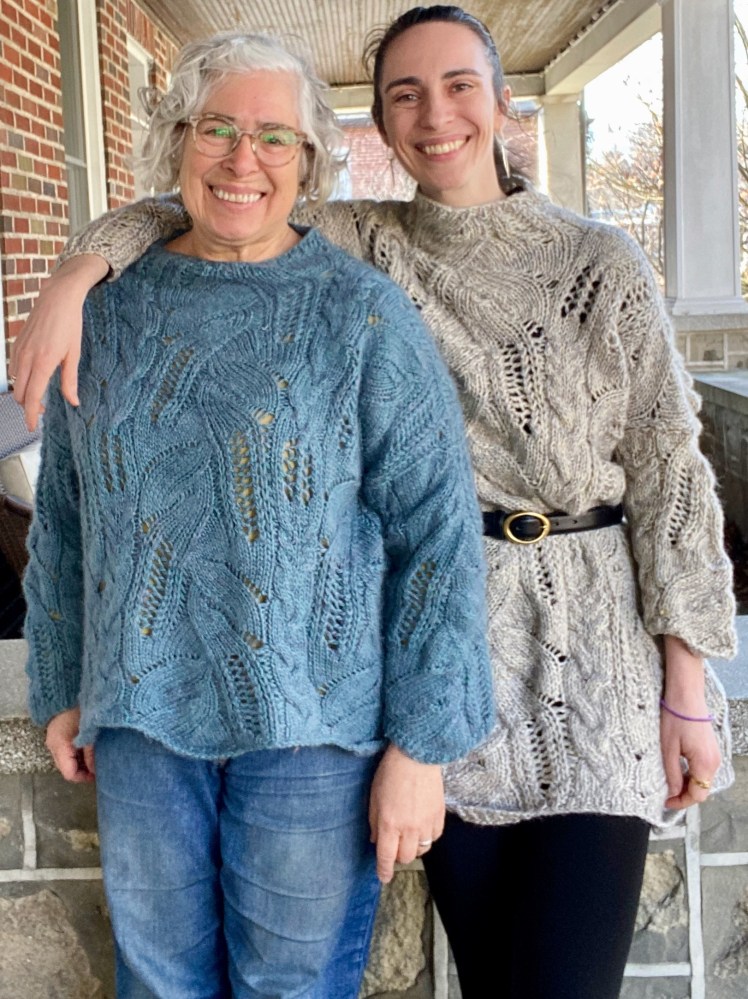
The blue-gray cable and lace swatch turned into a sweater that I love to wear, as well as a precursor sweater that I gave to my older daughter.
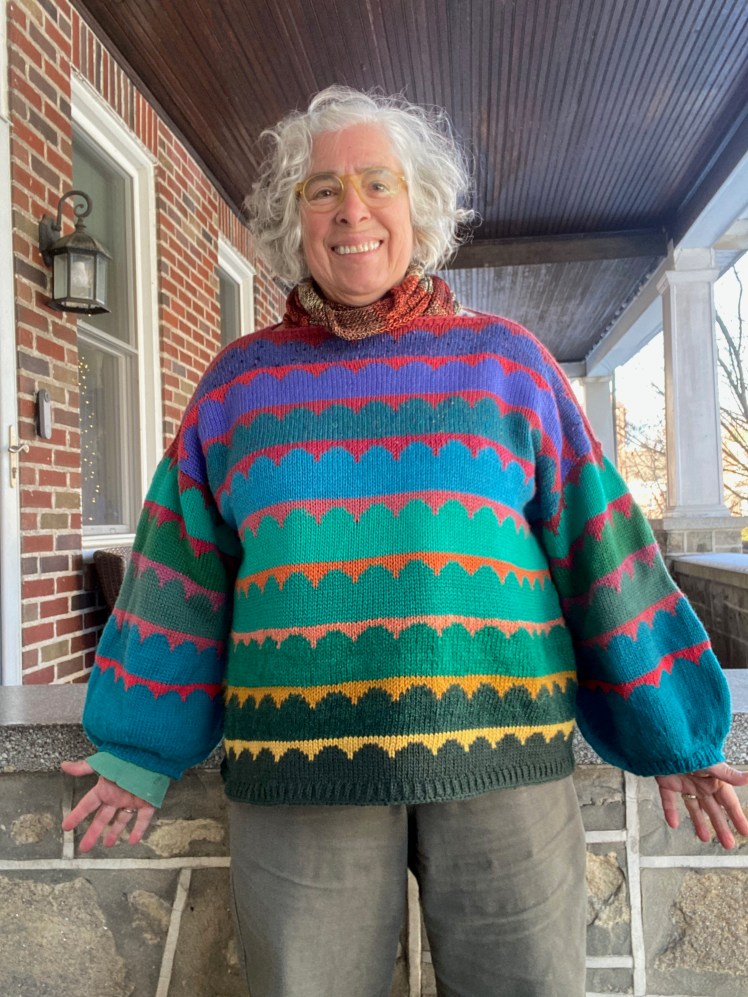
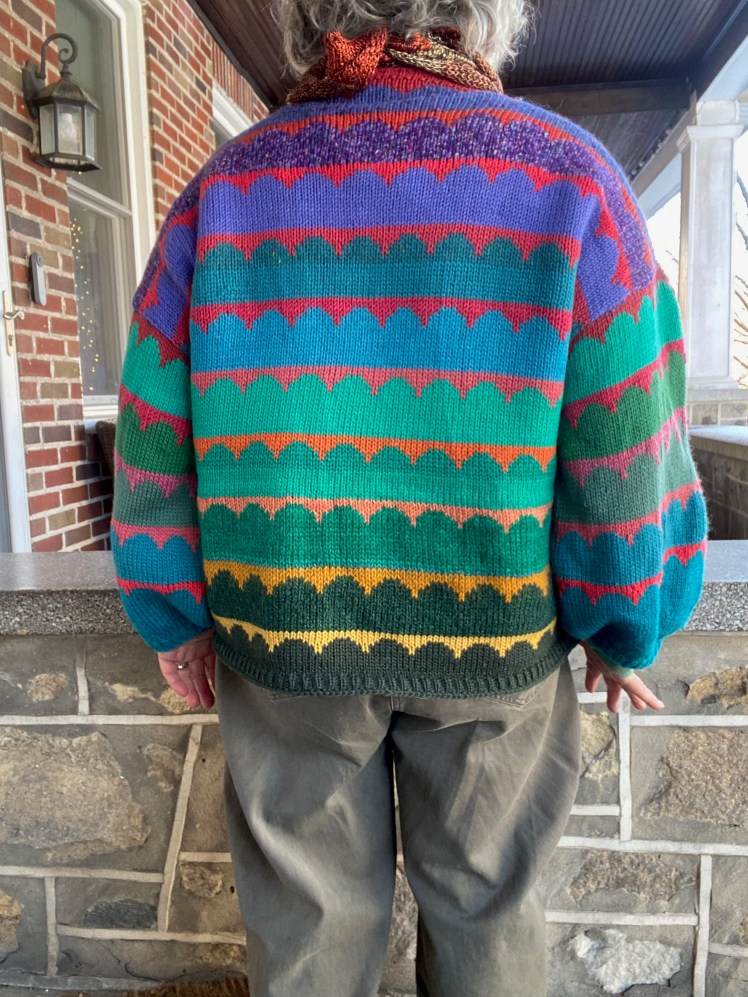
The winner of the dark horse prize for Swatchathon 2025 is that pair of stranded aqueduct shapes that I knitted on the LK150. I tried following the instructions in the manual for two-pass stranding and got completely flummoxed. But that experiment led me to the Needle Beetle, which I have mastered, and which taught me how the levers work so that I can do stranded knitting in two passes in any patterning I want, although I’m still interested in the 8-stitch limitation that the Needle Beetle imposes. Last year’s Robinia swatch actually turned into a machine-knit Robinia, and it came out beautifully. It’s a story I’ll tell in my next blog post, but here are a couple of photos.
Time passes and people change over time. I’m a bit uncomfortable about feeling that I no longer have the enthusiasm for conquering unfamiliar, complicated techniques for the thrill of the conquest. My hands, eyes, and brain still function at a high level, but I’m becoming more product-oriented rather than process-oriented. The functionality of a garment is the most important thing to me, and if the techniques don’t enhance functionality, technical pyrotechnics don’t pique my intellectual curiosity anymore. I’m a little sad to admit that.
I was all set to end this post yesterday after that last sentence, with a lament for a perceived first sign of mental decrepitude, and then I was out walking and thinking about all the things I still had to do during the day, my weekly political sign wave and a memorial service for a friend’s ex-husband, and I realized that I’m living in extraordinary times and managing to stay sane, productive, and cheerful nevertheless. Maybe there’s some other explanation for not seeking out crazy new techniques during January Swatchathon. Like mental exhaustion. There’s a lot going on right now. Something has to give.
 The Interior of My Brain: A Knitting and Fiber Arts Blog
Your postings are absolutely joyful! The colors! I live in Texas, but I still found and bought the pants pattern you made and are wearing. Thank you.
LikeLiked by 1 person
Thank you for the compliment!
LikeLike
“Maybe there’s some other explanation for not seeking out crazy new techniques during January Swatchathon. Like mental exhaustion. There’s a lot going on right now. Something has to give.”
That’s exactly it. You’re doing a LOT. Living through these times is a LOT. Be kind to yourself. Knit what feels good. Hugs.
LikeLiked by 1 person
Thanks, Kim! I shouldn’t need permission to do that, but habit says I should be able to function as if things were normal when they really, really aren’t.
LikeLike
Great post and love your fiber art journey!
LikeLiked by 1 person
Thanks so much!!!
LikeLike