
This spring we undertook a massive decluttering and refurnishing project to return our two spare bedrooms to functionality after having used one of the rooms to store 25 years of junk. The other room was our daughters’ childhood bedroom, still full of their stuff a decade and a half after the younger one flew the nest, plus my knitting machine and a ton of yarn. We spent two months sorting, culling, taking things to the dump if we couldn’t donate them, then buying and installing new shelves and cubbies to store the survivors, and we refurnished one of the rooms to serve as a guest room. My husband’s part of the effort was the boxes and boxes of papers and books. My part of the effort was my stash from the ’80’s and ’90’s and odd bits of knitting through the decades. I unearthed and handled a lot of stuff and thought of ways to bring new life to long-abandoned things.
In the process of sorting, I found a sweater I had made from my pre-Kaffe Fassett era (early/mid ’80’s), when I was knitting stitch patterns from Barbara Walker’s stitch treasuries in monochromatic solid yarns, in this case, Brown’s Sheep yarn, which was mothproofed and built for the ages. I remember wedging my head into it once and never again, because back then I didn’t do math and had made the neck too small, so it just lay around forever repelling moths and me. But I picked it up again a couple of months ago, along with a moth-eaten abandoned hat and a pair of worn-out holey gloves, and laid it out on top of the machine-knit face of a sweater from a couple years back, and conceived a plan. The trundle bed we got for the middle room is really too wide to be comfortable to sit on without lots and lots of pillows, so finally that old abandoned sweater had a mission in life.
Toward the end of the process of reclaiming these two rooms, we went to visit our younger daughter, where my LK150 knitting machine lives. I brought yarn from ancient stash with me, and I loosely followed Rebecca Yaker’s machine-knitted face recipe, with modifications to make the lips fuller and the nose longer and bumpier, and a couple of extra inches at the bottom of the piece to sew into the sides of the hat to make a three-dimensional head. I should have used a tighter tension and my fabric was a bit flaccid, so I threw the wet piece into the drier next time we did laundry to felt it. Here’s the before and after.
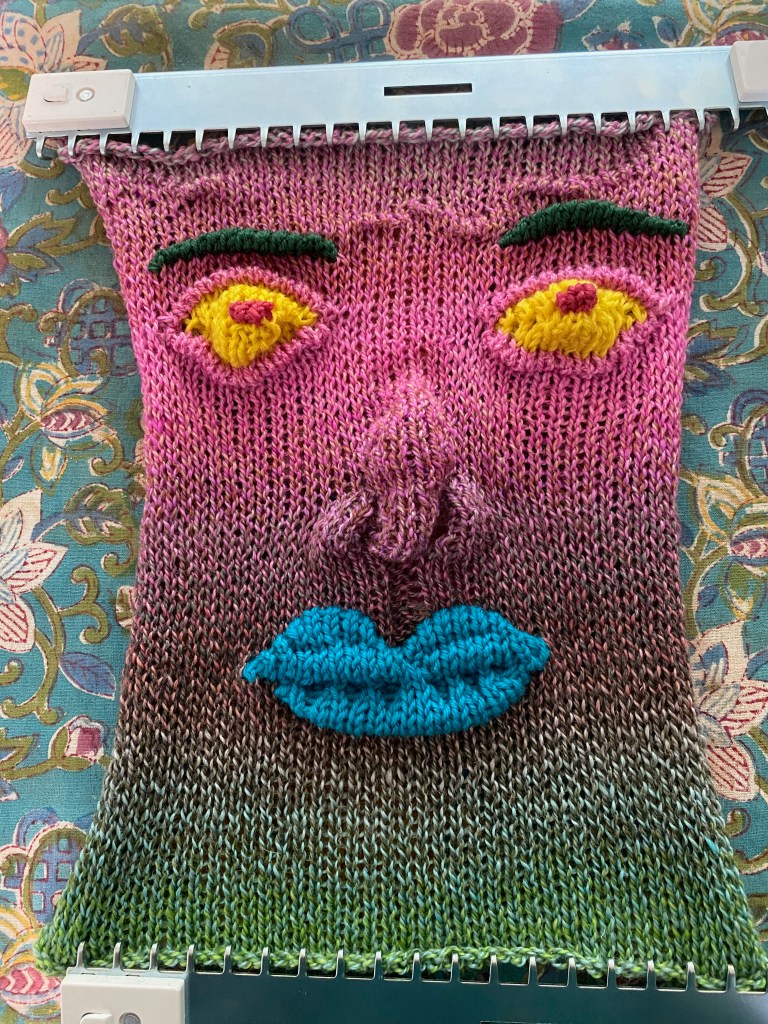
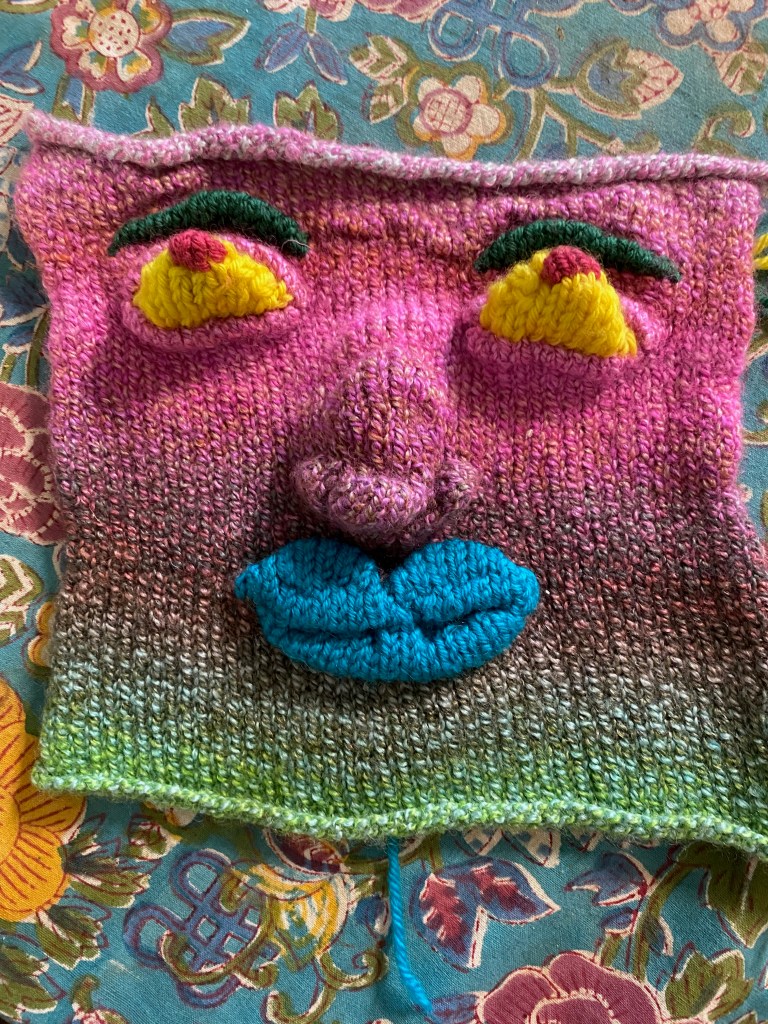
When we returned home from our visit to our daughter, I went to Joann Fabrics and was lucky to find pillow forms that were exactly the right size and shape to fit into the body of the sweater and into the sleeves, as well as a bag of poly fill for the head and gloves. First I put poly fill into the nose and eyes of the face and held it in place with stitches across the openings so that the poly fill didn’t fall out and collapse the shaping of the facial features. Then I mended the holes in the hat. I tried to be tidy but I didn’t try to make the mending invisible. After that I stitched the edges of the face around the circumference of the edge of the hat, and I had enough fabric at the bottom of the face to make a kind of neck at the back, although there wasn’t enough for much of a chin. This changed the face’s expression from benevolent if weird friendliness to haunted tragedy. Next I stuffed the poly fill into the hat and face to form the head. It took a lot more stuffing than I was expecting to get a head shape with enough substance to serve as a cushion, and it expanded the hat into a kind of a turban.
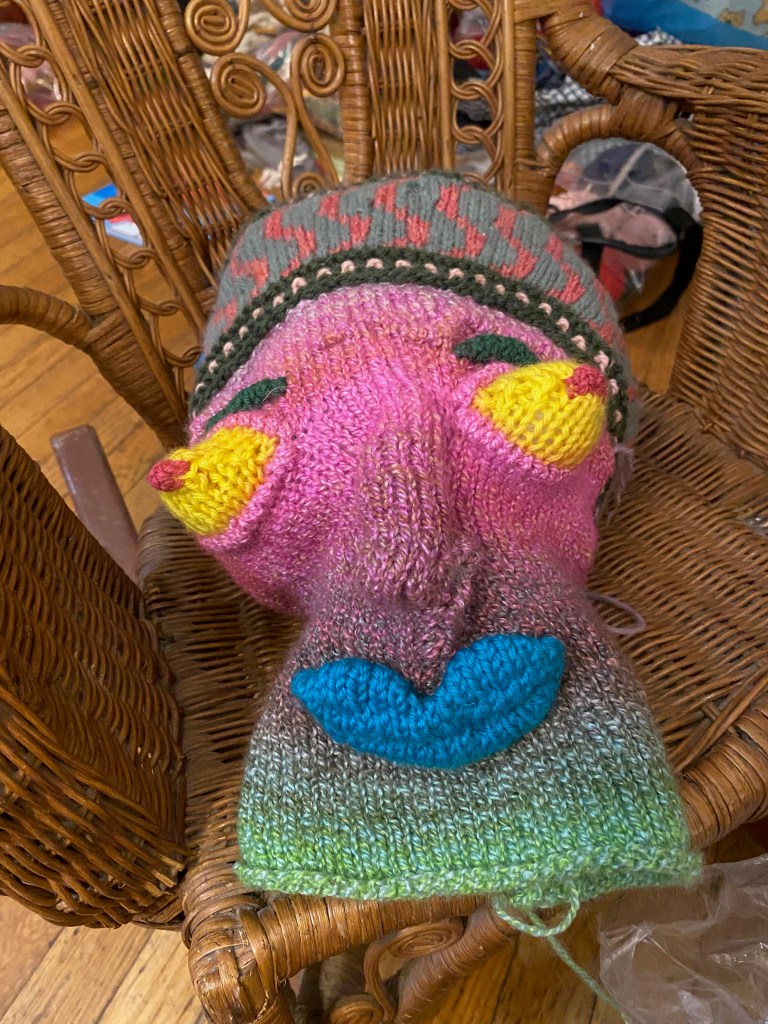

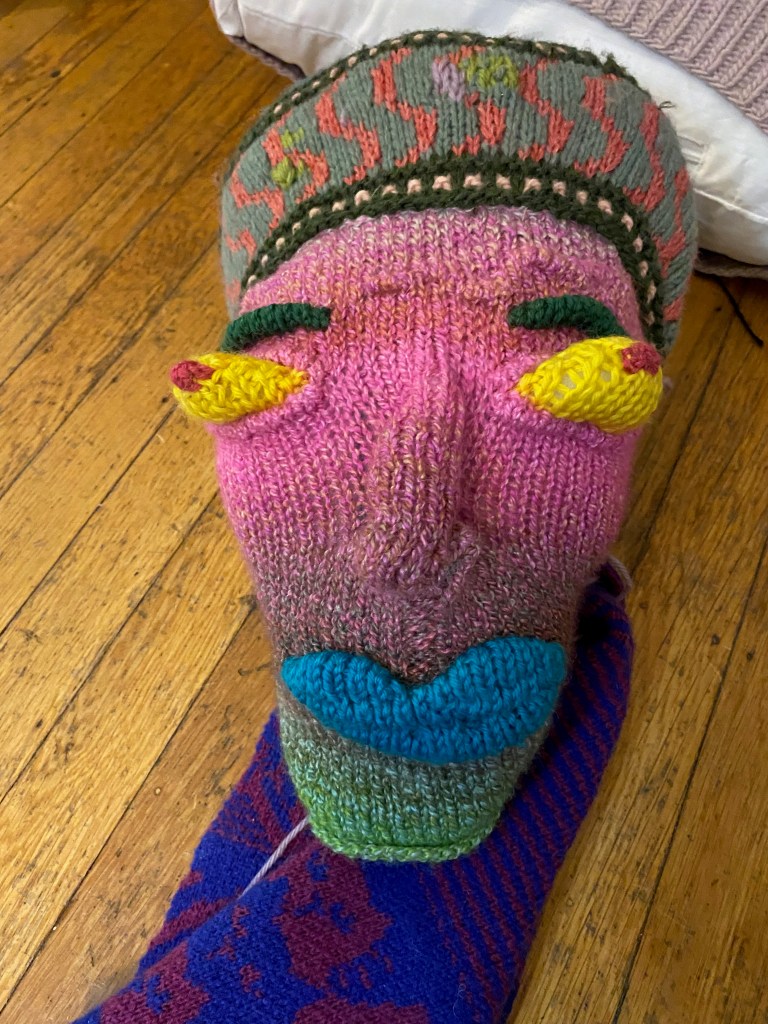
After stitching the bottom of the face to the collar of the sweater, I stuffed the bolsters into the sleeves and the square pillow into the body of the sweater.
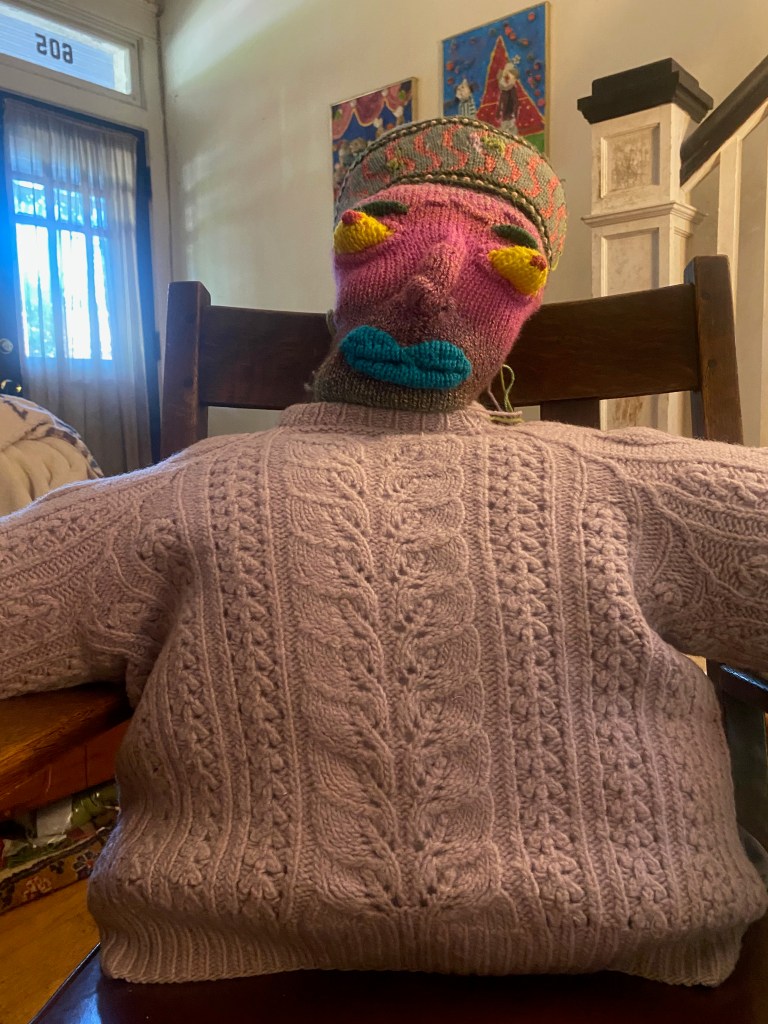
The neck needed a scarf for structural reasons as well as aesthetic reasons. My friend Tanya had knitted a long swatch of various tessellated cat patterns to show me how to input patterns into my electronic Brother knitting machine. She used double bed jacquard so that it lay flat, and it was the perfect accessory for my sweater pillow. At first I thought I would sew the scarf to the neck of the head and the neck band of the sweater, but it looked sloppy and hid the cat patterning so I took out out that bit of sewing and just tied the scarf around the neck so that the cats would be visible.

Next, the hands. I had seen a video recently showing a method for mending large holes in knitting that stretch over multiple rows. You can’t do duplicate stitch over stitches that aren’t there, but this method creates the framework into which you can do the moves for duplicate stitch and re-form the fabric. The video I saw demonstrates how to use a needle and sewing thread to make an elongated duplicate stitch from the top of the intact stitch at the bottom of the hole and up and across the bottom of the corresponding intact stitch at the top of the hole, then back down and across the top of the next intact stitch at the bottom of the hole, and so forth. Then you use yarn to duplicate-stitch across the row, from the intact stitch at one side of the hole, to the stitch next to it, using the same in-up-around-down-in series of duplicate-stitch moves, with the framework of the thread anchoring the recreated stitches, until you reach the end of the hole and join the stitching into the intact knitting on the side of the hole. Then you go up into the next row and down into the newly created mended stitch. You do that for each row of the hole until you get to the top of the hole, then cut away the thread, and in the video it looks as if there was never a hole. The video is speeded up to do all this in about three seconds. I tried it out using yarn rather than thread for the framework for the repair. My result is sloppy, but the method works. I’m going to repair lots of things this way. Eventually I’ll get good at it.
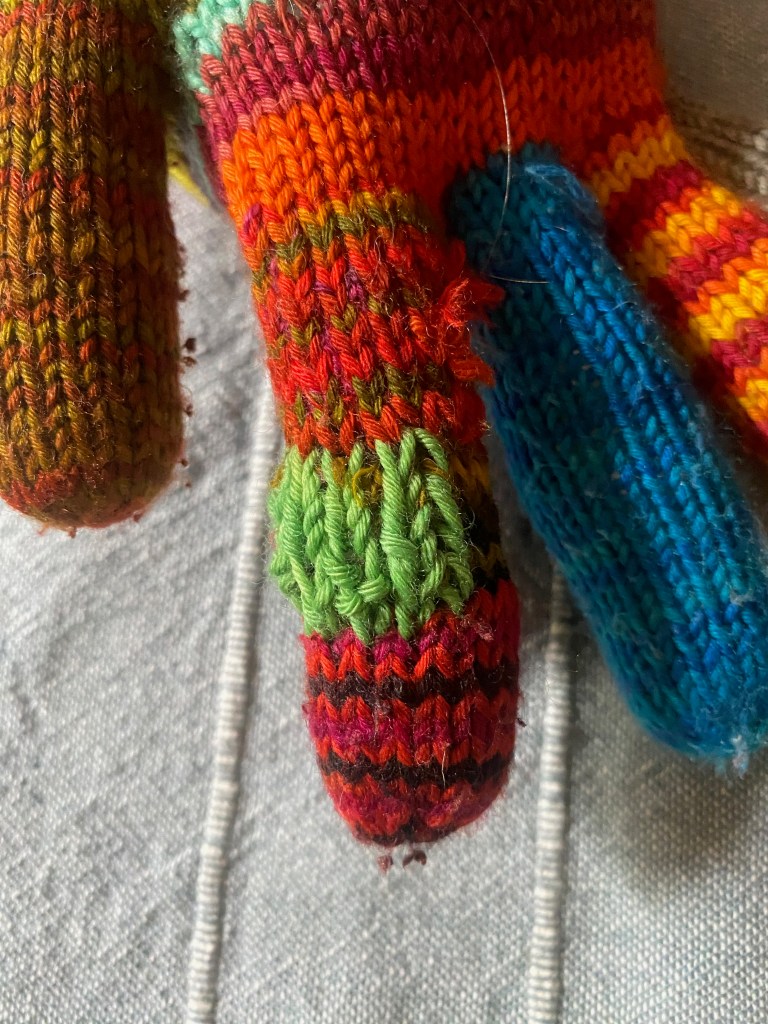
Then I stuffed the palms and fingers until they turned into soft hands to hold, and sewed the cuffs of the gloves to the inside of the cuffs of the sleeves. Except for the ends, my weird, scary, friendly sweater pillow was assembled. Melissa came over for coffee and assigned it a name and gender: Siobhan, pronouns she/her/hers.
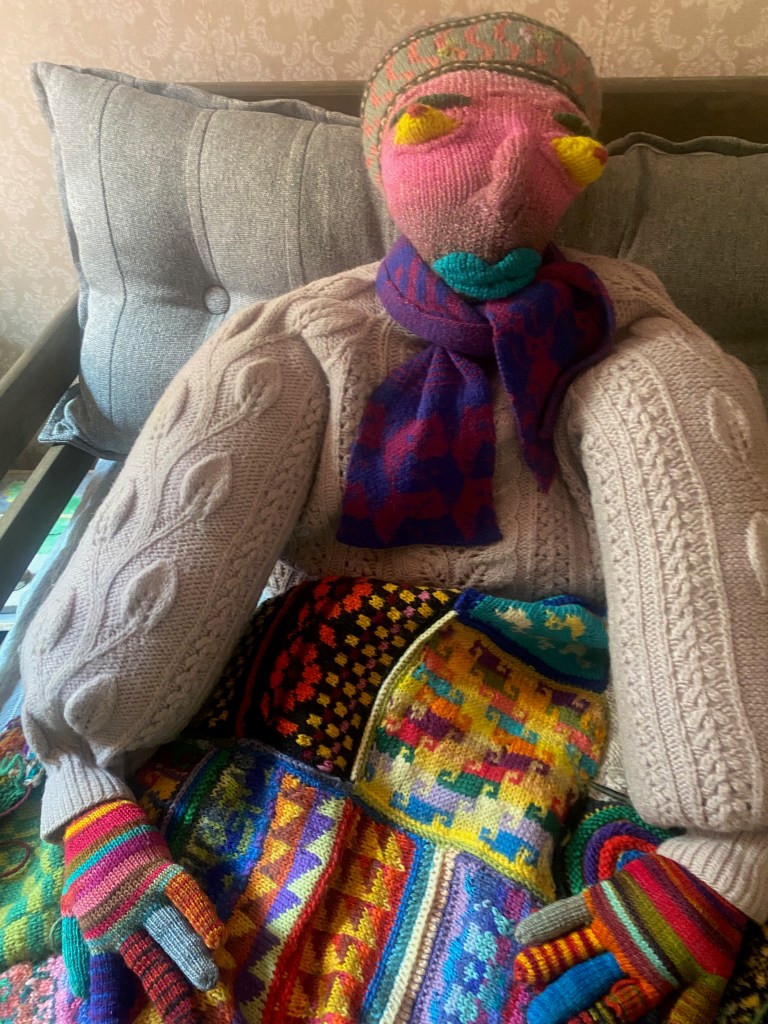
Instantly Siobhan had a back story: formative years during The Troubles, while I was knitting the sweater with the too-small neck that I wore only once. She witnessed terrible things that we can only imagine because she is too traumatized to tell us what they were. She gazes past us looking at things we can’t see, but her experiences have left her with infinite patience for anything a well-behaved adult might do to her in her capacity as a couch pillow, because she has already been through much worse. I limit this to well-behaved adults, because I didn’t stitch her parts together so firmly that they can withstand a destructive child. But as long as you don’t attack the stitches that hold her together, you can tell her anything, turn her head this way or that, smush her face with your head, lie on her any way that eases your weary bones, and she will make herself available to whatever you need to say or do to get comfortable and a good nap. She expects nothing beyond loneliness, but she welcomes your company.

Siobhan sits alone on a trundle bed that I want to use as a couch, but my little leggykins aren’t long enough to even dangle off the edge, much less reach the floor in a proper sitting posture. I need more pillows and cushions, many more of them. Siobhan needs a companion. So I have started rummaging through my old sweaters for one that I don’t wear anymore, and a hat that never looked good on me, and a way to connect a head with the neckband. I have found all of these things, although I still have to hunt for some gloves to stuff as hands. I’m thinking about how to knit a face into a fabric that I can form into a head that looks a bit closer to human than poor weird Siobhan, and I’ll knit it as soon as I get my current huge project off the knitting machine. I need to turn the trundle bed into a couch, and Siobhan needs friends to share the couch with.


 The Interior of My Brain: A Knitting and Fiber Arts Blog
“I didn’t do math and had made the neck too small, so it just lay around forever repelling moths and me.” Ha! What a great line! She really looks like she is ready to wrap anyone in her arms and give them comfort, despite – or perhaps because of – her own troubles.
This is brilliant. You really could publish a book of inspirational knitting stories!
LikeLiked by 1 person
Thank you, Tanya! You provided a needed accessory to poor dear Siobhan, and we’re both grateful!
LikeLiked by 1 person
Her eyes….OMG! I love your idea….but those eyes…so tit like.
LikeLiked by 1 person
Yeah, kind of.
LikeLike
I love it…from start to finish.
You’re so amazing and creative. It’s a wonderful cushion.
Good on you…
LikeLiked by 1 person
Thank you, Pat! You say such kind things! Always good to hear from you.
LikeLike
Siobhan’s changing expressions as she went through the process gave me quite a giggle today. Thanks for that, I needed it. Let’s hope she gets a friend soon!
LikeLike