
When I finished my first version of Junko Okamoto’s Ogawa pattern, a crocheted pullover worked side-to-side in a stitch that looked like knitted brioche rib, I was exhausted, my hands hurt, and the resulting garment was so wide that the sleeves were little more than cuffs. It’s a beautiful sweater, but I felt that I must have done things wrong to go through an such arduous process to follow the pattern, while producing such an oversized garment. After I finished my monster-sized Ogawa and understood the pattern, I wanted to give it another go.
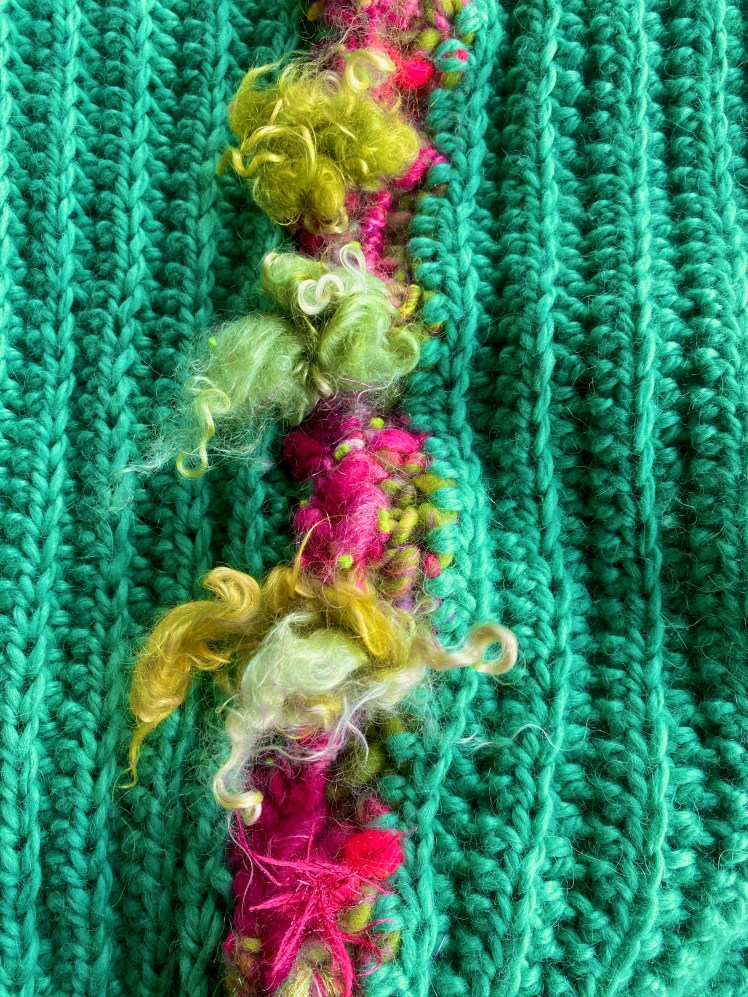
Before my hands had even healed from the stress of pushing and pulling three strands of yarn through back loops with a really big crochet hook, I had bought more yarn, Illimani Llama II in a light aqua, which I thought would be easier to work with and would get a gauge closer to Junko’s. I worked up a swatch with the 8.00 mm hook the pattern called for, and it wasn’t exactly at gauge but close enough to enable me to follow the instructions for the smallest size with enough positive ease to suit me. Then the yarn sat in stash for a year. While it sat there, my eye fell on some art yarn in my stash that had been dyed and spun by one of my local yarnie friends, Oona Jusem, @oonamoth on Instagram. It was hot pink and neon green, with big floofy tufts of unspun locks and shiny pink eyelash bits and other flotsam and jetsam that served Oona’s vision. I bought it while I was knitting my art yarn-infused Old Weird Barbie. I had a vague plan for something that didn’t materialize, but that little skein was going to fulfill its destiny in my Ogawa 2.
When I got around to starting the project a year later, I made some bad decisions. First, I assumed that my gauge would the the same as it had previously been. I was more proficient at crocheting the ribbing than I was the first time, and my gauge loosened. My second big mistake was not switching to a smaller hook when I realized that my gauge was much larger than the pattern called for. My lesson for the young ‘uns is, don’t be like me. Do a current gauge swatch. Switch to a hook that will get you gauge, if your plan is to get the measurements in the pattern. Anyway, I didn’t, and I followed the instructions very closely for the smallest size even though there are many rows in the pattern’s smallest size that I could have eliminated when I realized that I was creating Ogawa Monster Part 2. So that was bad decision number three. If I ever do this pattern again, and there’s no way in hell that I ever will, I will apply these lessons. I’m permanently done with this pattern, and I’m off crochet for a good long while.
As I worked through the instructions, I began to feel that I had been unnecessarily harsh on myself the first time for taking all the blame for getting confused by the pattern. No. The pattern is confusing. Aside from the fact that Junko doesn’t use standard U.S. or UK crochet terminology, her instructions send you hither and yon to find steps you’re supposed to repeat at certain points in the construction, and all of the instructions look exactly alike, so I got lost all the time. I came to congratulate old me for my wisdom the first time in jettisoning the instructions at the midway point and just mirroring on the second side what I had done on the first side. I admit I’m not a dedicated crocheter and have trouble understanding patterns, so good crocheters and those who easily understand other people’s instructions are free to disregard my complaints.
Eventually I made my way to the place where I wanted to crochet a ribbed stripe using that small skein of Oona’s art yarn. I wound the skein into a ball, placed it on my scale, and rewound the end into another ball that was precisely half of the total weight. Then I crocheted the ribbing stitch until I ran out of the yarn in that first ball, which by luck was exactly enough to get all the way down the body and back. It wasn’t as hard to crochet the irregular texture of the yarn as I expected, because whenever I got to a tuft of lock or a big knot of texture, I let it bunch up and stick out on the front. It was like the main yarn was a sober, solid citizen who suddenly had this freakout in acid green and hot pink floof and knots for a minute, then just as abruptly went back to being a sober, solid citizen staring back at you accusingly to say, what are you looking at??? When I got to the corresponding place on the back piece, I used the other ball and repeated the process.

Meanwhile, my weariness with crochet as a generic fiber medium was metastasizing into visceral aversion. Let me list the ways.
- It hurts my hands and takes forever. First on the list of why other people praise crochet is that it’s supposed to be fast. It is? Really? Not when I do it. It’s slow, painstaking, and it hurts.
- The hook falls out of the work. I don’t know how many moments of panic I experienced when my hook went missing. I have another hook the same size somewhere, but it did what crochet hooks do and disappeared. In hand knitting, you have to be really trying in order to disengage a sufficiently long circular needle from the stitches (which is why I don’t like straight needles or double-pointed needles). Whereas crochet hooks seem to be animated by the spirit of a cat, it’s there when it feels like it and makes itself very, very scarce when it decides to move on.
- If I don’t count every stitch every time, there will be too many or two few stitches for the accuracy and precision required to produce the desired shape. This is one of the ways that crochet is inferior to hand knitting, because you can go on autopilot in knitting. After you get to a fairly low level of knitting proficiency, you stop inadvertently dropping or adding unplanned stitches, and if you do, it’s easy to fix the error without ripping back. Sad experience with crochet taught me to use stitch markers very lavishly, which helped keep me accurate, but there was never that automaticity that permitted me to converse freely. Melissa comes over every Friday morning for coffee and knitting. For a while, we were both crocheting. Instead of talking, we were both counting. The conversations were not very interesting.
When I got to the back piece, that’s when I started getting really impatient with the layout of the pattern, because that was where Junko seemed to get bored with writing her wordy, unclear instructions and just said to go here or there in the instructions for the front piece. I got lost and eventually did what I did for the my first version, which was to ignore the instructions and use what I had previously done as my guide for what I should do. I was now consuming a huge amount of the Llama II yarn and abandoning the last deluded hope that version 2 would be very much smaller than version 1. Still I hung onto hope for something smaller than a circus tent until I could seam the shoulders and tighten up the yawning maw of a neckline with a neckband that would pull in and keep the garment on my body. This time I didn’t even try to follow the instructions for crocheting the neckband and just knitted a folded ribbing with a relatively small needle, and I attached the ribbing to the base of the band by binding off the live stitches together with the loop from the cast-on. With that done, I could get a good gauge of how long to make the sleeves.
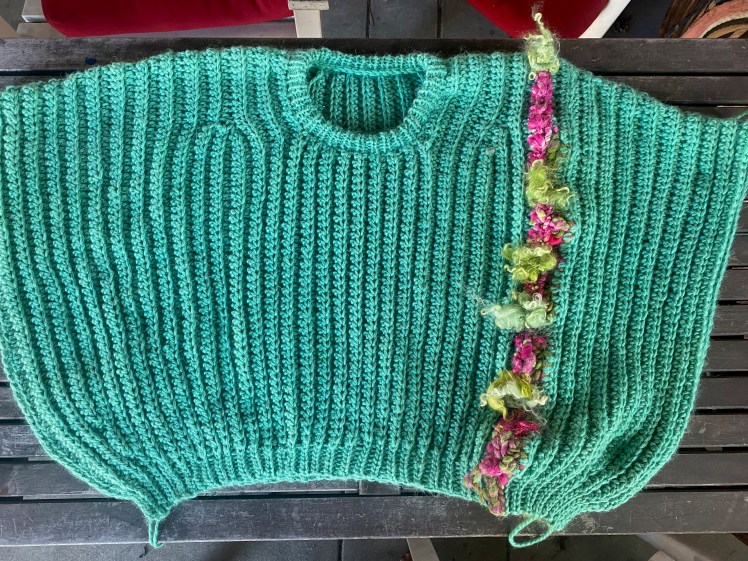
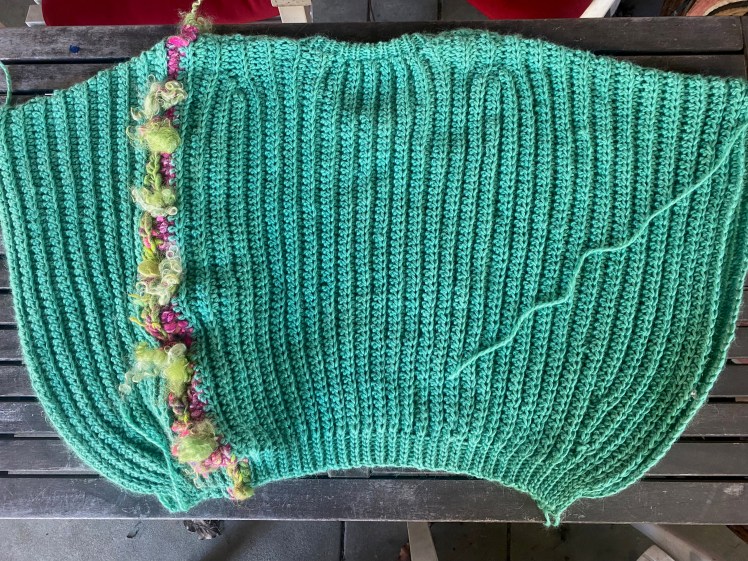
And yikes! Monster 2 was only about 4″ narrower on either side than Monster 1, but I thought that possibly that might give me enough space on my arm to undertake the pattern’s shortest sleeve instructions. But that produced a sleeve that not only was ridiculously long, but there were so many short-row wedges that the width of Junko’s sleeve left only a few inches for the side seams, since there’s a slit at the bottom of the garment where the tight ribbing pulls in and creates a curve, which is a design feature. Junko’s sleeve was much more of a batwing than I wanted to try to stuff into my winter jacket. So again I ditched the pattern’s instructions. I worked a simple tube on a much shorter length, with enough rows to get around my wrists, since the ribbing stitch for the cuff was a third of the size of the ribbing stitch for the rest of the sleeve. I really don’t understand whose anatomy would fit Junko’s sleeve, with its tiny cuff and oversized batwing. I suppose it works if your gauge matches Junko’s?
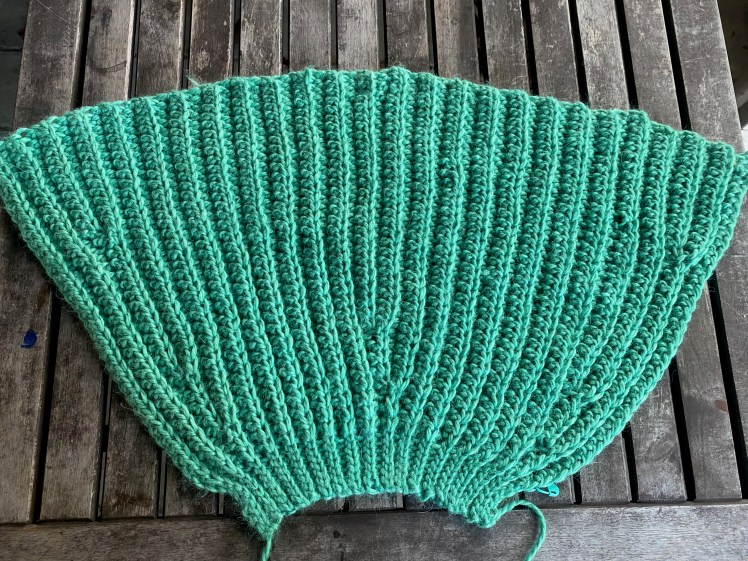
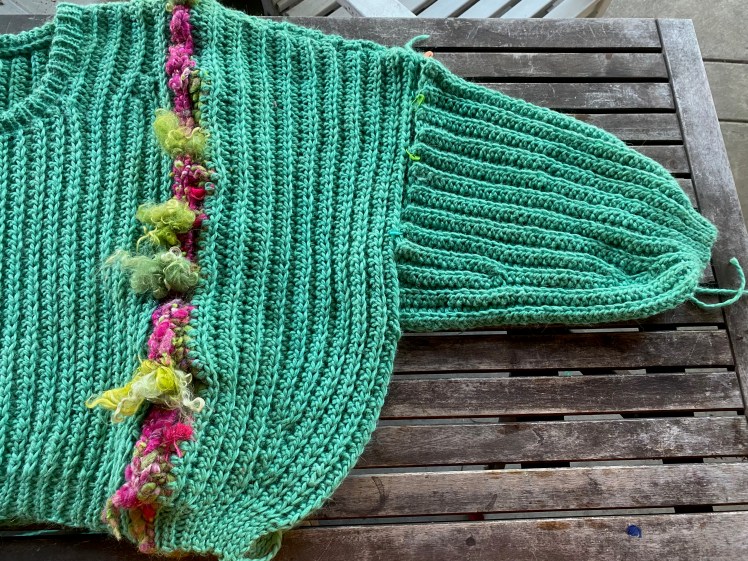
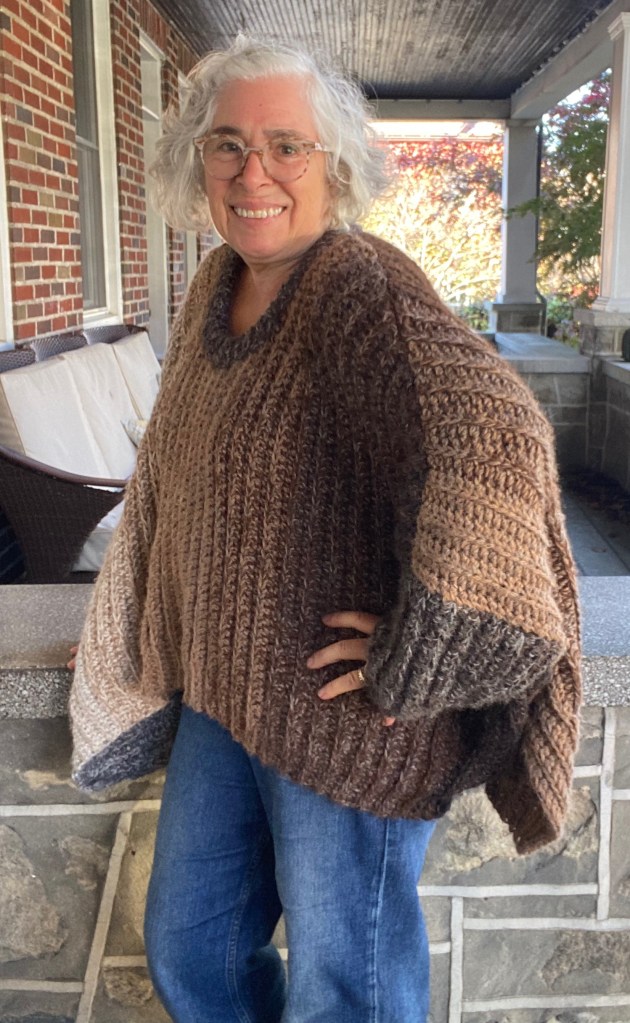
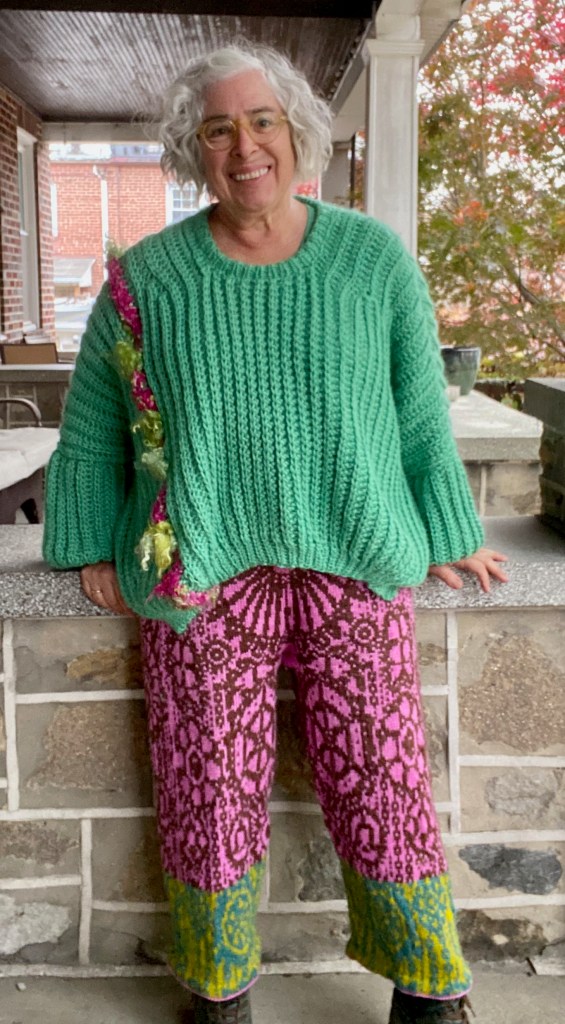
My relief at finishing this project, after souring on crochet and getting annoyed by the pattern, made me slightly averse to the sweater, which I finished a month ago. It styles well with my costume-y knitted pants, and it’s made of luxurious materials, so I thought it would be one of the things that I wear only for dress-up occasions, which I tend to avoid. I didn’t put it on again after a quick photo shoot to pair it with the pink pants.
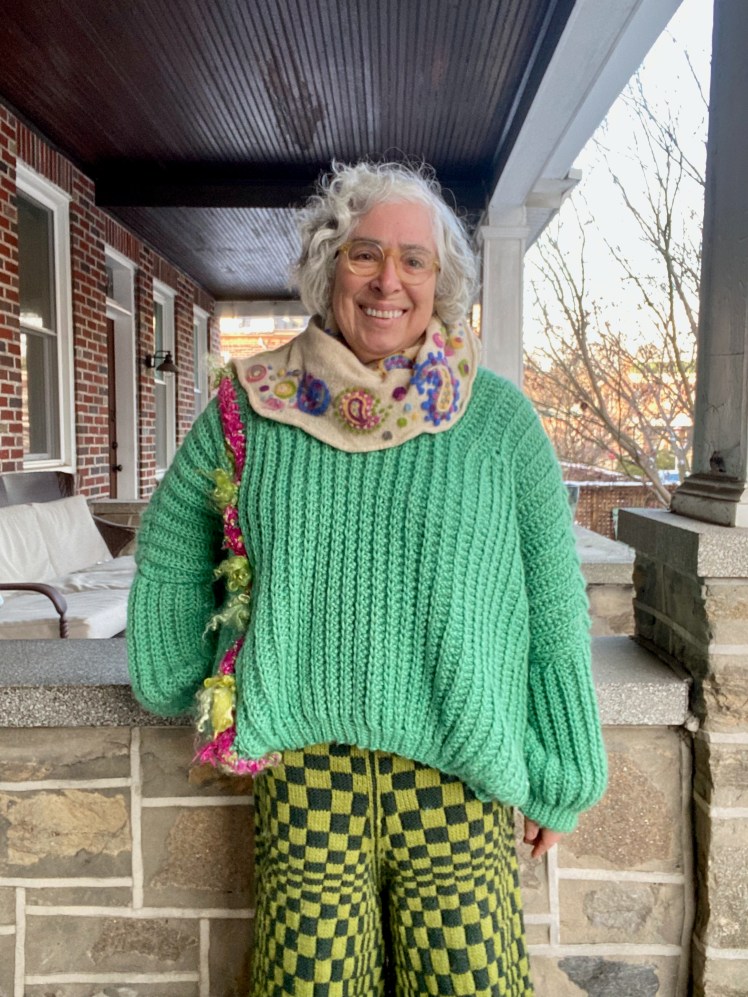
I laid the new Ogawa on top of the old Ogawa to see how much smaller the new version is than the old one, and it looks like it’s about 4 inches smaller at every side, so about 16 inches smaller. Still huge, but easier to wear. This photo displays its width.

But a month has gone by, and the trauma has faded enough that I put it on for coffee with Melissa, and it was comfortable and cosy and dressed down well when paired with baggy khaki pants. Then I put on my winter jacket for my morning walk, and it fit inside the jacket. The process of making this garment wasn’t enjoyable, but I think the product is functional, which is my most important criterion of success after the process is completed. At that point, functionality supersedes everything, even the cleverness and beauty of the design, when the work is done and I’m looking for something to wear. It came out a lot bigger than I was aiming for, but I wanted a sweatshirt shape in a faux-knitted brioche rib, and I got it. But next time I want a sweatshirt shape in something that looks like a knitted brioche rib, I’ll just knit it. Accept no substitutes.

Will I crochet ever again? Probably. Crochet does things that knitting doesn’t want to do, and time will dull the edges of my current aversion enough to make me think that the next crochet project will be worth it and maybe even enjoyable. Like the intentional decision to have multiple children. But for now, I won’t be jealous if crochet goes out with other people. I’ll be relieved that it’s not me.
 The Interior of My Brain: A Knitting and Fiber Arts Blog
You are smiling, that’s a good thing. Reading your post reinforces my own aversion to crochet.
LikeLiked by 1 person
I suppose someday I will crochet again, after I forget how much not-fun I have when I do too much of it. I do like the sweater now that I’m done with it. And I am really SO done with it.
LikeLiked by 1 person