
I have finally delivered on my promise to my husband to make him a sweater during sweater weather for his birthday in June. I knitted it on my KH965i, a standard gauge Brother electronic machine using preprogrammed patterns originally intended as knit-purl garter carriage patterns, but I set them up for fairisle knitting. The yarn is plant-dyed superwash merino in a heavy lace/light fingering weight, and I had 20 colors, including several larger skeins that were dyed or overdyed in indigo, and which got greater prominence in my color arrangement, since I had more yardage from them. Also I thought that the indigo skeins would hold their color better than the colors I had gotten from random plants I encountered in my rambles, back in the days when I was promiscuously dyeing everything I found, just to see what I might get. The sweaters I knitted from those experiments have faded to murky yellows, browns, and greens, which are actually very nice in a subtle, natural way. But I’m really hoping for some more stability from this set of plant-dyed yarns.
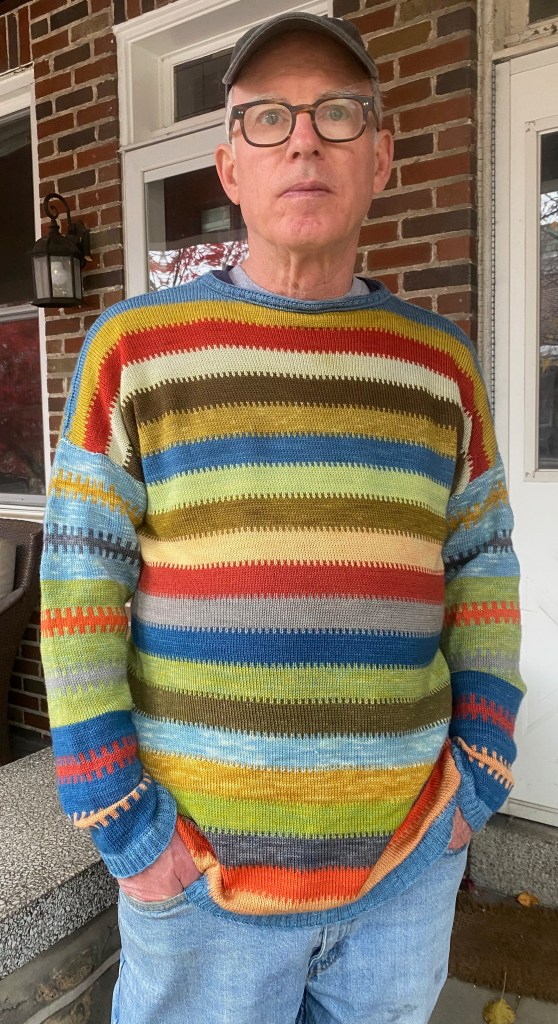
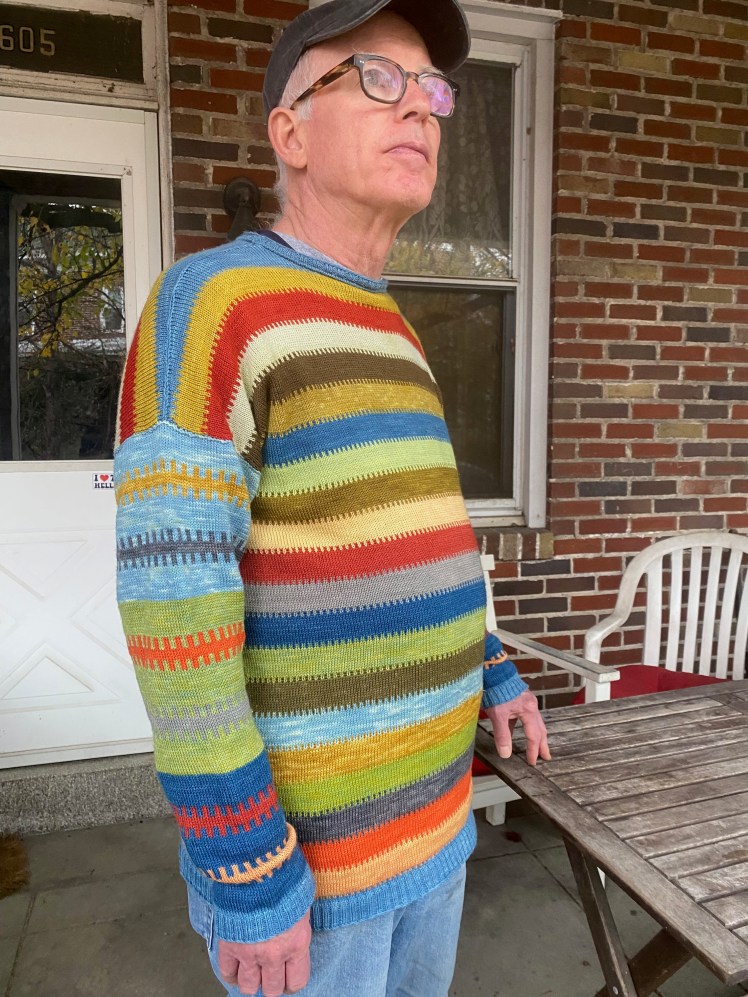
But in case the colors do fade, I arranged the colors to maximize value contrast between them, or to put colors of dubious stability between colors that were more likely to retain their color over time. I didn’t have a great deal of any one color, between 30 grams to 100 grams, so I decided against doing a rota of a smaller number of colors so that I could ensure that I would have enough for the other side to stripe evenly at the seams. I based the width of the stripes on numbers from the sweater I knitted Charles six or seven years ago from similar plant-dyed yarn, and it came to 14-row stripes. I got a little bit fancy with the transitions between the colors by using a knit-purl garter carriage pattern that was pre-programmed in my machine, but I set it for two-color fairisle, to put little 2-row teeth into the transitions. Then I turned off the electronic patterning and knitted plain for 12 rows.
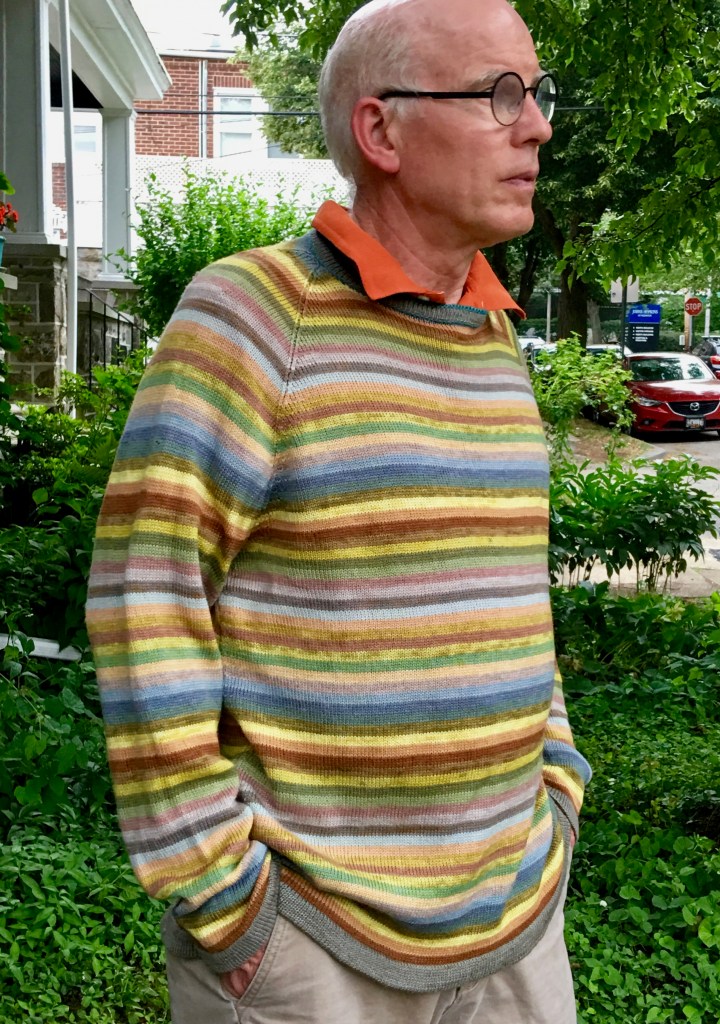
As for the garment shaping, I took the path of least resistance at every decision point. The sweater I first made for him had an elaborate short-row arrangement in the raglan sleeves and back to correct for the curve in his back that makes his sweaters ride up in the back. It was complicated to do the math and hard to keep track of in the knitting, and that sweater still rides up in the back. My alternate plan for this sweater was to sneak in two short rows per stripe in the lower 10 stripe sequences of the back. I knitted the front without short rows, and when I got the piece off the machine, I held it up against Charles’ body, front and back, and it was so long on him that I decided not to add any further length to the back piece. When I got to the shoulder and neck shaping, I pondered long and hard about how to combine the short-row needle manipulations with the two rows of electronic patterning that my numbers would require. That would be a delicate operation. In the end, I decided that I could achieve adequate shoulder shaping and a crew neck over 16 rows starting right after the last set of 1×1 stranded patterning, where the ochre meets the indigo, and did the shaping the simple way without having to juggle the electronics into the operation.
It wasn’t totally simple, because I did something boneheaded like not having the yarn completely threaded in the feeder, and a big chunk of stitches fell off and I spent the next hour reconstructing the stranding. And I did this more than once. Aren’t I supposed to be past this kind of boneheaded mistake by this point, nine years into machine knitting? I saw someone online asking for a knitting machine so that a friend who suffers from dementia could “crank out hats” and feel productive. No, sorry, that isn’t happening. Knitting machines are not suitable for people with dementia. They aren’t always suitable for people without dementia.
Another path of least resistance was my decision to make the back exactly the same way as the front, same shoulder shaping, same neck shaping, so that there isn’t any difference between the two sides, and Charles can just stick his head through the neck opening without me barking at him that he’s got it the wrong way. He has a massive head (because he needs a lot of storage for all those brains of his), so I was very careful to make sure there was plenty of give in the neck treatment. I didn’t tighten the tension when I knitted a welt from the live stitches of the short-rowing or the subsequent rows that I turned into a 1×2 ribbing by manually re-forming one stitch in three. I admit it, I’m scared to use my ribber. Then I bound off very loosely, and I could see that the ribbed neckband was falling over and curling as if those reconstructed purl stitches weren’t even there. That bothered me, but maybe seaming would help.

Looking at the different cakes of yarn that I had used for the two sides of the body, it looked as if I might not have enough of each color for both sleeves if I replicated the striping and stranding patterning that I used in the body. Besides, that would result in excessively long sleeves, according to the numbers I was reusing from the earlier sweater. And I was bored with the patterning and was ready to enliven the design with a variation on the theme. I decided to organize the space I needed to cover around three different indigo colors, a dark blue, a green, and a light blue, on top of a 14-row ribbed cuff in a medium blue. After the cuff, I needed 180 rows, so 60 rows for each color. Each 60-row section would have two sections of a 2×2 stranded pattern in a sequence of four rows of patterning in the indigo color and the contrast color, four rows plain in the contrast color, and another four rows of patterning in the indigo and the contrast color, for a total of 12 rows. Then back to the indigo for 12 rows, and start it all over again in the next indigo color. So 12 rows of plain knitting in indigo, 12 rows for the contrast color patterning, 12 plain rows of indigo, another 12 rows of contrast color patterning in a different color, and 12 plain rows of indigo for 60 rows. I repeated this sequence two more times with the other indigo colors for a total of 180 rows, on top of the 14-row ribbing. Meanwhile, I was adding two stitches at either end of the sleeve on rows ending in 5 and 0 until I had the same number of stitches that I had for the sleeves of the earlier sweater.

When I had the two sleeves knitted and off the machine, I started seaming the shoulders together. But it was clear that seaming wasn’t going to keep the neckband from rolling and caving in, so back onto the machine the neck went, so that I could turn that floppy bit of ribbing into a folded neckband. That would make it more substantial and polished-looking. I picked up stitches from the inside edge of the bound-off stitches, knitted the same number of rows as the original neckband, then picked up each stitch at the base of the neckband and put it on the needle with its live counterpart, knit the two loops together, and bound off for a tidy and strong neckband. The neckband was still large and loose enough for Charles to get his enormous melon head through it, and now it looks much better. The sloppy neckband had eaten away at my equanimity. It’s good not to have that niggling irritant poking into my satisfaction with my work.

But there were other niggling irritants to take its place after I seamed the pieces together and wet-blocked the assembled sweater and finally pulled it onto Charles’ patiently submitting body. Why was there bunching in the armpit? Why was the sweater twisting around on his body? Why was the shoulder seam rippling? Why was it clinging to the curves and lumps of an aging man’s body instead of gliding tactfully over them? I had used the numbers for the previous sweater that fit Charles well, with the same kind of yarn and same stitch tension. So why was this sweater telling me that it didn’t want Charles to wear it, it wanted to be worn by DD2’s husband, who is six inches taller than Charles and very slender? I sat the new sweater down for a serious discussion. It belonged to Charles, and it was going to have to get to know and love him. I told Charles he needed to wear the sweater for a few hours a day for a couple of days so that it could get used to him and adapt to him. Everyone did what I told them to do, and the sweater has accepted the fact that Charles is its person.


 The Interior of My Brain: A Knitting and Fiber Arts Blog
I’m so impressed that a good talking to convinced a sweater to change its ways. You are a wizard.
LikeLiked by 1 person
Might not always work, but it’s worth a try!
LikeLiked by 2 people
I love this sweater, and reading your posts is always so interesting.
Can I ask you the yarn yardage in 100 m and what tension you set on your machine?
You’re such a talented machine knitter!
LikeLiked by 1 person
I don’t know exactly, Mariagioia. The sweater weighs 508g, so maybe that’s about 700 m?
LikeLike
❤️❤️❤️
LikeLiked by 1 person
I forgot to say, I knitted the body at T7 and the ribbing at T5.
LikeLiked by 1 person
I love the short spikes of stranded knitting in the new sweater’s stripes, and especially the change in scale between the stripes on the sleeves and those on the main body. The 2019 model is still looking good, too. Happily, those coffee stains do a nice subtle samba against the faded natural dyes.
LikeLiked by 1 person
I should probably post a picture of how much the 2019 sweater has changed. It’s mostly yellow and brown, and the coffee stains are very visible and can’t be mistaken for anything other than coffee stains. For the new sweater, I really like the change in scale between the body and sleeves. I very much needed to mix things up in a logical and related way on the sleeves.
LikeLike
I also love the transition between stripes, and the colours too. It’s looks like a great fit, love how it moulded to shape after the serious discussion!
LikeLiked by 1 person
Thank you for the kind praise!
LikeLiked by 1 person
Both sweaters look great on him!!I would be really interested in photos of how the older one faded. In general your posts are really interesting, maybe you would like to do a complete one looking back at older projects: Which are used the most, how do yarns hold up, what (based on use) would you change next time, etc. Ps: The person asking for a knitting machine was maybe referring to the modern round ones, made of plastic, which you actually use with a crank (and are very easy to use!)
LikeLiked by 1 person
Thank you for the comment and the suggestion. It would be interesting to do a retrospective of what worked and what didn’t, what gets worn and what gets passed over, how my plant-dyed yarns have held up over time, as you suggest.
Are you referring to the Facebook post in which someone was requesting a knitting machine for a person with dementia? I don’t have any personal experience with plastic sock machines. I know a couple of people who have had tubular crank machines, and their reporting doesn’t sound positive. But if you have had good experiences with plastic sock machines, that’s great! What do you recommend?
LikeLike
Thank you for the fast reply! Because you said “Knitting machines are not suitable for people with dementia.”, I wanted to point out, that these plastic ones are way different to yours (with no buttons, hard to break needles) and maybe really are suitable for nearly everyone.
LikeLiked by 1 person
Specifically what are these machines? Make and model, in case I ever encounter this question again?
LikeLike