
I don’t like summer very much. I can’t wear my lovely wool sweaters, so I try to make wearable things out of plant fibers. It doesn’t always work out as I hope, but each summer I make something and hope that maybe this will be the year that I make a summer top that I can actually stand wearing in our heat and humidity. This year I made two finished summer tops and have a third on the needles, and have achieved some degree of success with them in terms of summer wearability. Wearability means: Is there space for air circulation? Is the fabric lightweight? Can it be worn without wearing something underneath? Does it cover everything I want covered and not fall off my shoulders? And– much as I hate publicly discussing my body image issues– does it make me look and feel fat?
The first of the summer tops of 2025 is from an undeservedly little-made crochet pattern by Karmen Režek called Floral Crop Top. It deserves to have lots of finished projects in its Ravelry project gallery because it’s a good shape for many body types and the pattern is accurately written, but there’s only one project on Ravelry other than the pattern sample. Maybe all the other finished projects are on Instagram, or maybe everyone is like me, delaying for months before writing up a Ravelry project page. I made some choices that caused me unforeseen results and a lot of extra work, but the pattern is completely blameless.
The first and basic choice that caused the unpredictability and the extra work was my decision to use a 70% viscose/30% cotton yarn, Berroco Splash, in gray with irregular splotches of black and brown. If I were naming the colorway, I would call it “You Can Send Me Dead Flowers.” I frogged it from a half-done summer top that had gone into hibernation two years ago because the knitting was boring and I knew I wasn’t going to like the look and feel of the garment on me. There’s nothing wrong with the yarn. It just did what the fiber content does by its nature. It shrinks when it’s washed and dried, and grows after wearing. I’m the problem for failing to take that into consideration and having to grope for workarounds. When I was crocheting the fabric, with its built-in flower shapes, the yarn was in its compact manifestation, so I crocheted and crocheted and crocheted, way past what the pattern called for and way past my enthusiasm for crocheting, just to get it long enough to cover my midriff. I didn’t really want it much longer than that.
It was the right size when I sewed it together and tried it on. Just long enough, and the armholes didn’t expose flesh that I didn’t intend to expose, the V’s at the front and back didn’t hint at a striptease, and the garment refrained from falling off my body. But the flowers rolled up in on themselves like bobbles rather than blooming flowers, and the whole idea was to have flowers, not bobbles. So I washed it, laid it out flat to dry, then ironed the flowers because they were still curled up in a fetal position. Then I tried it on, and it had stretched beyond recognition, committing all the sins whose punishment usually would be handing it off to someone bigger than me. And the flowers curled up again after staying open for an hour after the ironing. But I wasn’t ready to give up on it because the fabric was as cool and airy as you can get when you live inside a plastic bag in a sauna, which is what the worst of summer here feels like.
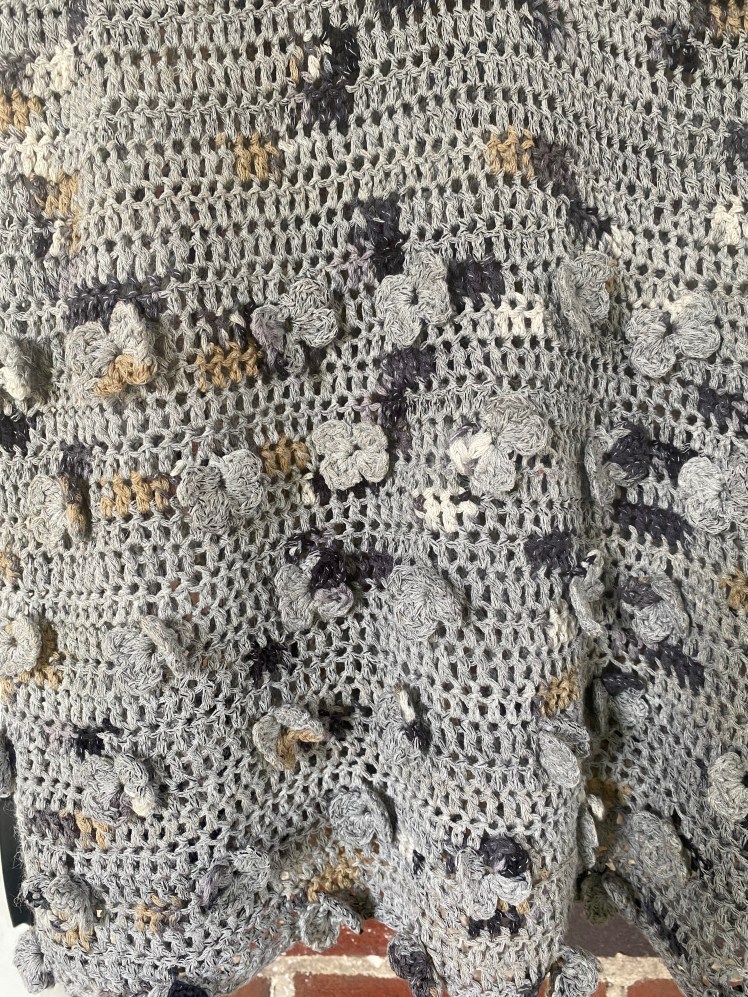
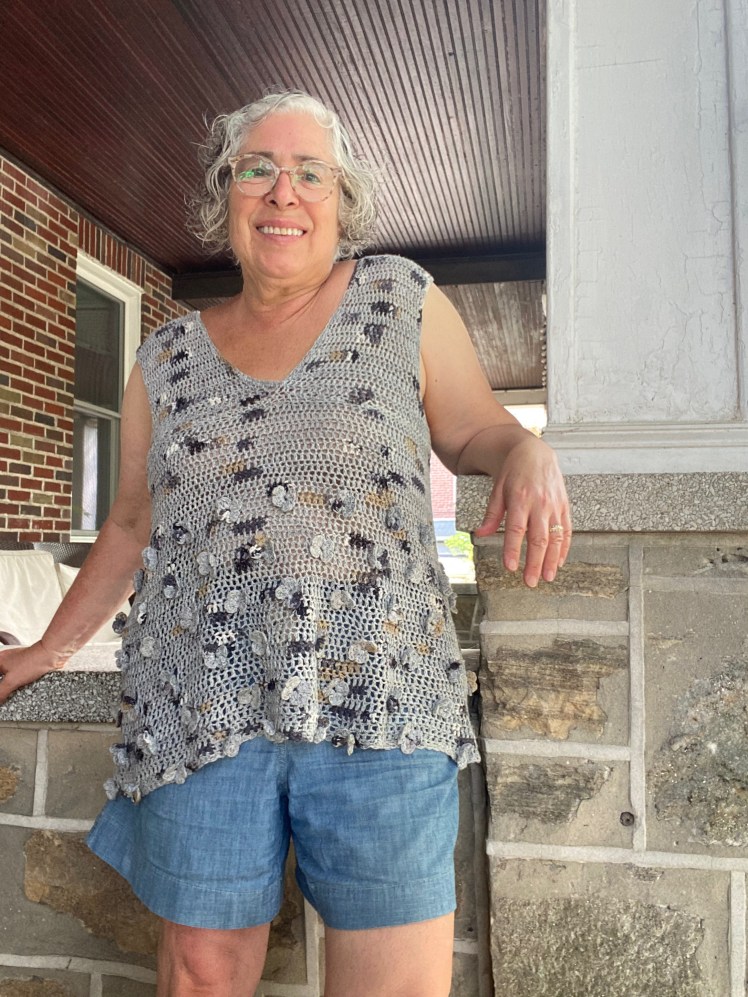
I washed the garment and threw it in the dryer, and it shrank right back to its previous size, maybe even a little smaller. But then it stretched again almost immediately. I crocheted a couple of rows of single crochet around the armholes and neckline, and tacked down three of the four petals of each flower with sewing thread. Now it fit well enough for me to wear it one miserably hot weekend, but it stretched again and I spent the weekend fighting to keep it on my body. Then I found some thin elastic thread and used it to gently elasticize the armholes and neckline. That seemed to do the trick for the armholes, but the neckline was still too deep for the coverage I wanted, and it still slipped off my shoulders. Finally I dug up some heavier elastic cord to thread through the stitches around the neckline. The neckline looks very puckered when it’s not on my body, but now when it’s on my body, it stays on my body. I think it’s finally wearable now. A bit longer than the slightly cropped look I was going for, but wearable.
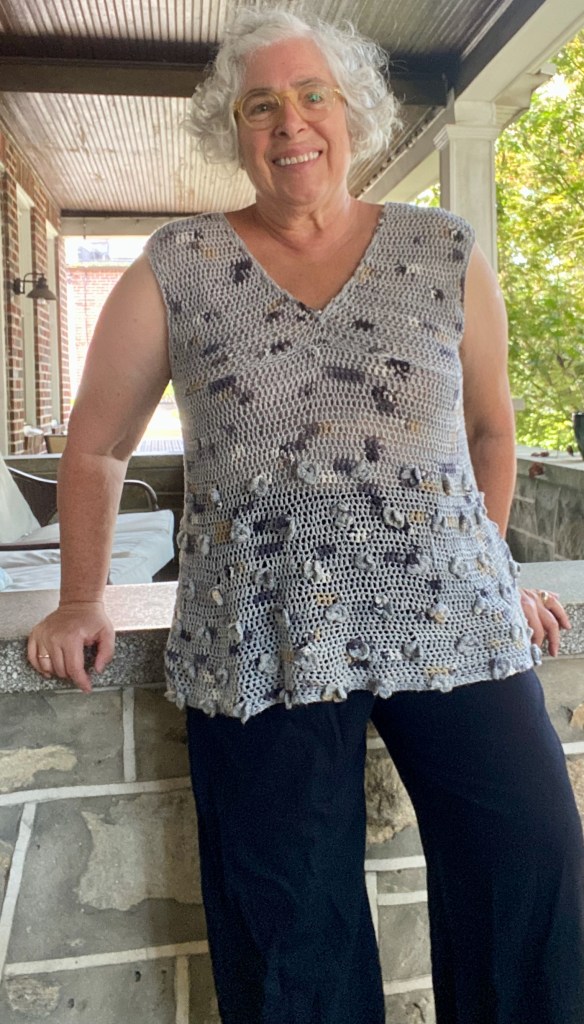
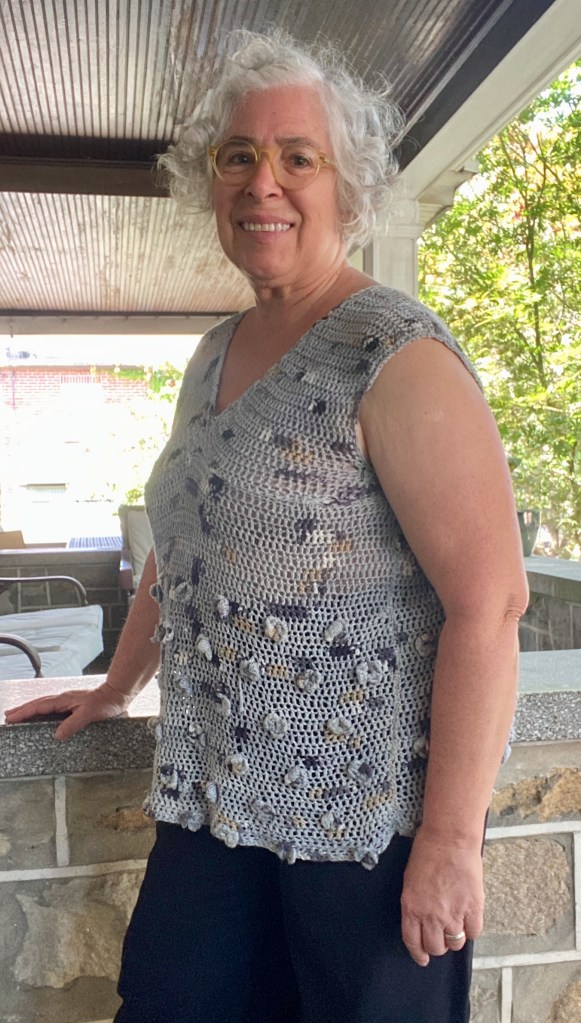
The second garment I undertook this summer was a brand-new pattern that I was smitten with on the first day of its release, a t-shirt in French blue with garter stitch sleeves, angled garter stitch side panels, and shorter stockinette center panels. That day I bought yarn for it and the next day I bought the pattern. I leaped into knitting this never-knitted pattern, knowing that I would inadvertently serve as an uncompensated test knitter, because Melissa happened to have the perfect yarn in stock, Cascade Hampton, a linen-cotton mix, in exactly the same blue as the pattern sample. The pattern is Metropolis by Yvonne Woodhouse. I’m sorry to say that the pattern has some math and logical errors, and when I wrote to the designer to suggest corrections, she was unresponsive. Fortunately, the design itself is simple and logical and adequately explained by plenty of detail photos on the Ravelry page, although the photos are not included in the pattern itself. Nevertheless the textual errors and unclear instructions didn’t expedite my understanding of the simple and logical concept the pattern was attempting to communicate, and there are some poorly executed increases up at the top of the raglans.
But once I got the concept, I was able to knit past the errors in the pattern with a shrug, and just knit, knit, knit, knit, knit. It was a slog. I had my doubts about the short-row shaping at the edges of the sleeves, but I did them, not totally accurately because I didn’t understand the purpose. My unclarity about the instructions resulted in some variations in the stitch counts between the two sleeves and the front and the back. When I became aware that my stitch counts were off by several stitches in each section of the work, I probably should have frogged. I didn’t. I was grimly determined to get this thing off my needles. Once I got down into the body, I followed the instructions for the angling of the garter stitch side panels into the front and back stockinette panel, where you increase into the edges of the side panels and decrease into the edges of the stockinette panels on one row, and for the next row, knit the stockinettes and garter stitch the garter stitches, do another set of those two rows, then one row of increasing the garter stitch panels and no decreases in the stockinette panels, and a plain row to end the sequence. This creates an A-line at the rate of one in six rows. I did that four or five times with the increasing awareness that this thing would come down to my knees before I got the stockinette panel narrow enough to please me. So I ended the increasing and kept the stitch count stable, without knowing exactly what my stitch count actually was.
When the body finally got long enough for me to consider binding off the front and back stockinette panels, I stuck plastic tube cords onto the ends of my needle, spread out the work, and tried it on in front of a mirror. I gasped in horror. I looked about a mile wide in it. I yanked it off, stuffed it into my bag, and stomped off to the yarn store thinking about frogging it then and there. Melissa was at the counter talking to one of the regulars, and I grunted some sort of greeting at them as I plunged into the bathroom and came out a second later to demand, “Should I frog this?” They looked me over lengthily and not reassuringly before Melissa said cautiously, “Well, you’re not finished. You’ve already knitted so much of it, you might as well knit a few inches more and see how it looks when the front is long enough. It might work out.” So I did that. Here it is after knitting and binding off one side panel and the front. It did work out.
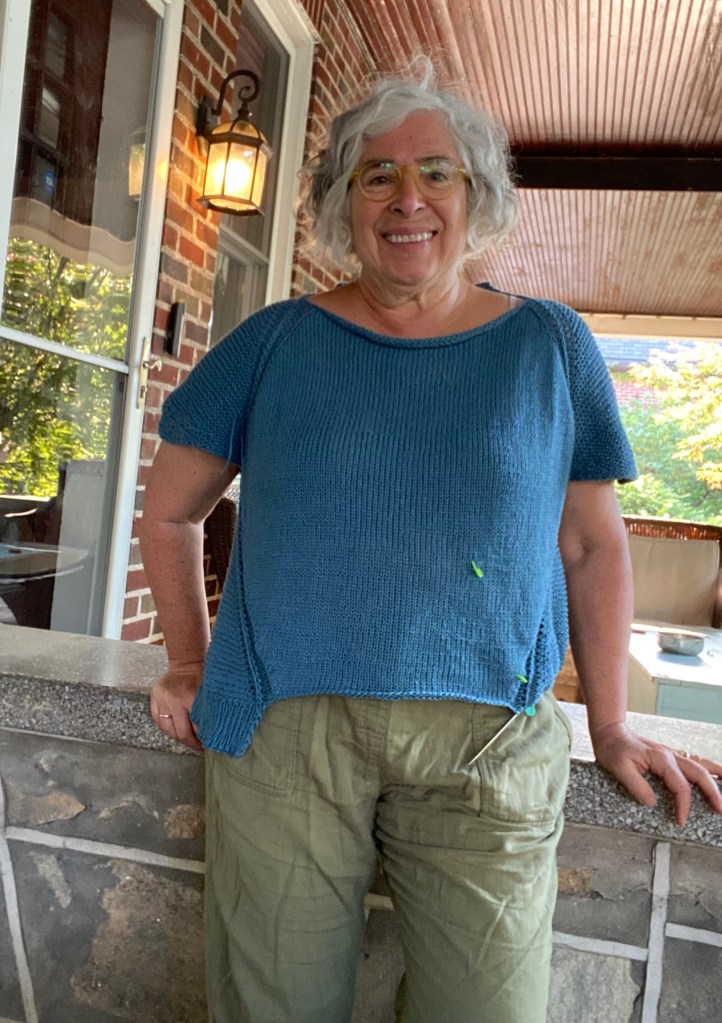
The picture below was taken before I washed and blocked the finished garment. I followed the instructions on the yarn label, which said to machine-wash it and lay it flat to dry. That stretched it from the gauge of the pattern, which was 18 stitches over 4″, to 16 stitches over 4″, which added up to enough growth to make the shirt fall off my body. I machine-washed it again and this time threw it into the drier with the rest of the laundry, and it returned to its original and intended size. This was very useful information about the behavior of this yarn, especially when I wore the garment for a while, and the yarn relaxed a bit with a warm, slightly sweaty body underneath it. The neckline got too wide and was slipping around and off my shoulders. Here’s a picture that illustrates the situation, although I couldn’t bring myself to take pictures when it got way too big.

And here’s a picture that illustrates my solution.
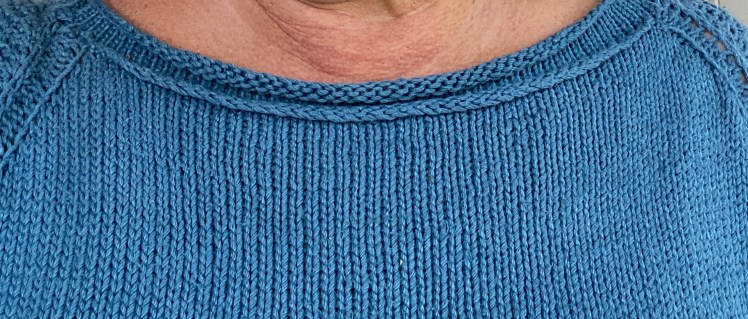
The rolled stockinette curl at the neckline is a design feature of the pattern. I liked it and wanted to preserve it even though I needed badly to tighten up the neckline, so I picked up stitches several rows beneath the edge of the knitting, enough for the fabric to curl. The raglan lines were five stitches wide, so I picked up three stitches for each raglan in order to pull in the opening, and modularly joined the new knitting to the ribbed neck flap at the back with a k2 tog or ssk decrease, depending on which end I was joining. I knitted six rows in stockinette, then just bound off and let the new neck edging curl like the original edge had curled. And after a half hour, I suddenly had a perfectly functioning summer top, which had the advantage of making the weird protruding ribbed neck flap make visual and functional sense. The pictures I took before I fixed the neckline avoided showing that defect, so just trust me, it needed fixing.

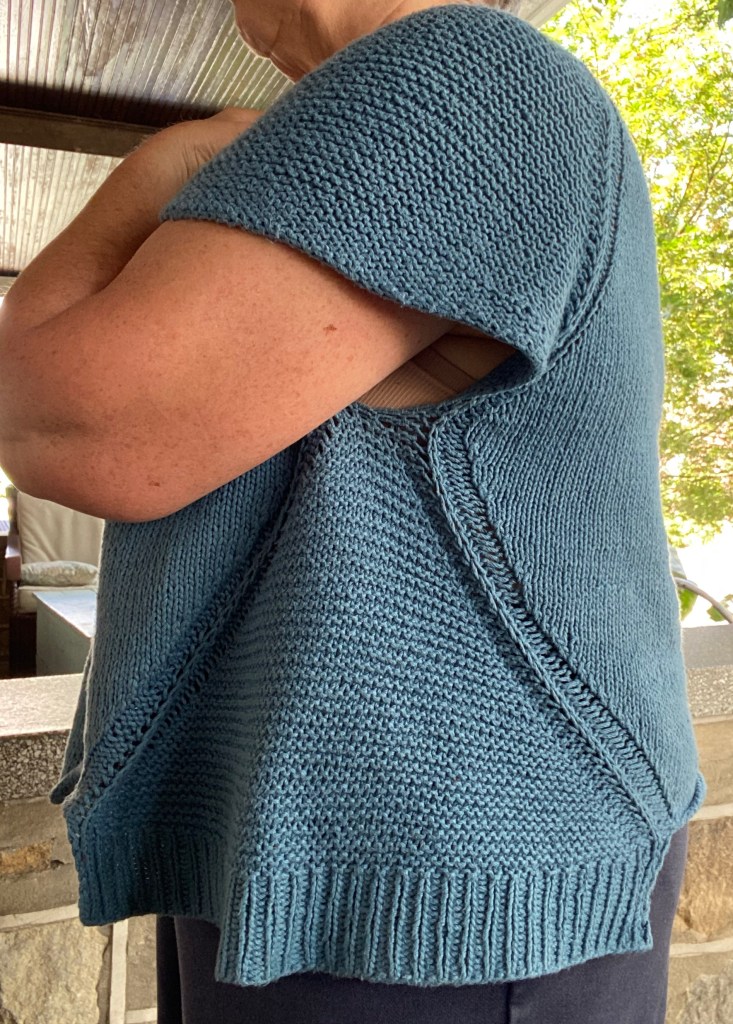

Now I’m wearing this top all the time, thanks to a good design that I made roomy enough, with appropriate modifications, and a really good yarn choice. When I wear this garment, I completely forget it’s on my body. Even better, it makes me forget I have a body. Which brings me to the third summer top that I embarked upon instead of returning to the cold-weather knitting I was planning to do after finishing the blue top.
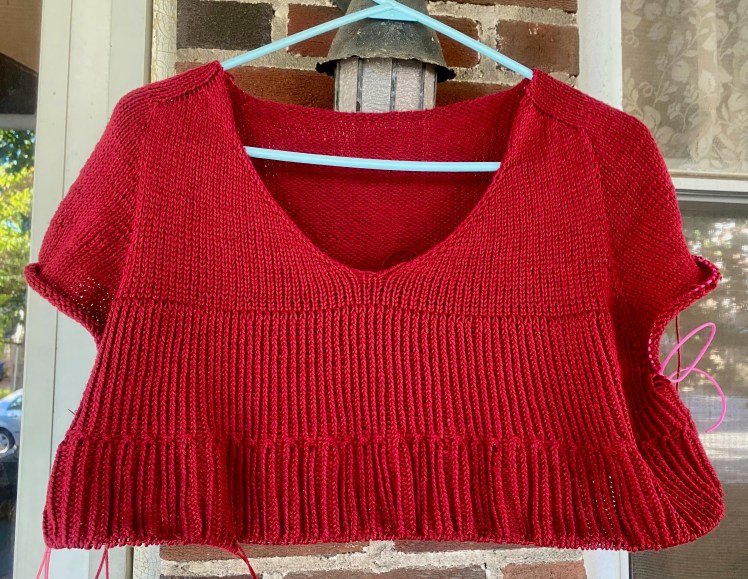
A short sleeved version of Irene Lin’s Ruth pullover appeared in my Ravelry friends activity, and I knew that it would be something I would wear to death if it was knitted in the same yarn that I had used for my Metropolis shirt. The patterning of twist-stitch ribbing increased in three tiers of the same length and created a graceful and comfortable line over the body that I knew would suit me. The question was, would the knitting be so tedious and time consuming that I would be knitting this garment and hating my life until next summer? Nevertheless I bought the pattern and the yarn, in brick red. Yes, there were going to be a whole lot of ribbed stitches by the bottom tier, somewhere between just under 500 stitches per row in the smallest size to 702 stitches per row in the largest sizes. But by now I knew how the Cascade Hampton yarn behaves, and the gauge I got from washed and machine-dried stockinette was larger enough than the pattern’s gauge that I could knit its smallest size and it would be big enough for me.
So I started it a few weeks ago, and now I’m a lot of the way toward the bottom of the second tier. It’s a lot of stitches, but I’m not bored and hating everything. I’m delighted to say that the pattern is perfect, numbers all correct, instructions crystal-clear, and even I can understand everything the first time I read it. I love the way the designer uses highlighting in her written instructions so that it’s easy to keep track of where I am in the row. It’s a miracle, a pattern that I can’t complain about! And it looks as if it’s going to fit exactly as I want it to fit!
At this stage the rows are very long and take a long time to knit them, and pretty soon they’re going to get even longer, with the final set of increases, for another 30 very long rows. It will probably take another couple of weeks to finish it. The weather has gotten much cooler and more comfortable, and any further sultry weather probably won’t last very long, so I won’t get much chance to wear this in the terrible weather I knitted it for. Oh, too bad (not). But with these three summer tops, I’m set for the torture of next summer. Maybe I can even give myself a break from summer knitting next year to spend next summer on far more entertaining winter knitting.
 The Interior of My Brain: A Knitting and Fiber Arts Blog
So much hard work – but the results are terrific.
Your persistence is inspiring and (I hope) will someday be contagious. I can diagnose and analyze problems with any failed project, but usually toss them aside in irritation rather than futz around with reworking them . . . 😉
LikeLiked by 1 person
Thanks, Gretchen! Figuring it out is kind of interesting.
LikeLike
Relatable and hilarious—“summertime and the living is sweaty” needs to be on a T-shirt. 😅 Loved the little domestic details (fans, ice, tactical shade). Do you have a go-to heatwave ritual—cold brew in the freezer, late-night walks, or reading in front of the AC like it’s a campfire?
LikeLike
We take our morning walks as early as possible, then drink lots of cold water and take a shower after, along with compartmentalization and dissociation from the awfulness of the heat and humidity.
LikeLike