
The political fiber artist Lisa Anne Auerbach posted a work-in-progress on Ravelry a couple of months ago, with an invitation to other knitters to join her in their own interpretation of her idea. Her idea was based on a link to an article in the New York Times that listed words that the Trump regime has banned from government websites. It’s not far-fetched to infer that the regime wants to ban these words from government website regardless of context, which adds absurdity and mindlessness to the insult of the regime’s ham-handed “war on woke”, which is to say, its war on Americans who are not the roughly 30% of the population identifying as white men. In fact the word “identity” is on that list.
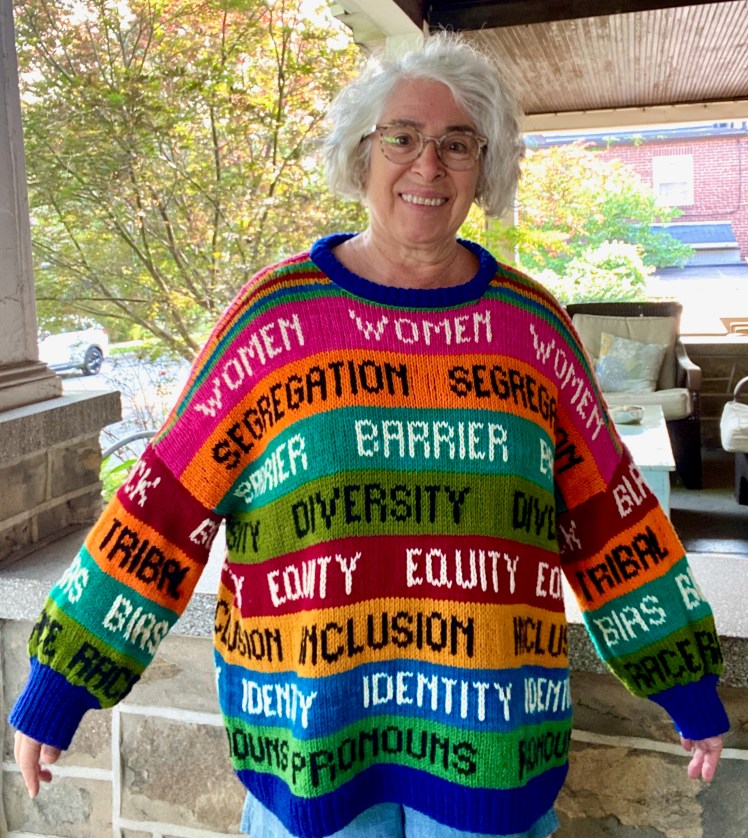
I had other things prioritized in my to-knit queue, but I immediately reshuffled my priorities and dove into my Wollmeise DK stash looking for colors that would contrast strongly with black and white lettering and be clearly legible from a distance and from any angle. Unlike in 2022, when I knitted my political protest dress “When Will This Sweater Be A Crime?” in reaction to the Supreme Court ruling ending federal protections to abortion access, our national emergency has gotten past the time when I can hide behind low-contrast colors and wordy, esoteric statements in order to stymie hostile people who don’t understand history, law, and nuance. Lisa Anne chose hyphenated words and phrases inspired by the New York Times’ list, using background and contrast colors from the same color family, with stranded motifs separating the words and phrases. I decided to use single words with a lot of space between them, in colors and black and white that screamed from the rooftops.
As I studied the list for words that would fit into the available space with maximum legibility, I began gravitating to the words that had common usages unrelated to the effort to open opportunities to the 70% of us who aren’t white men. Race? Can’t run races anymore. Black? Find some other way to describe the color. Bias? Can’t sew fabric that has been cut on a slant anymore. Equity? Well, Trump’s erratic, ego-driven economic chaos is making people too poor to pay off their houses now anyway. Diversity? With Trump’s “drill baby drill” environmental policies, most species of flora and fauna are going to be killed off, so there won’t be any biological diversity to talk about. Pronouns? I guess languages don’t really need a way to refer to objects other than to keep repeating the noun. Women? Who needs ’em. The message I got from this is that the regime’s fear and hatred of 70% of us is so extreme that inflicting gibberish on everyone and everything is a perfectly acceptable side effect of the project to erase an inconvenient majority. This makes the regime look like simple-minded fools, but that doesn’t matter when those who see the regime as simple-minded fools don’t matter.
I avoided single-meaning acronyms like DEI and LGBTQ because the regime’s supporters get triggered by acronyms in a knee-jerk way, and I want them to have to think for a moment before they react, by referring to non-binary sexuality with words that shouldn’t be controversial but have been shoehorned into a single context, like “pronouns” and “identity”. The exception to the multi-meaning word choices was “segregation.” The word segregation does have multiple contexts, but in the American milieu, it mostly refers to racial segregation. I chose to knit it because denying history, as the word’s erasure attempts to do, is the number-one task of racist authoritarianism. Keeping a subject population ignorant of the truth of what their ancestors did in the past enables their descendants to keep on doing it.
As always, my yarn, color choices, and stitch size were determined by practical factors, not by conscious messaging. I have an extensive stash of Wollmeise DK in the saturated colors Wollmeise is known for. Most of those colors are a similar value, so they won’t contrast well, and I wanted maximum contrast for legibility. But I still have black and white, so I chose hues and values that would read against black or white, and arranged the colors to alternate the black and white lettering sequences. It was mid-spring when I started the project, and I wanted to get it done as quickly as possible, which led me to aim for a large gauge of 4 stitches to the inch, achieved by knitting the yarn double-stranded on U.S. size 8 needles. I like my sweaters oversized, so I decided on a circumference of 60″, for 240 stitches. That would give me space for multiple repetitions of each word I chose, front and back, separated by 8 to 12 stitches between the repetitions.
The construction of the sweater was to be very simple, knitted bottom-up, with a couple of inches of ribbing and dropped shoulders that would require back-and-forth stranding for the front and back. I didn’t consider steeking, because Wollmeise DK is a highly processed superwash wool whose grippy fibers have been tortured into smoothness and will fall apart instantly if the fabric is cut, and I don’t have a sewing machine to secure the steeks. Wrong-side stranding isn’t my favorite, but I can do it when it’s the better alternative to something I like even less, like cutting steeks into superwash. At first I thought I needed to choose short words for the sequences in the yoke on the assumption that it would be simpler, but as I worked through the body, I became habituated enough to knitting the shapes of the letters to decide that there was no practical advantage to using only the very shortest words on the list, because it wouldn’t make the knitting easier. Knitting in the round or knitting back and forth, I still made mistakes, and then I fixed them. That’s what you do when you knit.

For the sake of the fit, I needed to put a shallow shoulder slope at the top of the knitting to avoid the ugly bunching of fabric at the armpits that blighted the oversized dropped-shoulder sweaters of the 1980’s. The numbers wouldn’t work for another word sequence in that space, so I thought about filling the angle with a black and white checkerboard. But recently I made some cushion covers using stripes of Wollmeise colors and when I laid the work against the cushions to look at it from an upright position, those stripes looked really good with the word sequences. It was also going to be a lot easier to work short rows into simple stripes than it would have been with a stranded checkerboard knitted back and forth. So stripes it was. I knitted two rows of each color in the sequence I used in the body, and wrangled the short rows into the stripes the best I could, which was good enough. Some people who commented on the finished garment on Ravelry interpreted the stripes as a Pride rainbow, and they’re welcome to interpret it as they wish, but the sequence isn’t a rainbow and the colors are a little bit different from the Pride rainbow. Not as different as I thought, I just discovered, upon googling Pride rainbows. Pride rainbows are a powerful symbol, but I don’t (consciously) use them because their overuse has ruined the aesthetics for me, and my sense of privacy makes me avoid making statements about sexuality that might be interpreted as a personal declaration.
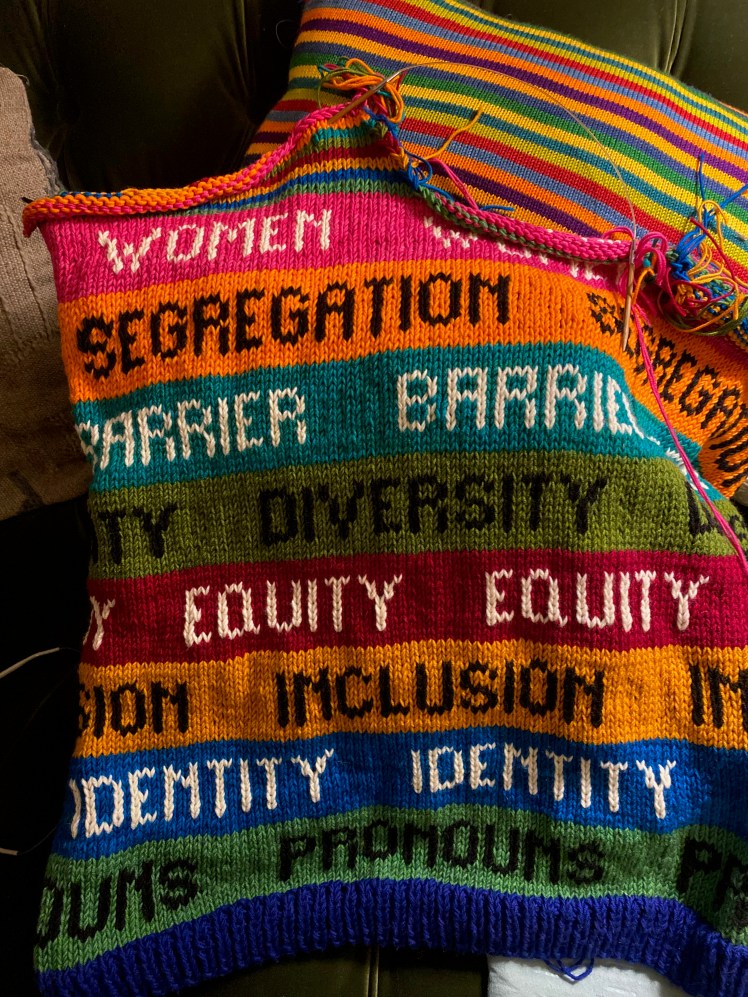
When the front and back were both knitted, I sewed the shoulders together and knitted the neckband in a folded 1×1 rib, binding off the last row together with the stitches I picked up to start the neckband.
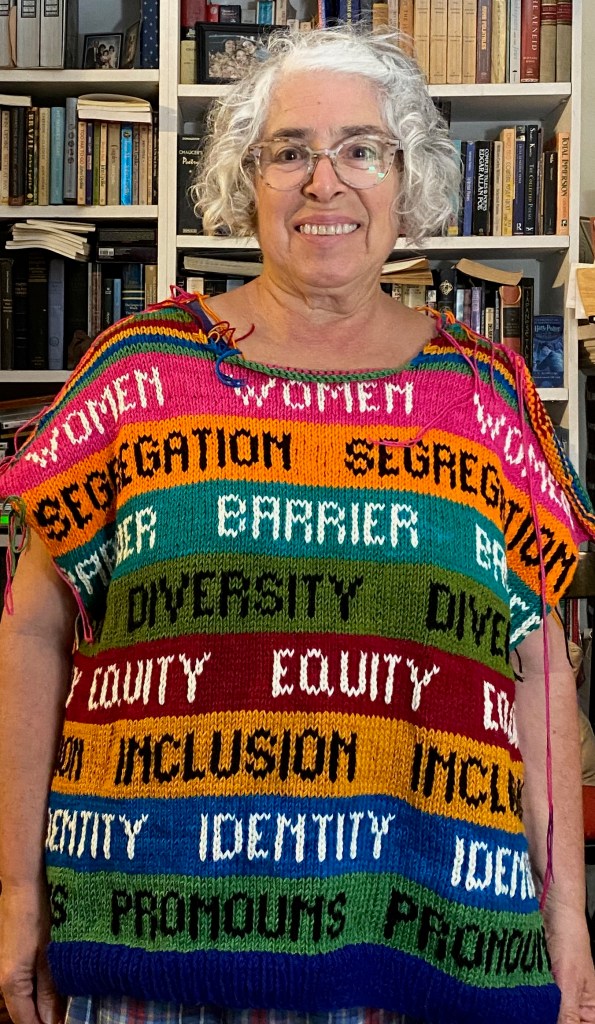
I knitted the neckband before making the sleeves because I was going to pick up the sleeve stitches from the sides of the front and back and knit them top-down, and I needed to have a finished neck so that I could get an accurate measure of where the dropped shoulders would land on my arm. That way I could knit the sleeves until they were long enough, because I hadn’t calculated their length ahead of time. I didn’t bother because Wollmeise stretches when the garment gets heavy, and this garment was really heavy. Gauge swatches are not very helpful when knitting large garments in Wollmeise.

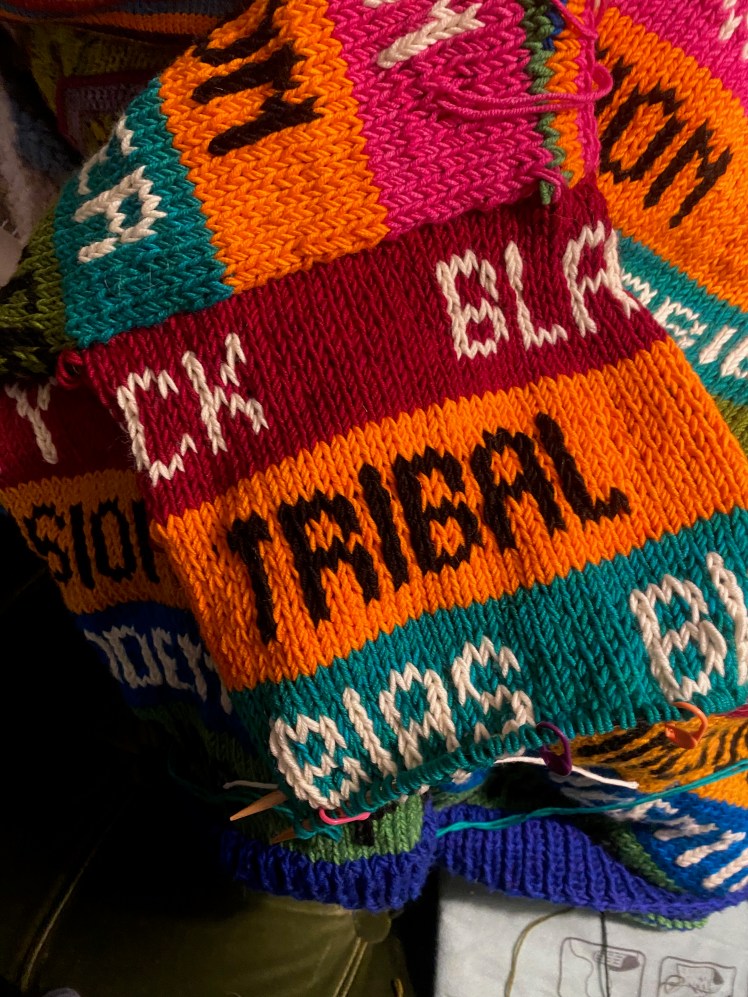
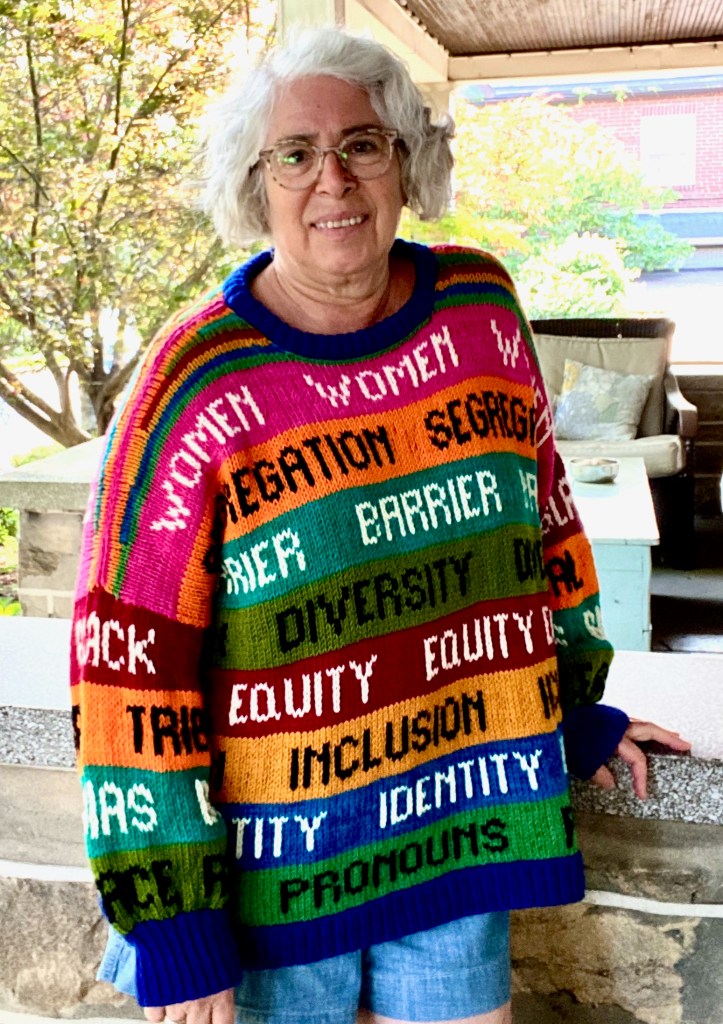
I knitted four sequences without shaping the lower arms in order to preserve spaces I needed for the lettering, and I chose fairly short words, which I placed at different positions around the sleeve to avoid visual monotony. When I decided after the fourth sequence that the sleeve was long enough, I decreased 2, knitted 1, all the way around, and knitted a 1×1 ribbed cuff. The finished work consists of about three pounds of superwash yarn, so when I washed it and laid it out flat, it was 30%-50% larger than it was before I wet it. I put it into the drier for 15 minutes while it was still wet and laid it out flat again to finish drying, and it returned to the size I wanted it to be.
While my conscious design choices were dictated by my stash yarn and the requirements of size and gauge, I realized after I had finished the sweater that I might have been unconsciously influenced by the design of lawn signs in my neighborhood that proclaim principles like “black lives matter”, “women’s rights are human rights”, “science is real”, “no human is illegal”, “love is love”, in bold black or white lettering against stripes of bright color. While I was knitting my design, I was looking through a “little library” box of giveaway books in my neighborhood and I found a copy of “How to Be An Anti-Racist”, which is now on pretty much every right-wing banned book list. I took it home to read because I remembered it had been much talked about when it came out in 2019, and now it was banned, like the words I was knitting. It wasn’t until my sweater was almost done that I looked down at the juxtaposition of the sweater and the book and realized that the book jacket design was a lot like my sweater. The designers of the sign and the book jacket were following the same design principles as I was: saturated colors, black and white lettering, a bold, unadorned alphabet, plenty of space between words to give maximum impact to the messaging. Maybe I wasn’t so much influenced as I was following the same effective design principles for communicating an assertive social message.

The weather had turned too hot to wear the sweater in public by the time I finished this work of soft protest, so I don’t know yet what kind of reactions it’s going to evoke, or provoke. I’m quite sure that when I wear it around my neighborhood in Baltimore, there will be nothing but positive reactions. But Ravelry friends warn me that I could be in for some hostility if I wear it in Trumpier places. I think I want to test that. Would people going about their business even bother to read the words? Then get so triggered that they would confront a small, physically harmless older woman in a public place? I’ve been having an imaginary conversation with such a person, who might stop me on the street to accuse me of being “woke”. The rhetorical tactic of turning a virtue such as empathy and knowledge of history into a slur by means of a sneer or a jeer rather than reasoned rebuttal is already an admission of losing the rational argument. I would reply, “When we stand up in front of the American flag with our hands on our hearts and say ‘with liberty and justice for all’, we should mean it. ‘All’ means all, not just the 30% of the people who are white men. White men aren’t excluded, but the 70% aren’t going away.” And I would thank the person who accosted me for the conversation, because people who disagree need to get back into the habit of talking to each other.

 The Interior of My Brain: A Knitting and Fiber Arts Blog
Just to say I love you, and thank you for this. 💕
LikeLiked by 2 people
Thank you! I don’t fool myself that this is going to get through to people who really believe that liberty and justice apply only to themselves, but maybe it can help mobilize and encourage people who don’t agree to be erased.
LikeLiked by 1 person
Well said, well done, Abby.
LikeLike
Thank you, Gretchen!
LikeLike
Your knitting project is great, thanks for sharing.
LikeLiked by 1 person
Thank you!
LikeLiked by 1 person
Well done. Your garment speaks for itself.
LikeLiked by 1 person
I’m looking forward to seeing how loudly it speaks.
LikeLike
LikeLiked by 1 person
I think I’m going to be wearing the sign!
LikeLike
I might disagree with you on some things, but I agree with you completely on this: “people who disagree need to get back into the habit of talking to each other.” Thank you for sharing your thought process. I learn so much from you.
LikeLike
Thank you for hearing me out.
LikeLike