
January is my annual swatching season. I dedicate the entire month, and sometimes some of the previous and following months, to swatching projects I plan to knit and to learning new techniques in hand knitting, machine knitting, crochet, and other fiber media. This year I focused almost exclusively on hand-manipulated fabrics knitted on the LK150 knitting machine, because I have one here at home as well as one at my younger daughter’s house, where I was visiting for about 12 days in January. I feel bad about neglecting my first machine, the KH965i, but I’m madly in love with the LK150 because it’s simple and basic and I’m a bit of a Luddite, and because it knits a much wider range of yarn than my standard-gauge electronic machine.
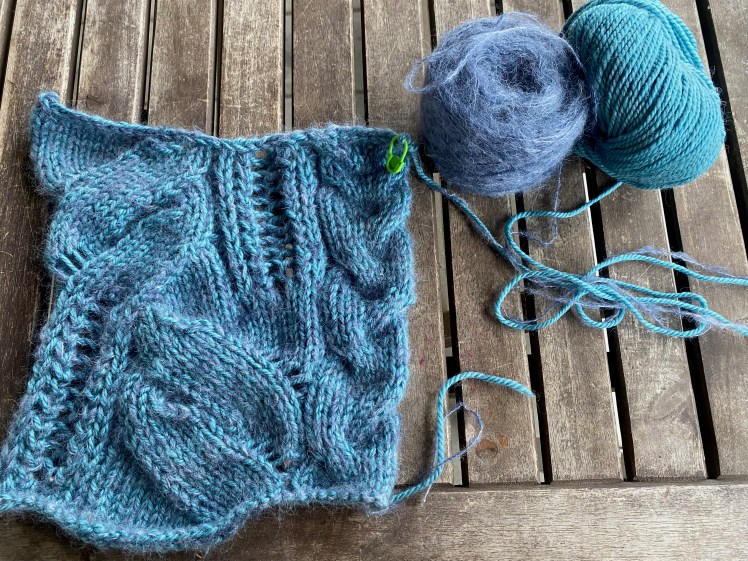
But I started off with a handknitting swatch, for a second attempt at a pattern by a Chinese designer that has a beautiful chart and instructions that are so minimal that there is no yarn recommendation or gauge information. My first attempt turned into a dress length garment that I don’t have the height to wear well. I put it into the mail to my willowy older daughter with the swanlike neck, whence it disappeared into the bowels of the APO mail system. I hope that someday it comes out the other end, so to speak. So I bought more yarn, made a swatch, and abbreviated the number of pattern repeats. I’m pretty close to finishing it, but I don’t dare try it on until I have washed and blocked it. According to the swatch, it should end up the width and length I want, but that won’t prevent me from panicking when it looks terrible before I completely finish.
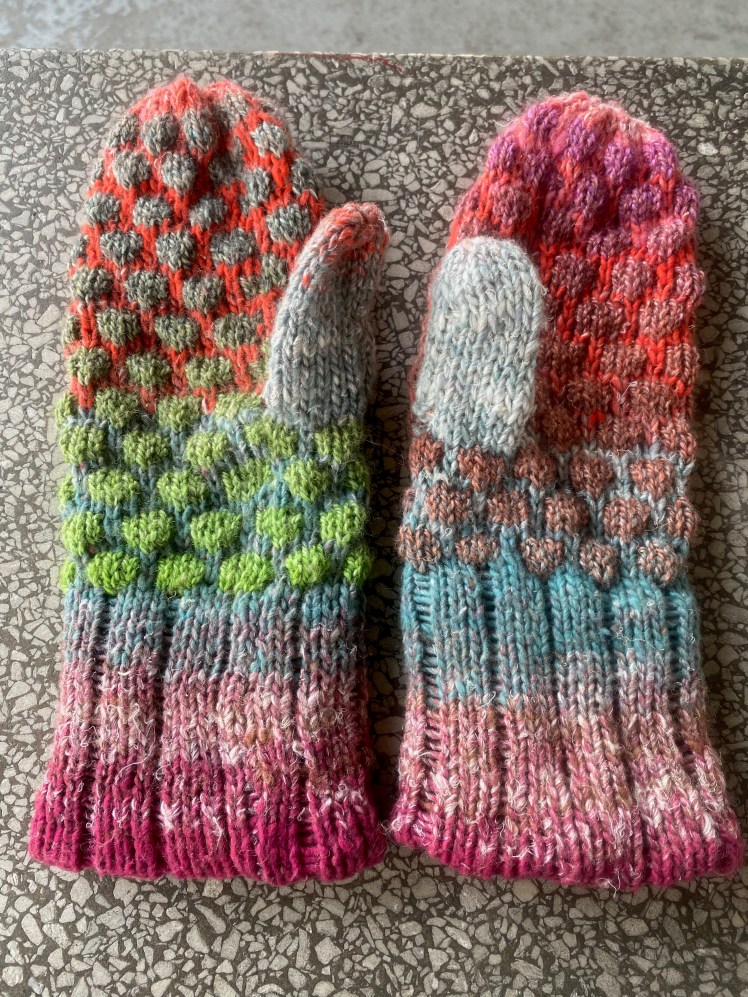
Then I dove into the LK150 tuck stitch experiments. I had just finished my younger daughter’s plated tuck stitch jacket, but I wasn’t finished with tuck stitch. Anna Haferman recently put out a video with step-by-step instructions for two-color bubble stitch mittens, which looked like a good project for getting proficiency with the technique. Her recipe also demonstrated how to make a mock ribbing by keeping every fourth needle out of work. Simple and basic, but I had never done that before. These mittens were a good project for using up some Noro silk and wool yarn in a weird colorway that someone had given me years ago, half knitted in an unappealing entrelac project she had rightly abandoned, so I frogged and wound the yarn, and paired it with some Feederbrook Farms slow change multi leftovers. Once I stopped making dumb mistakes, I had the second mitten knitted in about an hour and a half. Anna’s recipe calls for an extra stitch at either end of the knitting, which makes it easy to mattress seam the edges so that the seam is completely invisible. Inside the mitten, however, the seam is a big thick distraction. I think I would use the much thinner and equally invisible Bickford seam for such purposes in the future.
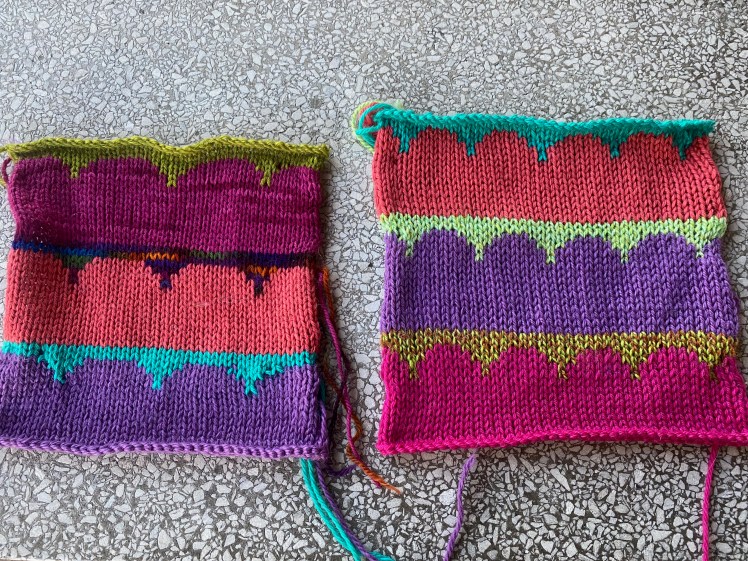
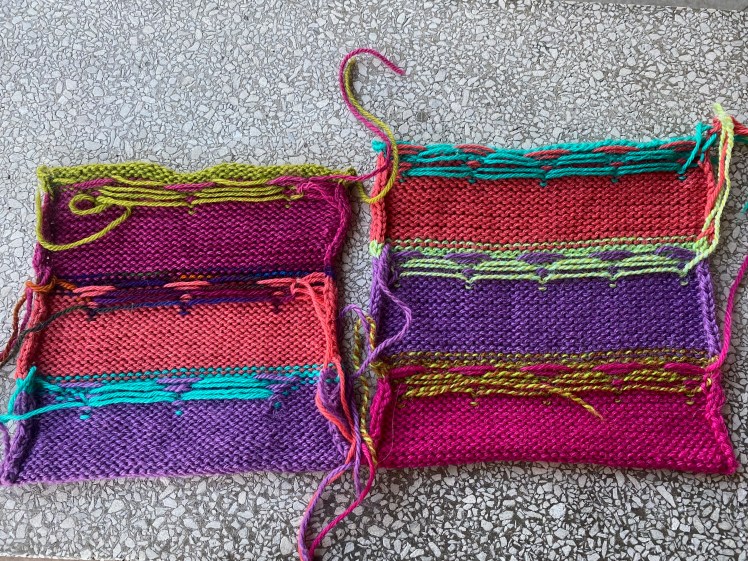
I did take a couple of detours away from tuck stitch on the LK150, although still on the LK150. I’m curious about how to do stranded patterning on this non-electronic, punchcard-less machine, so I tried the method described in the manual, using the very simple aqueduct pattern of the Robinia sweater, which I hand-knitted a couple of years ago for my younger daughter. That stranding is about as simple as you can get, since the two-color stranding is done on three rows of knitting. It is accomplished on the LK150 by knitting each row of patterning in two passes, one for each color, by using the slip stitch lever to slip over the needles, in B position, in the color that isn’t being used so that those stitches aren’t knitted, and knitting the needles in D position in the other color. The position of the needles is reversed to knit the other color in the row of patterning. The position of the carriage and the location of each yarn is a major complication. I just tried to write an explanation of the direction of knitting for each color of the 2-row pair, and I got hopelessly tangled in words so I deleted the text. Diagrams work better than words here, and there’s a diagram in the manual. Or watch a video. Maybe I’ll be able to articulate the process after I have fully internalized it into muscle memory, but at this stage, I can’t find words that aren’t gibberish. But I did manage to eke out two swatches.
I also took a detour onto Melissa’s bulky Brother machine that lives upstairs at her shop, but this swatch was also tuck stitch, inspired by a hand knitting pattern that uses a bubble stitch grid pattern that easily converts to machine knit tuck stitch. I had worsted weight leftovers at the shop from a skirt that I made my older daughter, left there because it is too heavy and thick for my standard gauge machine, and I had been advised that the LK150 probably wouldn’t be able to knit it in a tuck stitch. When I tried out the grid tuck stitch on Melissa’s KH230, four knitted stitches in one color and one stitch in hold in a second color, with two plain rows in the second color, I was having a bear of a time getting the tension right on the left-hand yarn mast. I was going to have to figure out why. Also, I realized that the 100 needles on the KH230 weren’t going to give me the width I wanted for the very oversized garment I was envisioning, and I would have to knit the front and back in panels. I quickly warmed to the idea of using up my leftovers in irregular color pairings in modularly joined panels that were as wide as I wanted them to be.
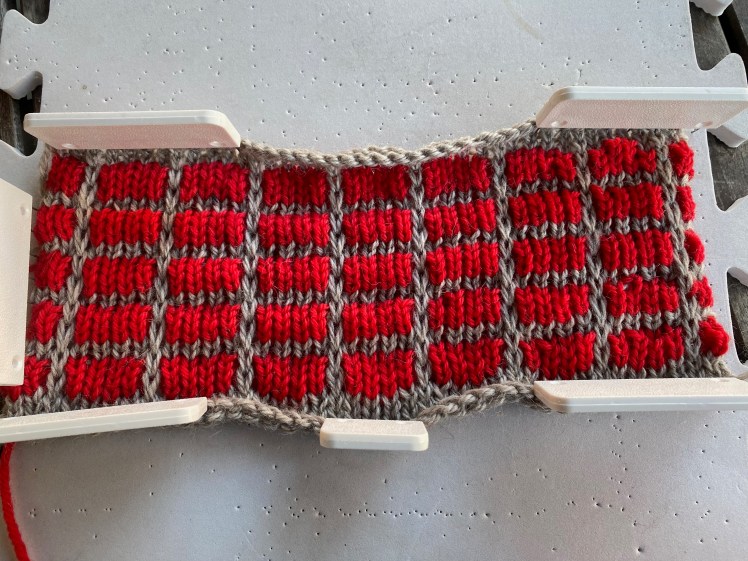
Returning to tuck stitch on the LK150, I swatched a monochromatic natural gray farm yarn that I had bought from the farmer at the farmer’s market at the Wisconsin state capital in Madison back in early November. It was a light DK weight, but I got such a flimsy see-through fabric when I knitted it at T3 that I decided to try it again later on my standard gauge machine. It would have to wait until after our mid-January trip to Wisconsin to visit our daughter and son-in-law. And the LK150 that lives at their house.

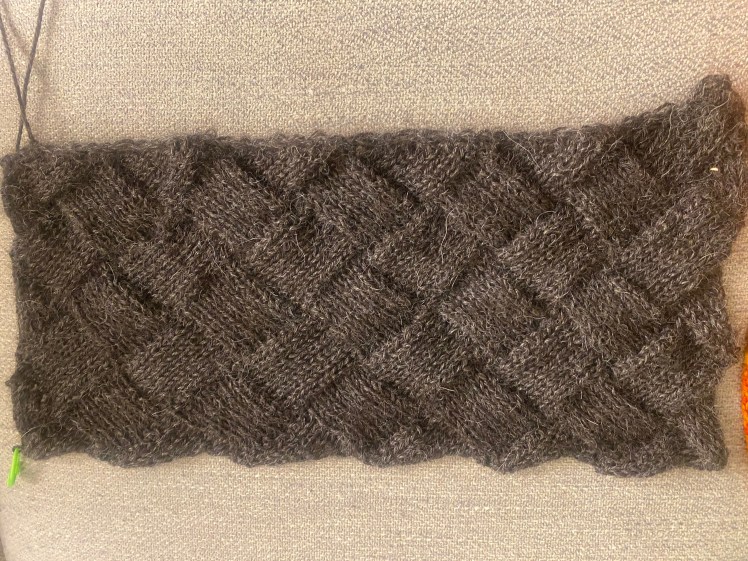
I brought a big bag of ancient stash, mostly leftovers from the entrelac pullover that I had knitted for the most part on the machine at my daughter’s house. I also brought some alpaca yarn left over from the recent plated tuck stitch jacket that I was presenting to this daughter. I have been knitting my undyed alpaca yarn at a very quick rate, and what I thought was an inexhaustible supply is down to a couple of complete skeins and a lot of small cakes of leftovers. The entrelac pullover is my favorite and most usable sweater, and I started thinking about making a second version in gradients of undyed alpaca using a smaller base for the diamonds, seven stitches instead of the 10 I used for my machine-knit version of the ‘Lil ‘Lac pattern. I managed to remember how to do entrelac without having to delve too extensively into the videos that had previously taught me, and knitted the yarn at T3. It’s not as substantial a fabric as I might have liked, but it’s acceptable, and I can work out the numbers based on the swatch. The question is, do I actually have the fortitude to undertake this scheme as a longterm project?
Now I moved on to the main event in my deep dive into machine-knit tuck stitch. January 2025 Swatchathon was going to be the one in which I finally started playing with the ideas that Alison Dupernex illustrated in her thrilling book Machine Knitting: Designing With Color. I had been drooling over her work for years, but she assumes prior knowledge of tuck and slip stitch. Now that I had that knowledge and a big bag of colored yarn, I jumped in with both feet and a big splash. Originally I was going to test out her ideas with small, separate swatches, but a knitter on the LK150 Facebook group inspired me with a big, beautiful, fringed sampler wrap that started off with the same mock ribbing that I had just learned from making the Anna Haferman mittens. Now I refocused the exercise from making a big pile of little swatches to making a 9-foot-long reversible scarf using all the colors in my bag, sides finished with i-cord, and fringes worked into the ridges of the mock ribbing at either end.
I really like reversibility as a design element, and these tuck stitch patterns look beautiful and very different on both sides. To exploit this characteristic, I selected colors for the stitch pattern I was trying out, knitted some inches, then knitted it off onto waste yarn and rehung it on the reverse side. Then I knitted the same stitch pattern in different colors, knitted off onto waste yarn and flipped the work back to the other side. That way there was no right or wrong side and the stockinette curling was minimized.
After the mock ribbing, I started the work with the bubble stitch from the mittens and then the grid stitch from the swatch I made on Melissa’s bulky machine, but after these warmups, I took a dive into an elaborate multi-layered tuck stitch circle for which Alison Dupernex had provided charted instructions. With the bravery of ignorance, I followed her instructions to pile up onto the held needles two rows of color A, two of color B, two of color C, two of color D, two of color C, two of color B, and two of color A, then put everything back into work and knit the 14 strands sitting on the needle butts to close up the circle with the background color. There was a gentle warning in the book to take care not to let the stitches on either side of the held needle jump off, but that didn’t prepare me for the fact of just how determined those stitches were to take a big laddered leap into the void and resist reconstruction with every fiber of their inanimate souls.

I struggled through the first 14-strand tuck stitch circle sequence, flipped the work, struggled through the second sequence thinking it would get easier with experience, which it did, a little bit, flipped the work, and struggled through the third sequence. Normally I would have evened out the stockinette/reverse stockinette balance by knitting a fourth sequence but I decided I didn’t have the gluttony for that much punishment. See those stitch markers in the second sequence? Those are dropped stitches that I missed during the excruciating salvage process while the knitting was in progress, and I discovered still more later. What baffles me is that Alison Dupernex knitted her samples on a 4.5 mm standard gauge machine, which has much less room for a massive strand pile-up on the needles than the 6.5 mm medium gauge machine that I was using. What kind of yarn was she using, that would fit on the thin, close-together needles of a 4.5 mm machine? Sewing thread??? The experience taught me that 14 tucked strands of DK weight was not going to be fun and easy knitting. My subsequent experiments used thinner yarn and six or eight strands, until I got to the final sequence of the large tuck stitch circles. Then I got brave and curious to see what would happen to 10 strands using the thinnest yarn I had with me, which was sport or heavy fingering weight. It was tricky, and there were accidents and repairs, but it was doable. Which made me think about a new way to use my massive stash of Wollmeise lace yarn.
At this point, I had finished the tuck stitch part of the sampler scarf. I would knit on the i-cord edging and finish the ends and apply the fringe when I got home. I had stuck to tuck stitch during this exploration because it looks interesting on both sides, whereas slipped stitch patterns, which look like tuck stitch on the knit side, tend to be pretty bland on the reverse side. But I still had an evening in Madison before we went home so I set the levers for slip stitch and gave it a try with the heaviest weight yarn I had in my bag. Encouraging! I have an idea for how to use this technique in something quick and easy.

When I got home to Baltimore, I knitted i-cord edgings onto the sides of the scarf, wove in the ends, and attached fringes in a variety of scrap yarns that were compatible with the colors of my tuck stitch patterns. Here are composite detail photographs of the front and back of each section of the scarf.
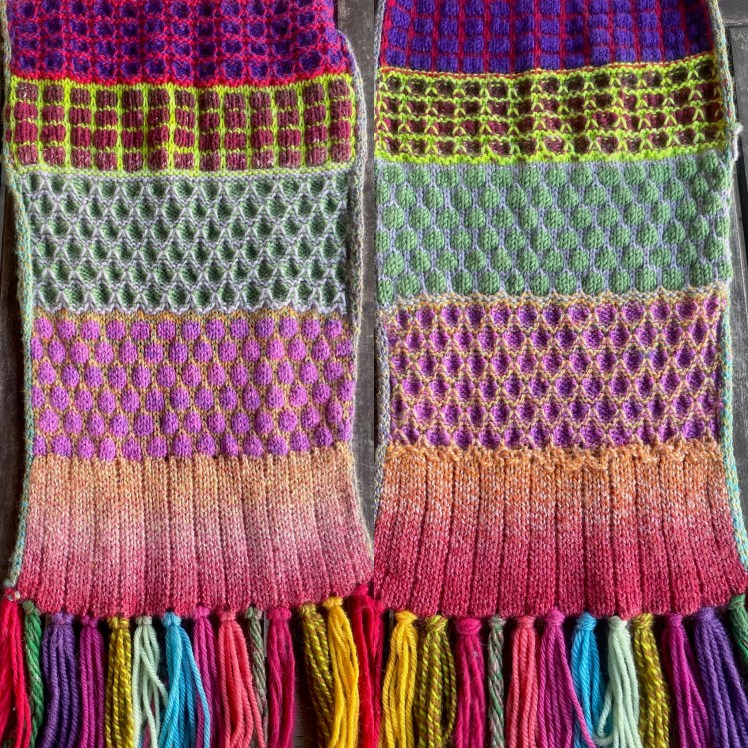


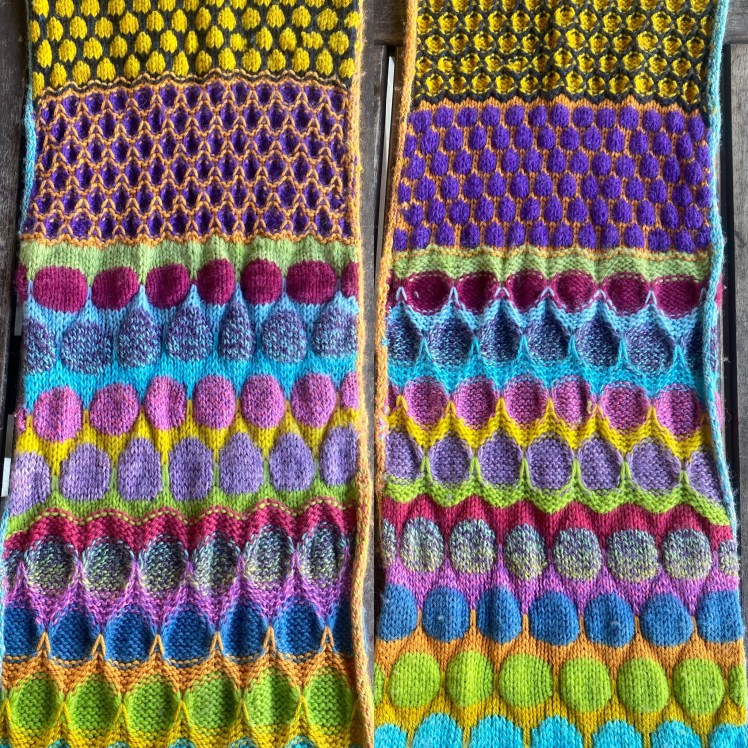
Modeled! I get at least one compliment from a stranger every time I wear the scarf.

Both sides are the right side.

While I ruminated about using lace-weight Wollmeise, I left Madison and returned to my machines at home. I felt bad about neglecting my dear KH965i for months, so I cleaned it with tender solicitude, then cast on the gray farm yarn from Wisconsin and put it on T7, to see if I would get a firmer fabric for the tucked bubble stitch I swatched previously on the LK150. Maybe the machine was miffed at my neglecting it in favor of the new interloper in the room it had dominated for almost eight years, or maybe it just didn’t like the somewhat hairy light DK yarn. It refused to knit it. It tangled on the first row after the cast-on, and when I was finally able to get a few rows knitted and start the tuck stitches, the mere four strands on the held needles were too much, and the stitches on the surrounding needles leapt off like lemmings in mass suicide. OK then, message received. I turned back to the LK150 and tried a swatch on T1, since T3 had proved to be too loose, although the knitting had been so easy it was almost self-knitting. Not so with T1. It was as if the LK150 had learned how to misbehave from the example of the KH965i, because now it too was rejecting the cast-on stitches and losing the stitches on the needles on either side of the needles in hold. I tried it again on T2. Finally, some cooperation. It knitted without temper tantrums, and the fabric was acceptable.
During the deep dive into tuck stitch on the LK150, I often got stopped by my yarn tangling up in the brushes on the under side of the carriage. Finally I learned I could avoid that problem by making sure the yarn was held taut enough that there wasn’t slack that would put it into a position of getting tangled down there. This learned experience gave me some insight into why the left-hand mast on Melissa’s KH230 wouldn’t give me a good knitting tension. As I had learned on the LK150, I needed to pull on the yarn before it engaged with the needles at the start of the row to make sure it had the tension to knit the needles and not get tangled and strangled by wheels and brushes on the undercarriage. Another useful bit of information I got was from doing tuck stitch of many strands using my big bag of yarn ranging from fingering weight to almost worsted weight. If I could pile up six strands of heavy DK into a problem-free tuck stitch circle, why couldn’t I pile up four strands of worsted? Maybe I didn’t need to transfer my operations to Melissa’s store in order to knit up the worsted weight yarn that I was keeping there.
I made a swatch using similar yarn that I have in stash here at home, starting out at T6. It knitted perfectly. How about T5? Also perfectly, and I preferred the firmer fabric. How about if I modularly joined another panel of the same patterning to the first swatch? I got a smooth join that looked as if it had been knitted at the same time as the piece it was being joined with. All I need to knit this sweater I’m envisioning is numbers and its turn in the queue.
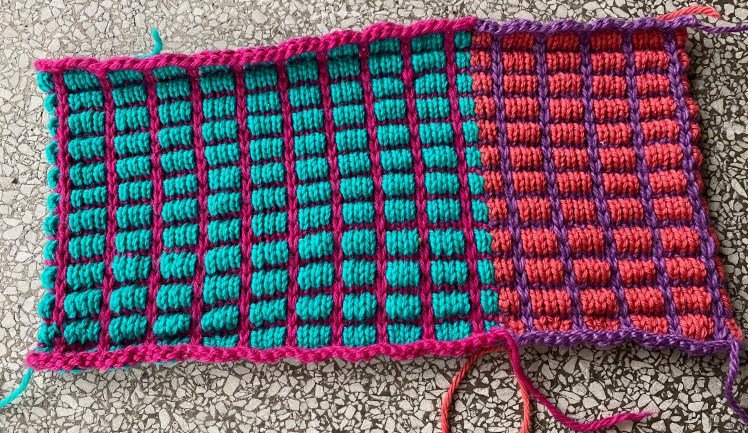
Finally, the last swatch for this year’s Swatchathon. I didn’t get to everything I had hoped to try out, like a swatch knitted on the KH965i using the snowflake pattern I had inputted for my younger daughter’s temperature blanket. That would have been knitted in white Wollmeise sock yarn for the snowflakes and a Wollmeise lace multi for the background. I’m seeing this as the basis for the next birthday sweater for my older daughter. I also wanted to adapt a pattern for a hat, constructed with 10-stitch short rows and modular joins. But I had some urgency with this final swatch, which was to see what happened with a 12-strand tuck stitch circle knitted on the LK150 with Wollmeise yarn. It’s urgent because I have a March deadline to knit a jacket for my sister’s birthday, and I needed to get started. I groped around for whatever Wollmeise lace I could easily put my hands on. Now that my precarious mountains of yarn have been corralled into vacuum storage bags sorted by weight, fiber, and color, I feel inhibited from reopening the bags because it’s a lot of commitment to have to suck the air out of the reinflated bags again. Winding uncaked skeins requires even more commitment, so I looked for caked yarn that I could get at easily. I ended up with a mixture of grays and subdued blue and green multis for my swatch.
As I had hoped, the needles of the LK150, knitted at T4, accommodate 12 strands of Wollmeise lace easily, knowing that tuck stitch requires a lot of weight to keep the stitches next to the held needles in place. Also my color combination of whatever I could put my hands on most easily pleased me enough to find more grays and muted colors for my sister’s jacket.
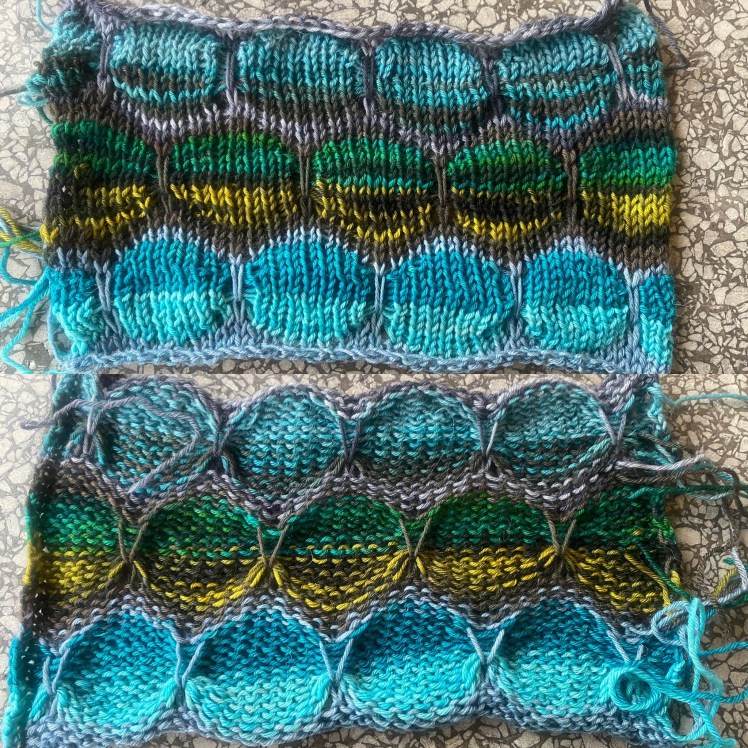
January 2025 Swatchathon Class Picture
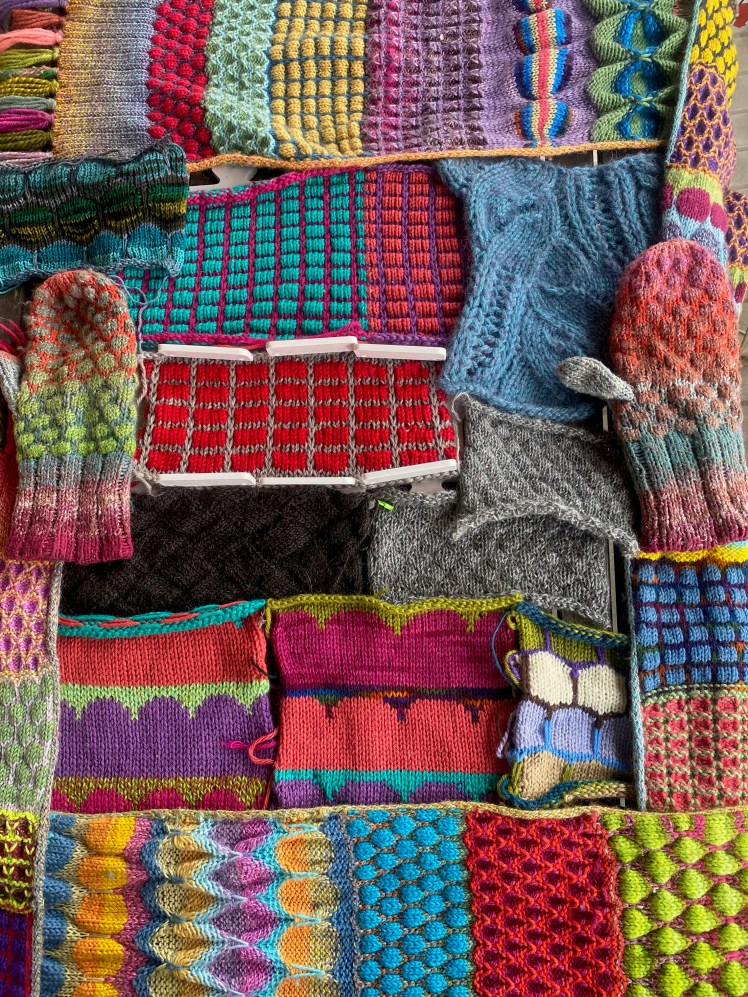
January 2024 Swatchathon: Where are they now?
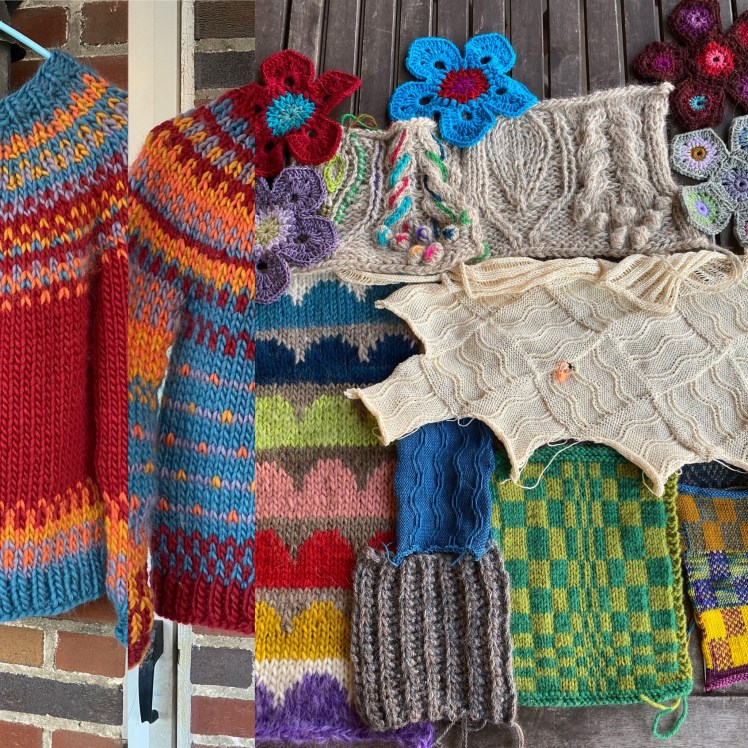
As usual, some swatches gave direct, practical numbers for a specific project, and were knitted into garments with an obvious resemblance to the swatch. Another category is the swatch that gives me an idea or skill that I use in a different way. And there are swatches that don’t turn into anything in the year after their Swatchathon, and maybe they never will or maybe they will sometime in the future.
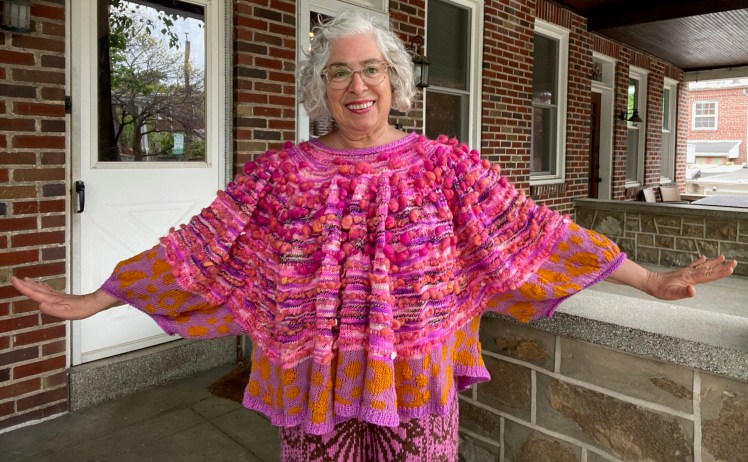
I borrowed the yoke increases from the two sweaters on the left of the compilation photo, and took them to an extreme in Old Weird Barbie, ending up with over 900 stitches in the yoke.
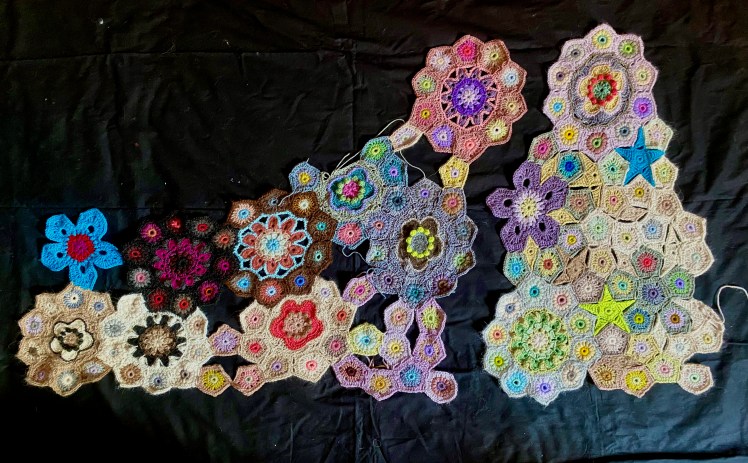
The crocheted flowers are part of a blanket that I worked on pretty steadily until August, when I ran out of cro-jo. It’s a beautiful design, someday I’ll get back to it. This photo doesn’t show the work at its current stage of progress, but I don’t have time right now to take it out of its vacuum storage bag and get it photographed in its full glory. Gee, it’s pretty. I really need to get back to it.
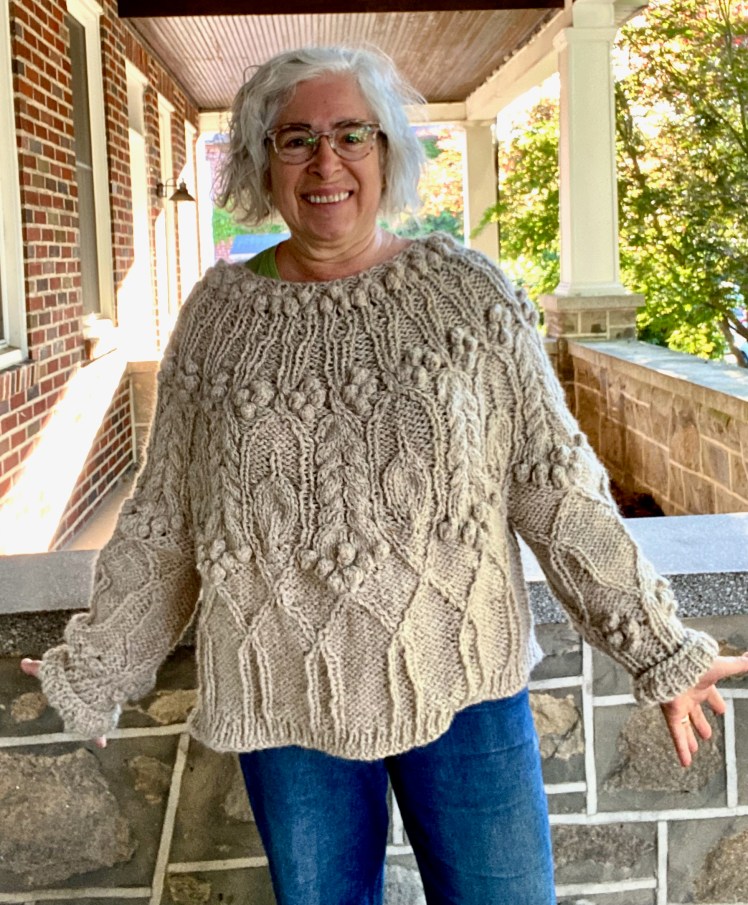
The cabled swatches turned into a full-grown sweater, minus the embroidery.
I didn’t get around to hand knitting the Robinia swatch in bulky yarn, but I haven’t given up the idea of Robinia and want to knit it on the knitting machine.
The machine knit slipped stitch patterning didn’t happen. The machine knit, slipped stitch entrelac knitted in cotton didn’t happen as planned, but I did machine-knit an entrelac sweater in sport-weight yarn from ancient stash. It’s one of my favorite things.

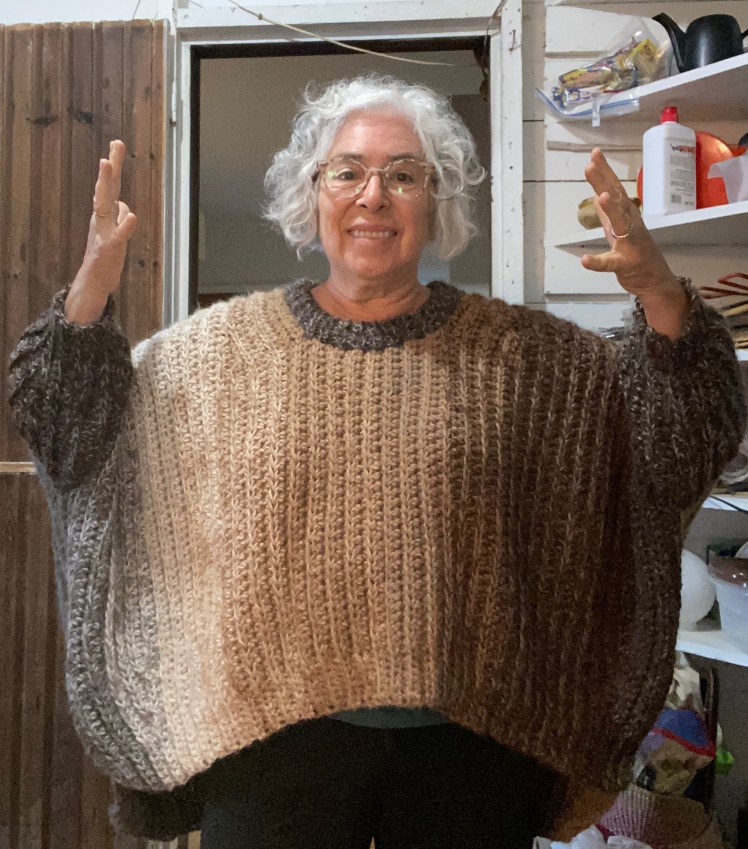
The crocheted, side-to-side, alpaca swatch did happen, in a big way, literally. It’s enormous. I love it.
The green-on-green stranded op-art swatch turned into pants that I wear when I want to be seen.

I haven’t done anything with the Stitchworld stranded checkerboard, although it deserves to be knitted. Now that I know how to enter patterns into my electronic machine’s memory, I should input it more to my taste and chop off a couple of rows to make the shape of the rectangle more square.
 The Interior of My Brain: A Knitting and Fiber Arts Blog
Still knitting up a storm in vibrant colours!!
I love it.
That entrelac sweater and your to be seen in public sweater are to die for.
Way to go. ♥️♥️
LikeLiked by 1 person
Thank you!!!
LikeLike
Well, this is a LOT to unpack.
LikeLiked by 1 person
Thank you for your detailed, thoughtful feedback, Tanya! Of course, what a brilliant solution to the problem of stitches jumping off the needles, by bringing all the needles all the way out and putting the levers back into work. I was pushing the needles into upper work so that I wouldn’t have to deal with the levers, but it’s a lot more work to repair stitches than to remember to flip the levers. There is one slip stitch swatch in this collection. I have already forgotten how I did it.
LikeLike
Your swatchathons are a sensory delight, and such an inspiration! You’re always reminding me to embrace my weird, and my inner nerd. Thank you!
LikeLiked by 1 person
Weird is good, nerd is good! Thank you for that!
LikeLike
So many topics and so many beautiful things. You are always an inspiration!
LikeLiked by 1 person
Thank you, Mariagioia! The inspiration goes both ways, as you’ll see pretty soon!
LikeLike