
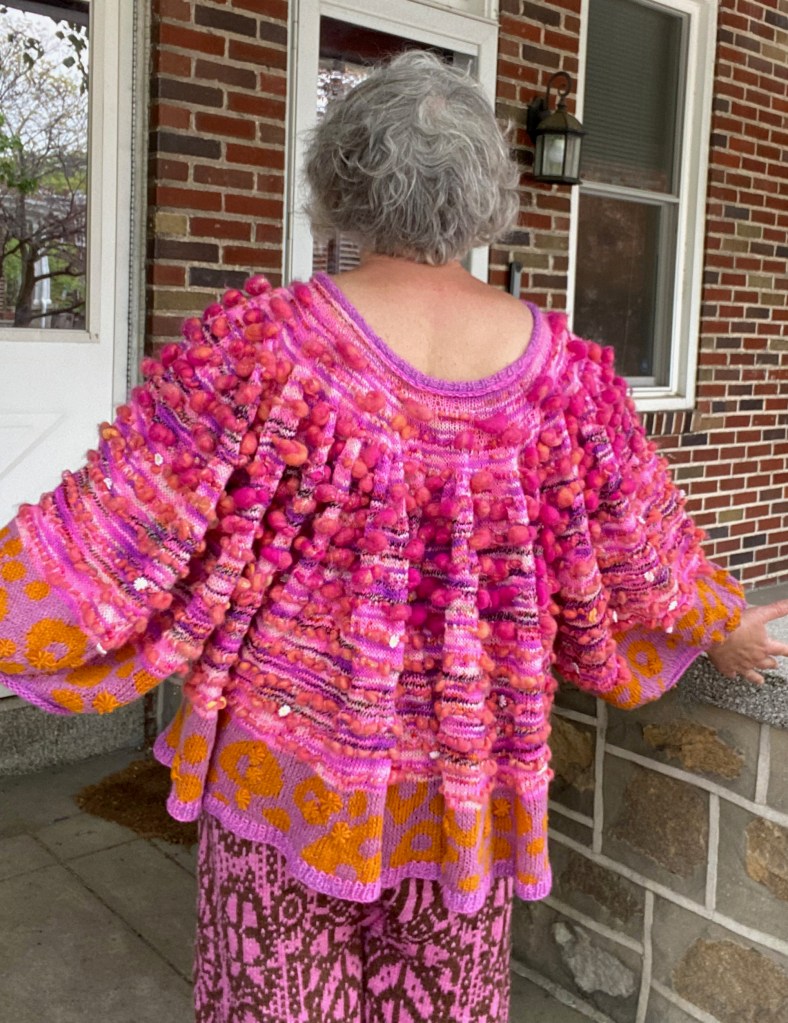
The origin for this work dates back to fall 2022, when I ran into a sweater during my daily perusal of my Ravelry friends activity that featured a sweater with a round yoke festooned with tufts of irregularly spun art yarn poking out of the surface of the knitting. It was a kind of roosimine, a technique for color work used in Baltic knitting in which the patterning is done by floating the contrast color in front of and behind the stitches of plain stockinette knitting. In its original form, roosimine looks like embroidery. This art yarn yoke didn’t look like embroidery. Once I understood that this mysterious fabric could be made using the most basic of knitting stitches and irregularly spun yarn, I even gave a moment’s thought to learning how to spin. Then I saw Melissa had art yarn at the shop and decided that for the same money as materials and a lot less time, I could have the spectacular pink/orange bobbly yarn with streaks of sparkly gold that was sitting right in front of me. I knew what to knit it with, too, because I had previously purchased a sweater quantity of pink/purple/orange/white/black variegated fingering weight yarn at a trunk show of Snallygaster Fibers yarn that Melissa had hosted at her shop Lovelyarns.
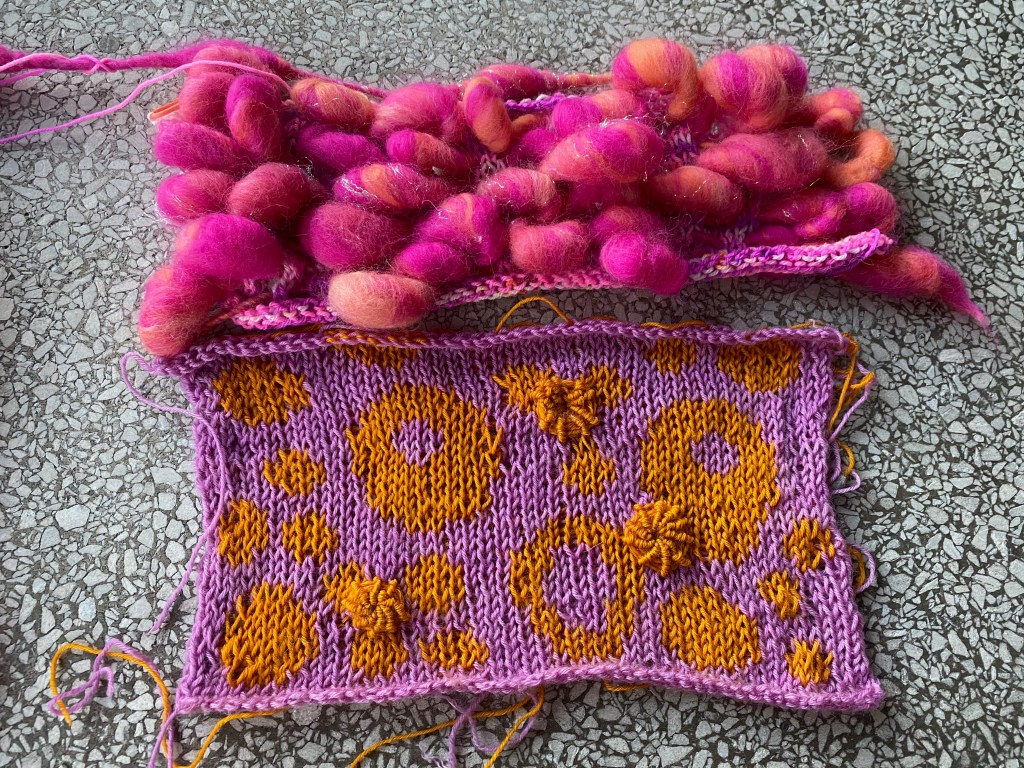
When I first started planning this sweater, I planned to knit the art yarn in a big, ever-increasing yoke until I ran out of it, and then knit the rest of the sweater in loosely stranded improvised circle shapes of Wollmeise lace in similar value hues of mauve and orange-yellow. Then I started winding the mauve yarn and discovered that bugs had gotten at it and it was breaking all over the place, leaving me with a million small balls with lots of plies that were about to break if left to their own devices. A sensible person would have just pitched the entire skein, but I liked that color and didn’t have any more of it, so I thought of another design element that would have the practical effect of reinforcing the weakness of the yarn: embroidered bullions using the orange-yellow yarn, which was in much better shape than the mauve. The weak places in the yarn would be the cue for a random scattering of embroidered bullions. I knitted the swatch for the January 2023 Swatchathon.
After the Swatchathon, I got involved in other projects that took a lot of time and thought, and I might have forgotten about this idea if one of the projects hadn’t been my pink Finnish pants and if the Barbie movie hadn’t come out during the summer. Special pink pants like those were going to need a special pink sweater to go with it, and the movie gave new meaning to my already deep love of pink. I loved the range of Barbies the movie animated, and as a member of the cohort of little girls portrayed in the opening scene of the movie, I could take my place among the Barbies as Old Weird Barbie.
I went back to my swatches and started planning the construction details. The yoke was going to be vast, with endless increases past the armpit and down to the ribcage. I was going to put a lot more space between the rows of art yarn than the swatch had, but the skein I had probably wasn’t going to go as far down the body as my swoncho idea was going to require. I asked Melissa where I could get more of this yarn, and she just went upstairs and handed me the skeins of similar but different yarn that she had put aside for herself. She didn’t have a plan for the yarn, and I did, and she loved my plan and wanted to see it materialize. She is a very generous friend.
Old Weird Barbie had its place in my queue after I finished the birthday knitting for my daughters and the Finnish pants, but then it was competing for my time and attention with Swatchathon projects. But it benefited from my experience with the first Swatchathon 2024 project, which was the two yoked sweaters I made for my daughters using enormous needles and big fat yarn. Those sweaters were knitted top-down with increase rows, an increase every three stitches, four rows apart. Gauge makes a difference: when you knit yarn that is thick enough for 12 mm needles, five increase rows is enough to go from neck to shoulder circumference in 20 rows. For Old Weird Barbie, I was knitting fingering weight yarn on 3.5 mm needles, starting with 100 stitches for the neck, at that same rate of increase, and didn’t stop increasing until I had 930 stitches on the very long, very crowded needle. I am not the type of knitter who is soothed by endless plain stockinette, and even though it wasn’t totally plain, since I was increasing every four rows and weaving in the art yarn in between the stitches so as to maximize the bumpiness of the yarn, I was still pretty much anesthetized by the process. At the early stage of the process, it was a good project for my brief and mild case of covid, but after I recovered and got back to full strength, it was an endurance test.
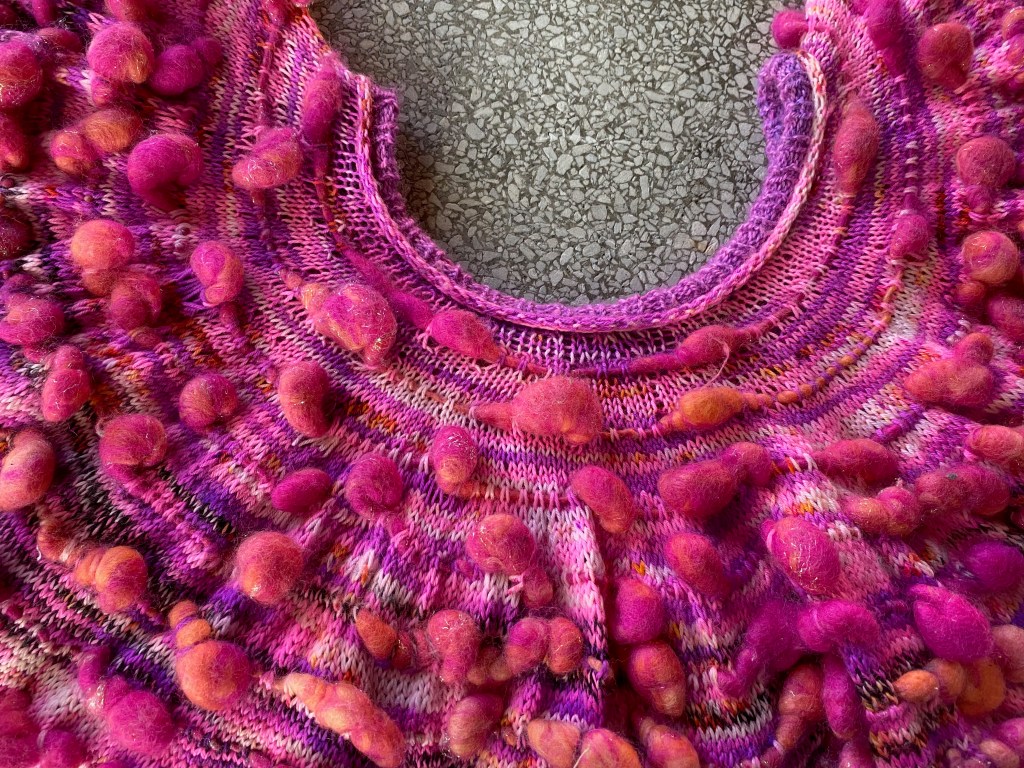
So I knitted and knitted and increased and increased with the goal of continuing the increases below the bustline and down to the ribcage. I ran out of the big bumpy pink, orange, and sparkly gold yarn at about armpit level, then moved on to a thinner pink/orange yarn with little white daisies and other fabric scraps spun into the yarn, and knitted that until I ran out of it. I stopped to count my stitches when I ran out of the big bumpy yarn, which was when I discovered I had reached 930 stitches and decided that was plenty for my purposes. I stopped increasing and knitted with the daisy yarn until I ran out of that. I couldn’t really tell how far down my body this 930-stitch monster went because putting it on scrap yarn was a pain and it puffed outward when I held it against my body, but it was clear that it reached pretty far down on my midsection. Now, at last, I could switch to the improvised stranding part of the composition.
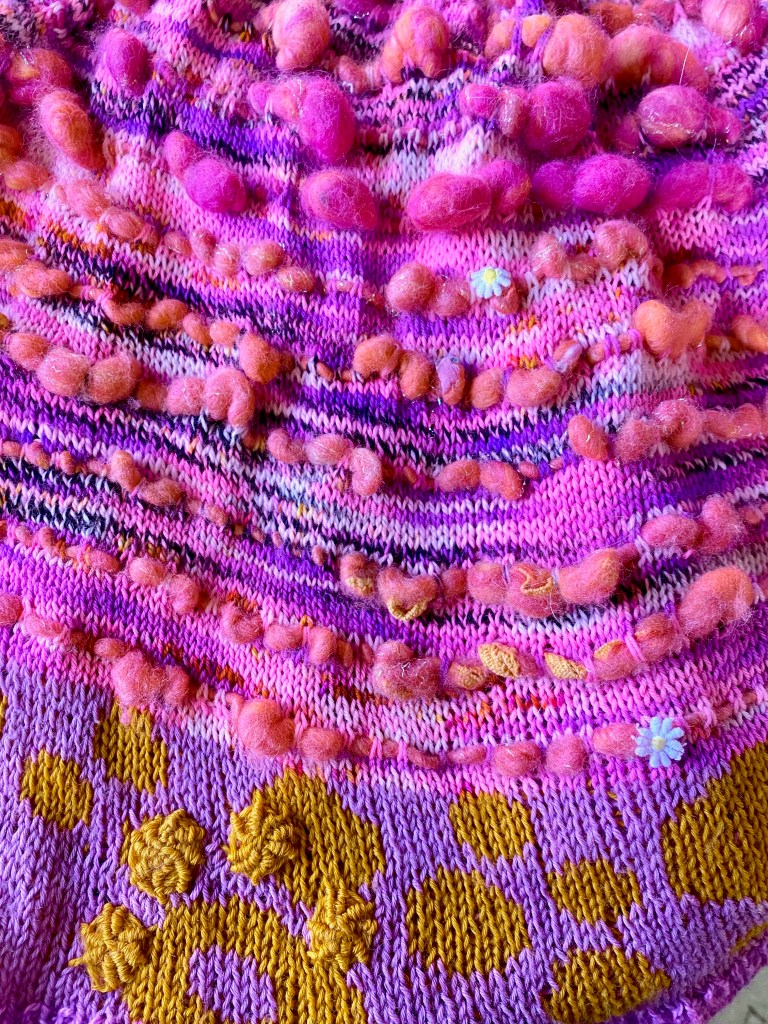
I divided my 930 stitches into four sections, front and back, two sleeves, 250 stitches each for the front and back, and 215 for each sleeve. I wanted the stranded part to be diaphanous and floaty, so I used very large needles for the weight of the yarn, 4.5 mm, when I would normally strand Wollmeise lace on 2.25 mm needles, since I’m a loose knitter. My original idea was that the stranded part would be about 8 inches, but now that I had fewer stitches on the needle, I could get a clearer idea of how long my yoke was, and it was long. After 20-something rows of the stranded circles, I had several inches of fabric, and I tried it on. Unwashed, with the superwash yarn still in its unrelaxed state, it was at my pelvic bone. It was so very big around, and I wanted to offset the huge circumference with a shorter garment length. It was time to knit an inch of ribbing and move on to the sleeves, which had the advantage of being less than half the circumference of the body, although there were two of them and I was getting really sick of knitting them.

Actually I enjoy improvised stranding, no counting, no mistakes no matter what I do, although accuracy requires me to note that this wasn’t the easiest stranding. The large size of the needles relative to the thin yarn made the unblocked fabric look sloppy, and the long distance between color changes required multiple weavings of the yarns within the floats. As I mentioned earlier, the pink yarn was not in good shape, so every time I came to a place where the plies were frayed, I broke the yarn and tied the ends together, both to preserve the tension within the fabric and to signal to me later that this was a place that needed an embroidered bullion. The patterning was an irregular scattering of small dots, five stitches wide, and big circles as wide as 19, maybe 21 stitches across, with small dots inside. I usually tried to make the big circles fairly circular and symmetrical, but if that didn’t happen, that was fine, since irregularity was a feature, not a bug. The stranding would have been fun if my spirit hadn’t already been broken by months of plain stockinette in the enormous swoncho yoke. I ended the sleeves at mid forearm, I think it was 23 rows. From the side, I looked like a pink mushroom.

But I wasn’t done yet. I still had the bullions to embroider on top of all the weak places in the yarn, and there were a lot of them, more than 50. It was enough to get fairly proficient at making them, although machine-like precision and evenness was never going to happen. I started the embroidery by inserting the needle into the knot either in the center of the bullion or as the end of one of the spokes, depending on how close to the edge of the knitting or the neighboring bullions it was. Most of the bullions have eight spokes, although there are some with six, and one or two mutant bullions with seven. I wasn’t able to get the spokes exactly the same length because the fabric was very loose and didn’t have the stability I needed to get equal lengths of yarn in the precise center of the shape, but I did try for whatever evenness I could get. Now that I think of it, I might have used an embroidery hoop to get more stability, but I didn’t think of that at the time. After wrapping the yarn around each spoke until there wasn’t room for any more wraps, I wove the ends of the weak yarn and the bullion yarn into the knitting and the bullion, so I’m pretty sure those weak spots are well reinforced.
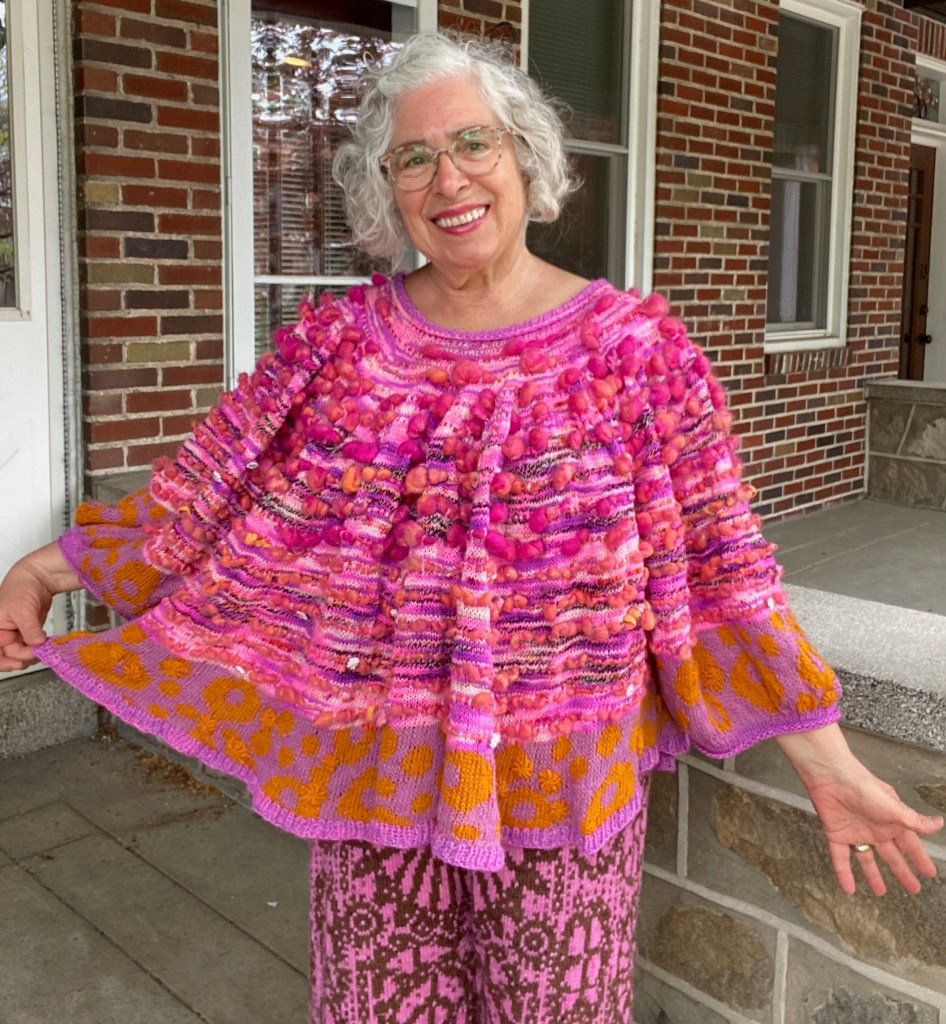
The fabric of the unwashed garment was quite bunched up, even though the floats were consistently the exact length to cover the distance between the color changes. Steaming the fabric helped a bit, but I couldn’t get between the gathers in the sleeves to smooth them out. I was worried about how much the garment might grow if I washed it and spread it out to dry, but I had stopped the knitting at the minimum acceptable length, so there was room for it to grow without reaching my knees and the sleeves sweeping the floor. I was also hoping that washing the garment might relax the fabric so that it would relax the fabric and make it flow over my body a little better so that I looked a bit less like a pink mushroom from the side.
It did grow about four inches after washing, but those four inches very much improved the look and wearability of the garment. The fabric got very light and airy, with more graceful lines as it flowed over my body. I still look like a pink mushroom from the side, because I always look like a mushroom from the side, but maybe less so. Old Barbies are allowed to no longer have their Stereotypical Barbie bodies. I am very satisfied that I have completed the Old Weird Barbie look.




 The Interior of My Brain: A Knitting and Fiber Arts Blog
Oh Abby. Another work of absolute genius. I could not love it more. Also, although I hesitate to apply the term to a grown woman and a master of the craft, you look ADORABLE in that sweater and leggings combination.
LikeLike
Weird is the word, but your big smile turns the effect into Artful.
LikeLike
Once again I love every single thing about this. You look awesome. The sweater is sensational. The leggings remain incredible. Just magic.
LikeLike