
You know that thrill of meeting someone for the first time and hitting it off? When they seem completely perfect and everything seems so effortlessly natural? Then you spend more time together and you discover each other’s limitations, and starry-eyed illusions collide with reality? That happened to me very recently, not with a replacement for my husband of 40+ years, but with my LK150 knitting machine, which is located at my daughter’s house in Madison, Wisconsin, where it and I had a love-at-first-sight connection last summer. After the drama I experienced trying to learn how to use my Brother KH965i machine, this simple machine without the bells and whistles did everything I usually want to do in my machine knitting without making me suffer. I unboxed the machine, clamped it to the unused side of my daughter’s kitchen island, threaded it up, and knitted a sweater, just like that. As soon as I got home from that July visit in a state of infatuation, I started combing through my ancient stash for yarn that’s too heavy for my standard gauge machine, since the internet says that LK150’s can knit even bulky yarn.
I had a lot of single ply wool-mohair blend yarn in my ancient stash, in worsted and bulky weights, and I found a bunch of colors that I was looking forward to putting together in a striped raglan pullover for my daughter. While I was at it, I put together another collection of yarn for a sweater for my older daughter as well, because I was expecting that the first sweater would take only a few days to knit, assemble, and finish, and I could use the same numbers to knit up the pieces for a similar-but-different sweater for my other daughter during the remainder of my visit. Then I would take the pieces home and assemble them, and I would have a birthday present all ready to put in the mail for her late-December birthday.

It was a great plan, but I’ve already foreshadowed the plot twist. This is where infatuation collides with reality. I cast on for a swatch and decided on T8, did a bit of math, and knit my first six rows in a hairy single ply worsted from Brown Sheep so that I could unravel and reform every third stitch for a 2X1 rib. It wasn’t an easy trip across the needle bed. The machine didn’t seem to like this yarn very much. Then I knitted an even thicker single ply Brown Sheep yarn for the first stripe and the machine liked that yarn even less. As I knitted successive stripes, I fretted a lot about that first stripe because it produced a fabric that was so much denser than the ribbing and the rest of the piece that it made the ribbing flip upward, and it was physically impossible to get the ribbing to lie the way I had intended. Tanya, my knitting friend in Madison, came over for dinner and looked at my yarn and the knitting on the machine, commenting that she had always had trouble with this kind of yarn on the LK150. OK, so it’s not just me, but that was the yarn I had and I was stuck with it.
I knitted my way up to the start of the raglan decreases despite the machine’s obvious unhappiness with what I was trying to make it knit, when suddenly a little white plastic piece popped off from somewhere on the carriage, and then I couldn’t get the carriage to affix to the rail that keeps the carriage engaged with the needles in order to form the stitches properly. My progress screeched to a halt. The machine had spoken, and it was angry. Our relationship was having its first crisis.

My daughter’s partner and I disassembled the carriage to see exactly where that little plastic bit had broken off from, in hopes that gluing it back in place would give it the strength to hold up to the stress of reassembling the carriage and knitting with it. While we were taking the carriage apart, another tab on the same part of the carriage also snapped off, and we saw that there was a third piece that had broken off without my noticing it, and we couldn’t find that piece. We used superglue to reaffix the pieces that we could find, and left it to set overnight. The next morning, I tried to push the tabs back into their openings, and the broken one on the end snapped off under not much more pressure than just looking at it. I realized that I had killed that carriage, and now it was only good for cannibalizing its parts. On top of that, a little screw that I had handled moments before suddenly dematerialized. I searched every fiber of the rug underneath the table, and the floor next to the rug, and the other rug under the coffee table next to the couch. It was just gone. I grieved.
Then I ordered a new carriage. I told Tanya that the broken carriage was a total loss, and she came by the next morning at 7 a.m. with her LK150 carriage, as well as an intarsia carriage, and something called a Needle Beetle, which is used for selecting needles for stranded and texture patterns that would otherwise have to be selected manually. Very interesting, but I had lost a day of work on the sweater, and I wanted to leave my daughter not only with a finished sweater but modeled photos. As she explained to her partner, “Mommy’s sweaters are free, but not really.”
When I was at home assembling my yarn for this project, I saw that the amount of each color was limited and varied. There probably wasn’t enough of each color for stripes of the same number of rows front and back and each sleeve in the same sequence as the body. I did want to impose a kind of organization and regularity to the striping by making the front and back the same and the sleeves different from the body but the same as each other. The height of the rows would depend on how much yarn I had, and I packed my kitchen scale to make sure I had enough of each color for both sides of whatever piece I was knitting, and the stripes were two to eight rows high. When I got to the raglan shaping at the yoke, all of the stripes were six rows high in blues and greens. The raglan shaping at the shoulders were also six rows high, using the warmer colors.
The numbers for the garment were quite simple, enough stitches in the body for four to five inches of ease and sleeves about a third of the circumference of the body. The raglans were formed by placing five stitches at the ends of each side of each piece, knit straight up for about an inch, decrease a stitch on each side every other row. All this was straight out Elizabeth Zimmermann’s Percentage System (EPS). EPS doesn’t work for every body, since Elizabeth developed it when knitting for her family of people with slender, proportional physiques, but my daughter has that kind of body. The 6-row striping pattern on all parts of the yoke made it easy for for me to use a sew-as-you-go method to knit the sleeves to the body with a perfect alignment of the stripes and a tidy join and a little less seaming at the end. I was troubled at the beginning of the knitting by the fact that the very bulky yarn I used for the first stripe of the body would not permit the ribbing to lie flat for a conventional edge. Then I took a good look at it a bit later in the process and saw that the yellow reverse stockinette at the bottom of the up-folded ribbing was really quite an attractive edging for the bottom of the garment, and I could accept this accident as something I might have pre-planned, if I had known that the heavier yarn would force the ribbing upward.
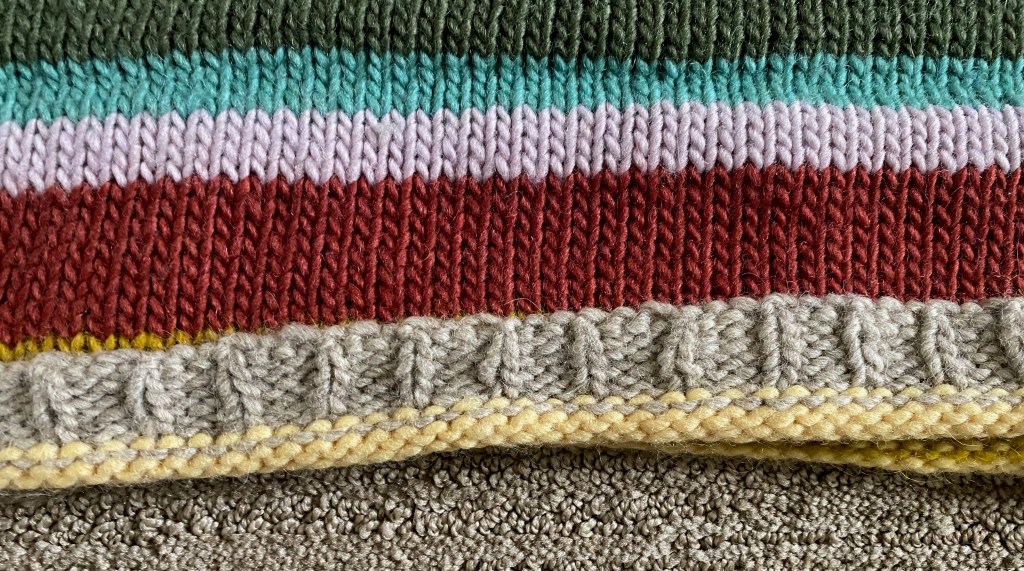
Now that I was able to resume work with someone else’s equipment, I had to work quickly but very, very carefully. No more pushing, no more forcing. This yarn wasn’t ideal for the machine, but it was what I had. I learned to give the tension mast much more slack than my KH965i would be able to knit, but that was what the LK150 required to keep the carriage moving without obstruction. Relationships are all about learning and adapting to each other’s needs. The machine was doing its best to do what I wanted it to do, and in return I had to learn what it was capable of doing and how to protect it. It was a massive relief to get the garment off the machine without breaking Tanya’s carriage. Next time I go to Madison, I’ll bring less challenging yarn that imposes less friction on the plastic parts.



I got my daughter’s sweater off the machine on a Thursday, and I wasn’t leaving until Sunday afternoon. I had brought enough yarn to knit a sweater for my older daughter after my younger daughter’s sweater was done, and now I had time to start it. During a walk, I figured out a design for using my leftover yarn and the intarsia carriage Tanya had included in her box of machine knitting goodies. The design repurposed a plan I already had for my older daughter’s birthday present, a sleeveless top/vest made of cotton yarn with a long color change and an intarsia heart. I have the yarn, I’ll probably make it for her later. But now I had different yarn, a different machine, a compatible intarsia carriage, and just barely enough time to make the front of this daughter’s birthday sweater. I also had a chart from a purchased pattern that had dimensions that would work for this purpose, so I didn’t have to chart from scratch during a time crunch.
I weeded out all the chunky yarn from my color options and lined up all the remaining pinks/reds/oranges. These would be the heart. The background would be the lighter, cooler colors left over from the first sweater, which I would arrange in stripes of arbitrary lengths, without thought of conserving them for other parts of the sweater. The back would be stripes of purple and dark green, and the sleeves would use up whatever warm colors were left over from the heart, alternated with stripes of purple and dark green. But that was a problem for later. Now the task was to knit the front piece in intarsia and get it off the machine in time to pack it for my flight home, without breaking Tanya’s intarsia carriage while working under time pressure with yarn that the machine didn’t like all that much.
My intarsia carriage for the KH965i came with sinkers through which one threads the yarn for the intarsia, and they give the yarn the weight it needs to stay on the needles. These little lengths of plastic were a wonderful discovery that saved my intarsia knitting from the frustrating disasters that I experienced with my earlier attempts. But Tanya’s intarsia carriage didn’t come with sinkers. I went to the hardware store and got clothespins, which were good for keeping the yarn on the needles on the first row of a color change. But it turned out that neither sinkers nor clothespins were needed for adding tension necessary for keeping the stitches on the needles. In fact, any tension at all would stop the carriage dead in its tracks, and I was already emotionally scarred from having killed my own carriage and was not going to do that to a borrowed carriage. Other than making sure that my yarn had plenty of slack rather than weighting it with sinkers, using the intarsia carriage for the LK150 was a lot like using the intarsia carriage for the KH965i. You still have to make sure the previous knitting is behind the latches when you lay the yarn on top of the needles, checking to make sure you haven’t skipped any needles and all the latches are open before you move the carriage across the needles, and afterward, you still have to check to make sure that every one of the stitches stayed on its needle. After a while, I got pretty efficient, which was a good thing, because I had a flight to catch.

Now I’m back at home, and I’m finishing the machine part of my older daughter’s sweater on Melissa’s bulky Brother machine at the shop. The remaining pieces are knitted in simple stripes at T5.1, and this sturdy metal machine is happy to accept thick and hairy yarn with a smile.
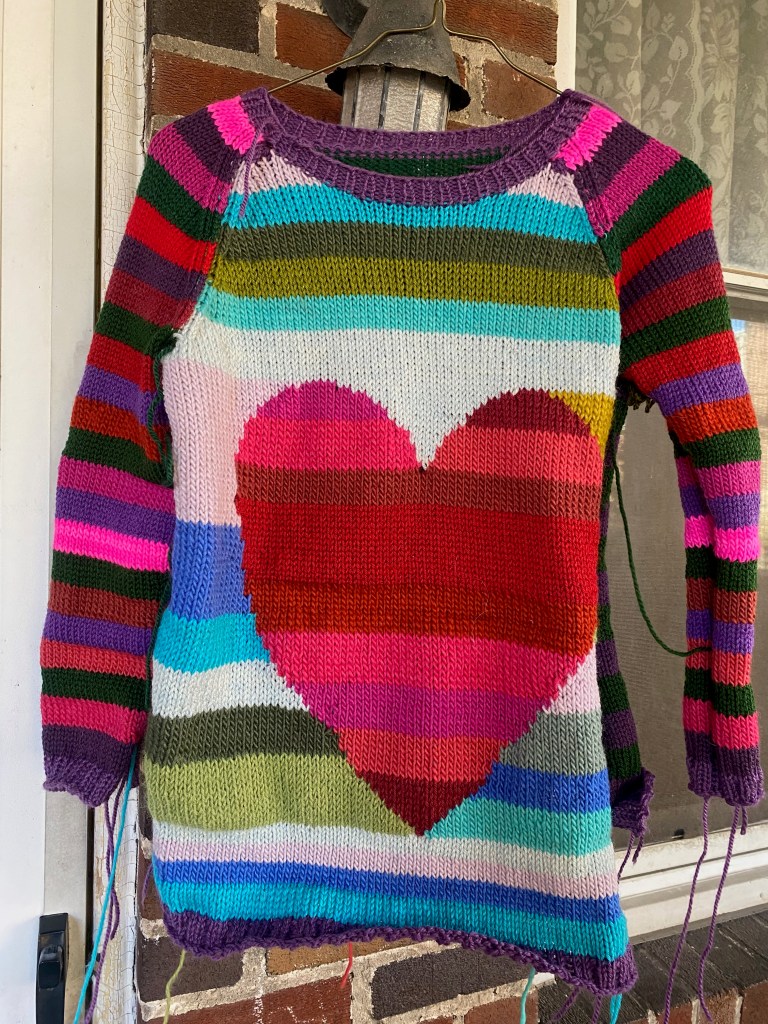

Three machines, three different sets of strengths and weaknesses and capabilities. No one knitting machine is as versatile as a pair of skilled and healthy hands, but every machine is faster than the fastest hands, as long as the brain controlling the machine knows what it is doing. My takeaway is that machine knitters need as many different machines as they have room for.
 The Interior of My Brain: A Knitting and Fiber Arts Blog
Thank you, Abby – the story of your process and machines is so instructive.
Your daughter looks wonderful, and the sweater does her justice.
LikeLiked by 1 person
Thanks so much, Gretchen!
LikeLike
I enjoy reading every one of your mailings and always learn something new.
And the colors and styles of your sweaters all appeal to me and inspire me.
Now I need to set up my metal bulky machine and make a few sweaters from lambs pride yarn!
LikeLiked by 1 person
Lamb’s Pride is such a wonderful yarn, and a metal bulky machine will thank you for feeding it such lovely stuff!
LikeLike
Oh, Abby, you ARE a gifted writer. This is a wonderful essay. I am SO enjoying your documenting of the developing relationship between knitter and machine that we all eventually experience in some way. The machines have as much personality and are as different from one another as (insert name of favorite machine here, I choose) boats! Even two machines of the exact same make and model are different from one another! And they are as infinitely patient in teaching us to respect them as is any house cat!!
I totally know that feeling of going from working on the mid-gauge, putting a good amount of force into moving the carriage, over to the bulky gauge machine, which feels like being greeted by some gentle giant, who invites you to bring that yarn along, and it will take care of everything, no bother at all.
I’m so pleased you were able to prevail and complete the sweater during your visit. It looks just fab on daughter. And the photo of daughter and partner is 100% adorable!
The heart sweater is just joyful. That big, red and pink heart really “makes me smile”.
As always, thanks for the post.
LikeLiked by 1 person
Wow, Tanya, thanks! You’re quite the wordsmith yourself. I love your description of the feel of the bulky machine as a gentle giant that will take care everything and make everything all right again.
LikeLike